
Aave Founder's Self-Narrative on Focus Areas for 2026: Aave V4, Horizon, and Mobile端

Original Article Title: Aave Will Win: 2026 Master Plan
Original Article Author: @StaniKulechov
Translation: Peggy, BlockBeats
Editor's Note: As DeFi gradually moves beyond the "narrative-driven" early stage towards scalability and institutionalization, Aave is currently at a key juncture. This extensive article, written personally by founder Stani Kulechov, is not just a retrospective view but also a comprehensive exposition of Aave's future over the next decade and beyond, as regulatory uncertainty gradually dissipates.
With the U.S. Securities and Exchange Commission (SEC) concluding its four-year investigation into the Aave protocol, Aave has crossed the most exhausting and uncertain phase on the compliance front. Against this backdrop, Aave's self-description of its role has become clearer: no longer merely positioned as a leading DeFi lending protocol, but aimed at the on-chain global credit layer.
Below is the original text:

I have spent almost a full decade building Aave, long before the concept of DeFi emerged. Along the way, I have witnessed numerous cycles of hype and downturns, but our mission has never wavered.
When Aave was founded, the entire DeFi space was not even worth $1 billion; today, the volume of Aave alone is over 50 times that of the entire space back then.
Over the years, many teams have come and gone. Aave Labs has been building for over 7 years, and very few teams truly match us in terms of long-term track record. We have driven and delivered:
- Aave Protocol V1, V2, V3, and the upcoming V4 in progress
- Aave's native stablecoin GHO
- Engaged in a 4-year-long compliance and regulatory game with the SEC, defending Aave
- Ongoing maintenance of Aave.com and the upcoming Aave Pro
- Cross-chain extensions for GHO
- First deployments outside the EVM ecosystem
- Aave App
- Aave documentation system and developer toolkit
And many more works not listed here one by one
Today, the Aave Protocol has become the largest, most trusted, and most liquid lending protocol in history, situated in a virtually incomparable independent track.
But even so, in my view, compared to the future landscape that is truly about to unfold, we are still in "Day Zero." This article will outline our long-term vision spanning decades: bringing the next trillion-dollar-level asset into Aave and driving millions of new users truly onto the blockchain.
Aave in 2025
In 2025, it was the most successful year in Aave's history.
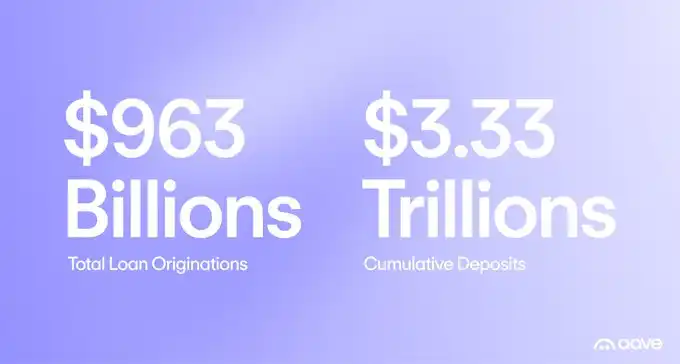
At one point, our net deposit size reached $750 billion; even more impressive, since launching 5 years ago, Aave has cumulatively processed a total historical deposit volume of $33.3 trillion, with a total loan issuance close to $1 trillion.
In the past one to two years, we embraced the cross-chain world comprehensively within the Aave ecosystem. Continuing Aave's consistent style, it has now become the only protocol with TVL exceeding $10 billion on four different networks.
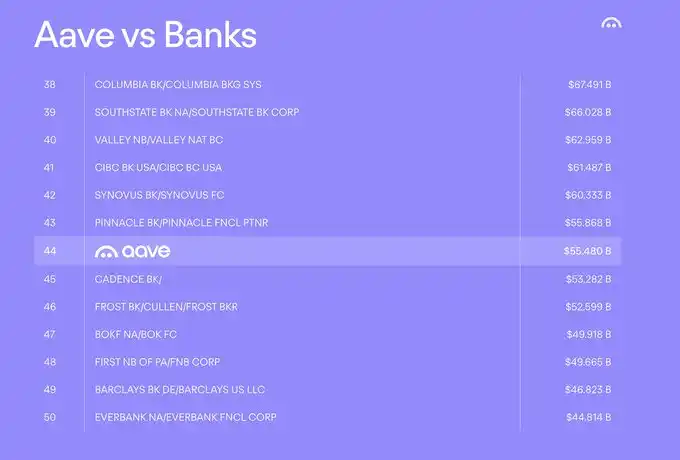
More importantly, in terms of scale, the Aave protocol can now be compared to the top 50 banks in the United States — and the U.S. is precisely the core hub of the global financial system.
These growth achievements have positioned Aave with a 59% market share of the DeFi lending market and carrying 61% of the total active loans in DeFi.
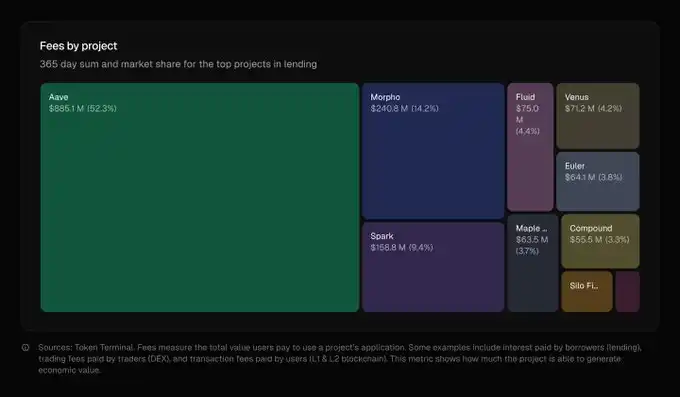
Just this year, the protocol generated $885 million in fee income, accounting for 52% of the total fee income of all lending protocols, even surpassing the sum of the next five major competitors. The continuous income from these fees has further led to a significant AAVE buyback program.
A DeFi protocol operating at such a scale is unprecedented in the industry's history.
The market has made its choice based on results: Aave is no longer a transient product but a long-standing infrastructure.
Next, I would like to discuss Aave Labs' assessment and planning for next year.
2026 Outlook
Looking ahead, we are entering the next phase of our overall strategy, which will revolve around Three Core Pillars: Aave V4, Horizon, Aave App
Aave V4

Aave V4 will be a key step for Aave towards becoming the "global financial base layer." This is a thorough reimagining of the Aave protocol.
The core innovation lies in: achieving liquidity unification through a Hub & Spoke model. V4's architecture will replace the current fragmented pool structure by establishing a capital hub on each network; on top of this, highly customizable "spoke modules" can be built to provide dedicated lending markets for different types of assets.
This design will enable Aave to have the capacity to handle trillions of dollars in assets, becoming the preferred platform for institutions, fintech firms, and various enterprises to access deep and reliable liquidity.
At the same time, we will be launching V4 alongside an entirely new developer experience next year. Over the past few months, Aave Labs has been building a new toolset aimed at enabling developers to launch and expand products on Aave with unprecedented ease.
Heading into 2026, Aave will see a series of new markets, assets, and integrations in the DeFi space that have never been seen before. We will also continue to collaborate with fintech firms and work closely with DAOs and ecosystem partners to steadily advance deployments and gradually increase TVL.
Horizon
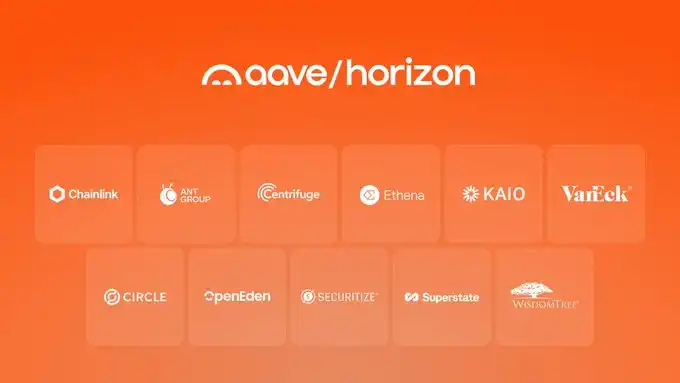
Horizon serves as a bridge to the next trillion dollars.
Launched earlier this year, it is Aave's dedicated market for institutional-grade real-world assets (RWA). Through Horizon, eligible institutions can collateralize tokenized US treasuries and other credit-based assets to borrow stablecoins.
This is a solution tailored by Aave Labs for global large financial institutions, meeting their real-world needs in terms of compliance, risk management, and operations. By providing a secure, efficient on-chain entry point for institutional funds, Horizon becomes the primary conduit for bringing traditional finance's massive capital onto the blockchain.
Horizon will bring numerous top-tier financial institutions into the Aave ecosystem in a way that was previously not possible, and will drive Aave's expansion towards a base of assets over $500 trillion.
In a very short period of time, Horizon has grown to become the largest and fastest-growing RWA collateralized lending platform. We do not believe that this growth trajectory will slow down in the short term.
Currently, Horizon's net deposit size is approximately $550 million. By 2026, our goal is to rapidly expand this number to $1 billion or higher. To achieve this, we will deepen our partnerships with leading institutions such as Circle, Ripple, Franklin Templeton, VanEck, among others, to bring more globally significant asset classes into Aave.
If Aave wants to play a truly central role in the entire financial system, it must first incorporate stocks, ETFs, funds, real estate and mortgages, commodities, receivables, and bonds and fixed-income assets into the on-chain lending system. Horizon is a key player in achieving this goal.
Aave App
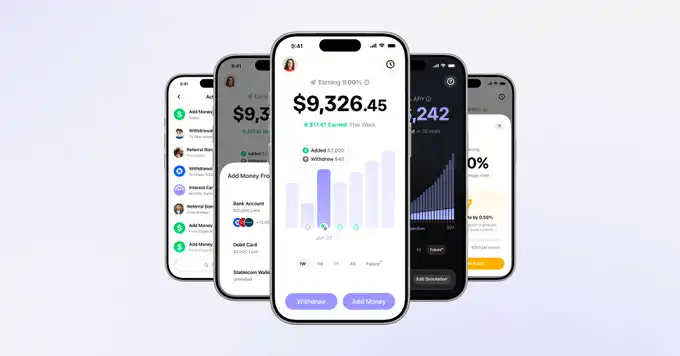
The Aave App is the "Trojan Horse" to the next million users. It is the flagship mobile application of the Aave protocol, aiming to truly bring DeFi to everyone.
The protocol itself is a highly complex financial system, and the mission of the Aave App is to shield this complexity, provide an intuitive, user-friendly product experience, and address real-world needs in the current economic environment.
The Aave App integrates deeply with Push — our global, zero-fee stablecoin on/off-ramp, covering over 70% of the global capital markets. This will make the Aave App the market's best product for a cash-to-DeFi experience.
Many people are not aware that mobile fintech is already a $2 trillion industry. Apps like CashApp and Venmo have tens of millions of users, but there is almost no real product capability in terms of "savings"; the Aave App has the potential to fundamentally change how people save.
Early next year, we will officially launch the Aave App comprehensively and embark on the journey towards the first million users. This will inject growth momentum directly into the Aave protocol through a new market that has not been fully tapped into before. Without product-level scalable adoption, Aave cannot expand to the trillion-dollar level.
Staying true to a strong stance, fostering continuous innovation, and freely designing products is the most beneficial path for Aave.
At Aave Labs, we always focus on three things: bringing the next trillion-dollar asset onto the chain; onboarding millions of new users into DeFi; and ensuring the victory of $AAVE.
This vision requires us to build not a mere "alternative" to the traditional financial system but a financially superior infrastructure.
Much more importantly, Aave Labs is highly aligned with the long-term success of the Aave protocol. Alignment is not just a verbal statement but is reflected in action:
Aave Labs and its employees are the largest AAVE holders
Everything we build is aimed at strengthening the core fee-capture mechanism of the protocol, with all proceeds going to the DAO
The number of products delivered by Aave Labs to Aave surpasses any other team
For 8 years, I have dedicated countless hours to driving Aave's growth—whether through product innovation, global business expansion, or organizing numerous community events
By the way, I bought another $10 million worth of AAVE on-chain yesterday
I've also seen various discussions on the DAO forum. I want to be very clear: No one cares more about Aave than I do. Open discussion is a hallmark of DeFi governance, not a sign of misalignment.
Aave, as the Global Credit Layer
Our multi-decade goal is to build the foundational credit layer of the on-chain economy. To Aave Labs, any form of future value can be tokenized, used as productive collateral, or borrowed without intermediaries.
In such a future, Aave is the bedrock, the foundational liquidity layer on which the next generation of financial products and services is built.
Everything we've done in recent years has been laying the groundwork for this still-ahead target.
Here, we sincerely thank the Aave DAO, numerous service providers, and countless developers who have contributed to Aave. This is a true collective effort, and we are grateful for the ecosystem that has grown around the protocol. Aave Labs is ready to face the challenges of the next phase, always keeping Aave's long-term interests as the top priority.
Building in public is not easy, governance in and of itself is hard in DeFi. Aave is one of the few DeFi protocols that has stood the test of time, and that is its uniqueness. Innovation must always come first — this is also why the Aave ecosystem can continue to thrive.
But now is not the time to celebrate... we are just getting started.
Aave will win.
You may also like

Japan’s Three Megabanks Plan Joint Stablecoin Issuance in Fiscal 2026
MUFG, SMBC, and Mizuho reportedly plan to jointly issue fiat-pegged stablecoins in fiscal 2026, signaling Japan’s growing push into bank-led digital payment infrastructure.

Humanity Discloses H Token Dual-Chain Attack Details, With Losses on Ethereum and BSC Exceeding $36 Million
Humanity said the H token attack across Ethereum and BSC caused more than $36 million in losses after leaked ProxyAdmin keys enabled malicious contract upgrades and token minting.

White House Discusses CLARITY Act With Law Enforcement Ahead of Senate Vote
The White House discussed the CLARITY Act with law enforcement ahead of a Senate vote, focusing on illicit finance risks and developer protections.

$75 billion in foreign capital has fled, and South Korean retail investors have absorbed it all using leverage

Bitcoin Trading Guide 2026: Strategies for Experienced Traders

What Is XAUT and PAXG? Why Tokenized Gold Is Booming in 2026

Cryptocurrency CEXs are flocking to sell US stocks, and traditional brokerages are facing an "uninvited guest."

Will the SpaceX IPO Hurt Bitcoin? Here's What Traders Are Watching
Foreign selling in the South Korean stock market accelerates, with cumulative net sales reportedly reaching $75 billion this year
On June 9, The Kobeissi Letter, citing Goldman Sachs data, reported that global investors are selling South Korean stocks at an unusually rapid pace. In the latest trading session, foreign investors sold about $801 million worth of Kospi constituent stocks again; total foreign outflows last week reached about $10 billion, and the market has been in net foreign selling on nearly every trading day over the past month. According to the data cited in the report, foreign investors have sold about $75 billion worth of South Korean stocks so far this year. Meanwhile, South Korean retail and institutional investors together recorded roughly $69 billion in net buying over the same period, suggesting that the market’s main buying support has come from domestic capital rather than returning overseas funds. The information currently disclosed still mainly comes from The Kobeissi Letter’s retelling and Goldman Sachs data summaries, while public details on the statistical period and the specific definition of “selling” remain relatively limited.

Fortune Warns of Strategy’s Financing Structure Risks as Bitcoin Premium Narrows
Fortune warned that Strategy’s Bitcoin treasury model faces growing financing risks as MSTR’s net asset premium narrows and preferred stock dividend pressure increases.

Ferrari Challenge Le Mans: Carl Moon to Dominate in WEEX Livery

Sahara AI Responds to SAHARA’s Sharp Drop: No Contract or Product Security Issues Found, Internal Investigation Underway
Sahara AI responded to SAHARA’s 60% price drop, saying no token contract or product security issues have been found and an internal investigation is underway.

WEEX Deposit/Withdrawal Dynamic Island: Your Asset Status, Always in Sight
Scaling Crypto Derivatives: The Digital Asset Infrastructure Behind High-Volume Trading
In the fast-moving digital asset ecosystem, derivatives platforms face an extreme architectural test. High-leverage futures markets demand more than just standard security—they require absolute operational precision, zero-latency matching engines, and ironclad structural scalability, all while navigating intense market volatility.
As global platforms scale to meet these demands, the industry is shifting away from rigid, monolithic setups toward a more agile, "decoupled" infrastructure philosophy.
The Blueprint for High-Volume Copy TradingFor elite global exchanges like WEEX (founded in 2018), this architectural choice becomes critical when scaling high-volume retail features like social copy trading. When thousands of users automatically mirror the real-time strategies of elite traders simultaneously, it triggers sudden, monumental spikes in concurrent transactional volume.
To prevent execution latency or settlement bottlenecks during these peak volatility events, a platform's primary engine must remain entirely dedicated to risk management, copy-trade synchronization, and order matching.
The Architectural Rule: New-generation platforms must separate front-end user execution engines from heavy backend infrastructural overhead to eliminate operational friction.
By separating these layers, platforms can maintain complete sovereignty over their trading environments and user experiences while strategically aligning with institutional-grade infrastructure ecosystems. This strategic framework allows modern exchanges to leverage advanced Digital Asset Custody infrastructure such as Cobo’s behind the scenes, ensuring that backend wallet management scales elastically alongside trading spikes.
Capitalizing on Market Momentum and 400× LeverageIn a derivatives arena where platforms offer up to 400× leverage on perpetual contracts, capital efficiency and market agility are core business metrics. To capture market momentum, an exchange needs the ability to rapidly expand its asset offerings, supporting everything from legacy crypto assets to sudden, trending altcoins across a massive library of trading pairs.
Adopting a flexible, scalable Wallet-as-a-Service (WaaS) solution such as Cobo’s could completely rewrite the development timeline for high-growth exchanges. Instead of spending months of engineering capital building out custom backend wallet architectures for every new blockchain network, platforms can deploy localized infrastructure in days.
This agility allows platforms to instantly scale their listings to over a thousand trading pairs without compromising security or delaying time-to-market. It mirrors the exact operational advantages seen during high-velocity market events, similar to how advanced wallet infrastructure empowers platforms during sudden asset surges; allowing exchanges to pass that speed and liquidity directly to their global user base.
A Mature Foundation for GrowthThe synergy between trusted infrastructure ecosystems and global trading platforms represents the natural evolution of a maturing crypto market. As WEEX continues to scale its global spot and derivatives offerings for over 6 million users, adopting robust backend paradigms proves that platforms no longer have to compromise between cutting-edge trading velocity and uncompromised structural security.

Morning Report | BitMine increased its holdings by 126,971 ETH last week; trader Eugene announced his exit from the crypto market

Wang Chuan: How can one not feel anxious after the neighbor Old Wang made thirty times profit by investing in storage stocks? (Seven) - A quarter-century cycle

Get Paid to Onboard? Try WEEX’s New Homepage with Rewards for Registration, Deposit & Trade
WEEX Custom Layout: Build Your Perfect Trading Workspace in Seconds
Japan’s Three Megabanks Plan Joint Stablecoin Issuance in Fiscal 2026
MUFG, SMBC, and Mizuho reportedly plan to jointly issue fiat-pegged stablecoins in fiscal 2026, signaling Japan’s growing push into bank-led digital payment infrastructure.
Humanity Discloses H Token Dual-Chain Attack Details, With Losses on Ethereum and BSC Exceeding $36 Million
Humanity said the H token attack across Ethereum and BSC caused more than $36 million in losses after leaked ProxyAdmin keys enabled malicious contract upgrades and token minting.
White House Discusses CLARITY Act With Law Enforcement Ahead of Senate Vote
The White House discussed the CLARITY Act with law enforcement ahead of a Senate vote, focusing on illicit finance risks and developer protections.
$75 billion in foreign capital has fled, and South Korean retail investors have absorbed it all using leverage
Bitcoin Trading Guide 2026: Strategies for Experienced Traders
What Is XAUT and PAXG? Why Tokenized Gold Is Booming in 2026


