
Base App is now fully open! How was your experience?

Original Article Title: "Base App Fully Open, How Is the Experience?"
Original Article Author: KarenZ, Foresight News
On December 18, the Base App launched by Coinbase officially announced the end of the Beta testing phase and opened up to users in over 140 countries and regions worldwide. This is a key step for Coinbase to build an on-chain ecosystem gateway and realize the mass adoption vision of Web3.
Evolved from the early purely utilitarian "Coinbase Wallet" to today's "Base App," this product is attempting to define a new form of on-chain "super app" — deeply integrating social, transactional, payment, and complex on-chain interactions.
Its core vision is as Base's head Jesse Pollak puts it: "Make on-chain interactions as simple as online."
The Versatile Landscape of Base App
Base App is no longer limited to traditional asset management but is a comprehensive platform integrating social, payment, and chat functionalities.
Base App has the following four core features:
· Closed-loop of social and creator economy: Integrated with Farcaster and Zora protocols. Each user-posted update can be transformed into a tradable digital asset through Zora, realizing true "earn-while-you-post." Additionally, the social feed directly incorporates curated transaction updates, making "on-chain discovery" intuitive and socially engaging.
· On-chain capabilities and payment experience: Supports cryptocurrency trading, explores built-in Mini apps (such as trading platforms, prediction markets, lending platforms, games, content tipping platforms), also supports free and instant USDC transfers via NFC, and allows earning yield through holding USDC.
· Interconnected Eco Mini Apps: Similar to WeChat Mini Programs, Base App has built-in mini-applications covering DeFi, prediction markets, games, and other fields. Smart wallet and quick payments: Users automatically receive a Base account (supporting multi-chain smart wallet identity) and Base Pay (a fast payment method based on USDC) upon registration.
· Privacy Communication and AI Collaboration: The chat function is based on XMTP encryption protocol to ensure privacy and security. Users can not only send and receive USDC directly in conversations or build communities of up to 250 people but also engage AI agents to assist in executing complex trades or portfolio management.
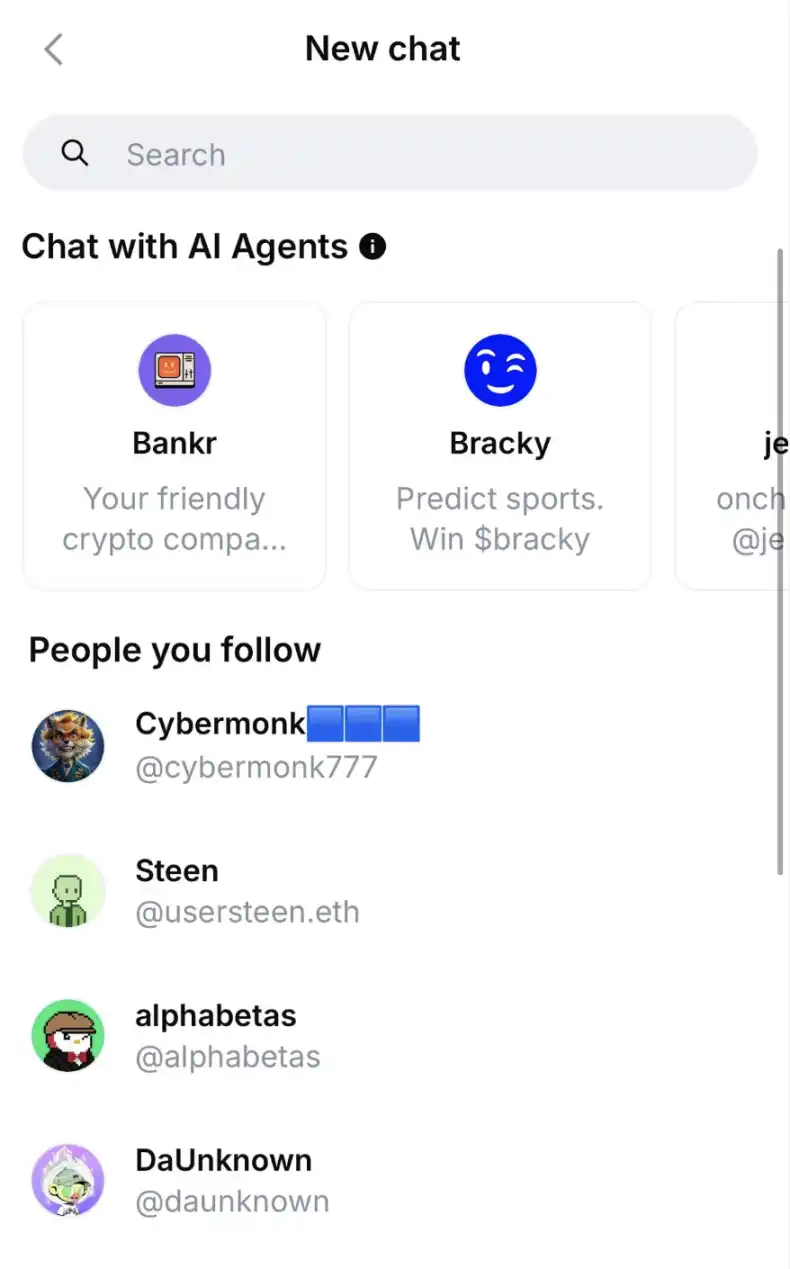
How's the Experience? What Kind of App Is This?
In practical use, the UI design of the Base App is extremely simple, and the interaction is relatively smooth.
Seamless Onboarding: Farewell to Mnemonic Anxiety
For newcomers, the most convenient thing is to not need a mnemonic phrase or back up 12 words. Key management is entirely entrusted to Passkeys, and users can create an on-chain account in seconds. This experience is almost the same as registering for a regular Web2 social account, significantly reducing the barrier to entry for non-crypto users.
Seamless Integration of Social and Financial
In the main Feed of the transaction section, under content posts where creators have enabled earnings, a real-time market button will be displayed, allowing users to switch to the trading page with one click.
The platform will also highlight large transactions or behavior where multiple people are buying in bulk, making it easier for users to follow. In addition, there is a convenient "hidden operation" — double-tap on a post of interest or a creator's coin to quickly buy in with a preset amount.
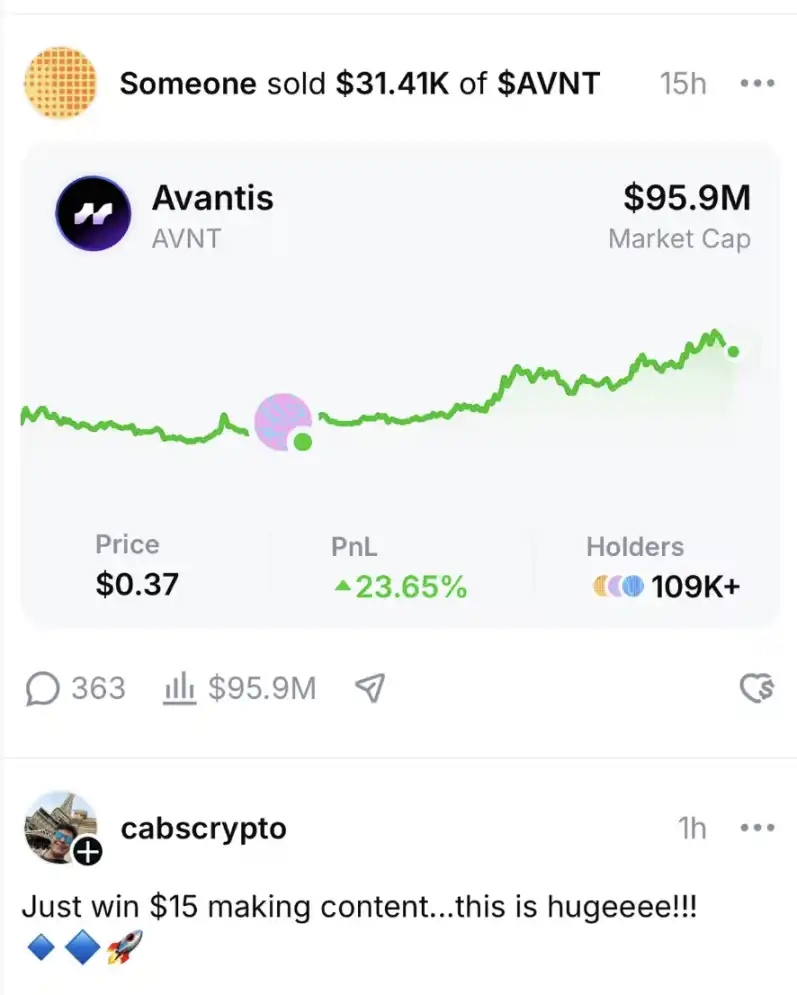
The discussion section focuses on pure content streams that have not enabled earnings.
According to the official description, the Feed algorithm will combine user interactions (likes, comments, follows), interest test results, as well as content timeliness, relevance, and diversity to provide personalized recommendations. Users can also interact directly in the Feed with links or Mini Apps shared by others.
Human-Centric On-Chain Identity
When you open the Base App, what you see is no longer a cold 0x... code but Basenames. The Base App is deeply integrated with the on-chain identity system, making transfers as simple as sending a red envelope to a WeChat friend. Names are no longer just symbols but serve as a "digital ID card" that spans the entire ecosystem.
Transaction: Gas Sponsorship
To achieve the ultimate experience, the Base App employs a "Gas Sponsorship" model in many scenarios, with the network fees covered by the official team. However, it is important to note that this convenience is not entirely free: when conducting token exchanges (Swap) or cross-chain operations within the app, you still need to pay a fee of about 1% (on Base).
Rich Mini Apps
The Base App Search section encompasses all integrated Mini Apps, covering applications in various fields such as transactions, gaming, creator platforms, DeFi platforms, prediction markets, music, and more. The Mini Apps homepage currently features the derivative protocol Avantis, Web3 soccer fantasy game Football.Fun, DeFi protocol Gauntlet, lending protocol Morpho, and Moonwell.
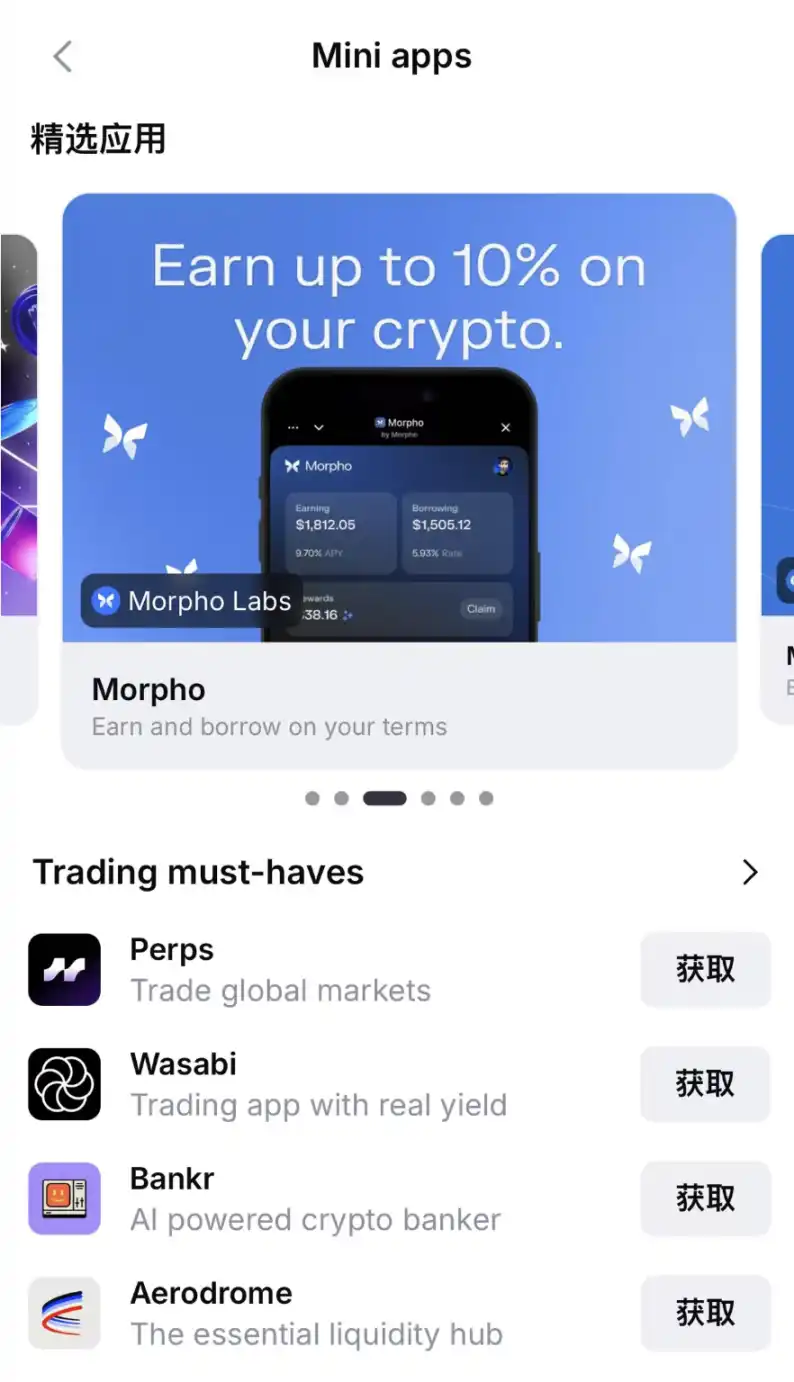
USDC Holding Yield Automatically Distributed Weekly
The Base App wallet page supports one-click activation of USDC yield, currently with an APY of approximately 3.35% (adjusted by Coinbase). Rewards accumulate daily and are distributed weekly (U.S. users need to link their Coinbase account).
What Are the Challenges?
As an emerging platform, the Base App still faces some obvious pain points or challenges in practical use:
· “Walled Garden” Effect of Social Features: For a product positioned as a “layer-one super app,” user adoption is its lifeblood. If the Base App’s user base is insufficient, it will directly lead to its core functionality entering a “negative loop.” If there are few active users, content updates in the information flow will be slow, and the retention rate will gradually decrease.
· Information Flow Quality Needs Improvement: The current social feed algorithm is still not transparent, and the content pool is filled with speculative and useless information, with high-quality deep interactions relatively scarce.
· “Liquidity Trap” of On-Chain Transactions: Its social trading section relies on displaying “multi-person concentrated purchases” to guide copy trading. If the user base is too small, this trend discovery loses statistical significance, and what users see may only be random actions by a few individuals.
· Security Defense Boundaries: Simplicity also brings risks. Phishing links disguised under beautiful social dynamics still exist. For newbie users accustomed to Web2 security protection, operational errors may lead to authorization leakage, posing a serious challenge in the on-chain world.
Of course, for the current stage of the Base App, its greatest challenge is not lack of functionality, but how to efficiently convert Coinbase's hundreds of millions of users and stabilize retention rates.
Summary
The full opening of Base App marks a shift in the focus of the Base ecosystem from "building infrastructure" to "competition for existing users" and "user adoption."
By consolidating wallet, transactions, social, creator economy, payments, mini-program ecosystem, rewards, and more into one, it has built a powerful on-chain traffic entrance. For developers, the Mini Apps framework provides a shortcut to directly reach Coinbase's massive user base.
Although there is still a long way to go in content governance and user attraction, Base App has undoubtedly provided a clear template: the future of Web3 should not be an isolated wallet but an on-chain society that is engaging, interactive, and rewarding.
You may also like

Cryptocurrency CEXs are flocking to sell US stocks, and traditional brokerages are facing an "uninvited guest."

Will the SpaceX IPO Hurt Bitcoin? Here's What Traders Are Watching
Foreign selling in the South Korean stock market accelerates, with cumulative net sales reportedly reaching $75 billion this year
On June 9, The Kobeissi Letter, citing Goldman Sachs data, reported that global investors are selling South Korean stocks at an unusually rapid pace. In the latest trading session, foreign investors sold about $801 million worth of Kospi constituent stocks again; total foreign outflows last week reached about $10 billion, and the market has been in net foreign selling on nearly every trading day over the past month. According to the data cited in the report, foreign investors have sold about $75 billion worth of South Korean stocks so far this year. Meanwhile, South Korean retail and institutional investors together recorded roughly $69 billion in net buying over the same period, suggesting that the market’s main buying support has come from domestic capital rather than returning overseas funds. The information currently disclosed still mainly comes from The Kobeissi Letter’s retelling and Goldman Sachs data summaries, while public details on the statistical period and the specific definition of “selling” remain relatively limited.

Fortune Warns of Strategy’s Financing Structure Risks as Bitcoin Premium Narrows
Fortune warned that Strategy’s Bitcoin treasury model faces growing financing risks as MSTR’s net asset premium narrows and preferred stock dividend pressure increases.

Ferrari Challenge Le Mans: Carl Moon to Dominate in WEEX Livery

Sahara AI Responds to SAHARA’s Sharp Drop: No Contract or Product Security Issues Found, Internal Investigation Underway
Sahara AI responded to SAHARA’s 60% price drop, saying no token contract or product security issues have been found and an internal investigation is underway.

WEEX Deposit/Withdrawal Dynamic Island: Your Asset Status, Always in Sight

Scaling Crypto Derivatives: The Digital Asset Infrastructure Behind High-Volume Trading
In the fast-moving digital asset ecosystem, derivatives platforms face an extreme architectural test. High-leverage futures markets demand more than just standard security—they require absolute operational precision, zero-latency matching engines, and ironclad structural scalability, all while navigating intense market volatility.
As global platforms scale to meet these demands, the industry is shifting away from rigid, monolithic setups toward a more agile, "decoupled" infrastructure philosophy.
The Blueprint for High-Volume Copy TradingFor elite global exchanges like WEEX (founded in 2018), this architectural choice becomes critical when scaling high-volume retail features like social copy trading. When thousands of users automatically mirror the real-time strategies of elite traders simultaneously, it triggers sudden, monumental spikes in concurrent transactional volume.
To prevent execution latency or settlement bottlenecks during these peak volatility events, a platform's primary engine must remain entirely dedicated to risk management, copy-trade synchronization, and order matching.
The Architectural Rule: New-generation platforms must separate front-end user execution engines from heavy backend infrastructural overhead to eliminate operational friction.
By separating these layers, platforms can maintain complete sovereignty over their trading environments and user experiences while strategically aligning with institutional-grade infrastructure ecosystems. This strategic framework allows modern exchanges to leverage advanced Digital Asset Custody infrastructure such as Cobo’s behind the scenes, ensuring that backend wallet management scales elastically alongside trading spikes.
Capitalizing on Market Momentum and 400× LeverageIn a derivatives arena where platforms offer up to 400× leverage on perpetual contracts, capital efficiency and market agility are core business metrics. To capture market momentum, an exchange needs the ability to rapidly expand its asset offerings, supporting everything from legacy crypto assets to sudden, trending altcoins across a massive library of trading pairs.
Adopting a flexible, scalable Wallet-as-a-Service (WaaS) solution such as Cobo’s could completely rewrite the development timeline for high-growth exchanges. Instead of spending months of engineering capital building out custom backend wallet architectures for every new blockchain network, platforms can deploy localized infrastructure in days.
This agility allows platforms to instantly scale their listings to over a thousand trading pairs without compromising security or delaying time-to-market. It mirrors the exact operational advantages seen during high-velocity market events, similar to how advanced wallet infrastructure empowers platforms during sudden asset surges; allowing exchanges to pass that speed and liquidity directly to their global user base.
A Mature Foundation for GrowthThe synergy between trusted infrastructure ecosystems and global trading platforms represents the natural evolution of a maturing crypto market. As WEEX continues to scale its global spot and derivatives offerings for over 6 million users, adopting robust backend paradigms proves that platforms no longer have to compromise between cutting-edge trading velocity and uncompromised structural security.

Morning Report | BitMine increased its holdings by 126,971 ETH last week; trader Eugene announced his exit from the crypto market

Wang Chuan: How can one not feel anxious after the neighbor Old Wang made thirty times profit by investing in storage stocks? (Seven) - A quarter-century cycle

Get Paid to Onboard? Try WEEX’s New Homepage with Rewards for Registration, Deposit & Trade

WEEX Custom Layout: Build Your Perfect Trading Workspace in Seconds

See “Buy Walls” & “Sell Walls” Instantly: WEEX Launches the Depth Chart for Smarter Trades

What Is Quick Trade on WEEX? 2 Ways WEEX Ends Chart-Panel Jumping
Morning News | Five major virtual asset platforms in South Korea have experienced 57 incidents of hacking and system failures in six years; Grayscale submits registration application for Canton ETF

Should we escape the peak? The principle of the tail-end market in the stock market

RootData: May 2026 Cryptocurrency Exchange Transparency Research Report

Founder of Baixing.com: My Experience with Claude Code in Fourteen Points
Cryptocurrency CEXs are flocking to sell US stocks, and traditional brokerages are facing an "uninvited guest."
Will the SpaceX IPO Hurt Bitcoin? Here's What Traders Are Watching
Foreign selling in the South Korean stock market accelerates, with cumulative net sales reportedly reaching $75 billion this year
On June 9, The Kobeissi Letter, citing Goldman Sachs data, reported that global investors are selling South Korean stocks at an unusually rapid pace. In the latest trading session, foreign investors sold about $801 million worth of Kospi constituent stocks again; total foreign outflows last week reached about $10 billion, and the market has been in net foreign selling on nearly every trading day over the past month. According to the data cited in the report, foreign investors have sold about $75 billion worth of South Korean stocks so far this year. Meanwhile, South Korean retail and institutional investors together recorded roughly $69 billion in net buying over the same period, suggesting that the market’s main buying support has come from domestic capital rather than returning overseas funds. The information currently disclosed still mainly comes from The Kobeissi Letter’s retelling and Goldman Sachs data summaries, while public details on the statistical period and the specific definition of “selling” remain relatively limited.
Fortune Warns of Strategy’s Financing Structure Risks as Bitcoin Premium Narrows
Fortune warned that Strategy’s Bitcoin treasury model faces growing financing risks as MSTR’s net asset premium narrows and preferred stock dividend pressure increases.
Ferrari Challenge Le Mans: Carl Moon to Dominate in WEEX Livery
Sahara AI Responds to SAHARA’s Sharp Drop: No Contract or Product Security Issues Found, Internal Investigation Underway
Sahara AI responded to SAHARA’s 60% price drop, saying no token contract or product security issues have been found and an internal investigation is underway.


