
Base's 2025 Report Card: Revenue Grows 30X, Solidifies L2 Leadership





Original Title: Are you Based? Base's Outlook for 2026
Original Author: AJC, Messari
Original Translator: Tim, PANews
In 2025, Base further solidified its position as the Ethereum L2 leader across various performance metrics. Among these, revenue remains the most telling indicator of its dominance in the overall L2 ecosystem.
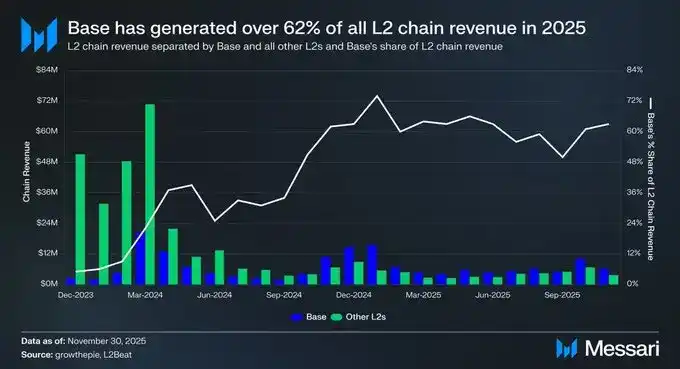
Despite a significant drop in L2's total revenue from its 2024 peak, Base continues to command a significant share of the L2 market. In December 2023, Base's on-chain revenue was $2.5 million, accounting for only 5% of L2's total revenue of $53.7 million. One year later, Base's on-chain revenue grew to $14.7 million, representing 63% of L2's total revenue of $23.5 million in December 2024. This trend persisted into 2025, with Base achieving $75.4 million in revenue year-to-date, accounting for 62% of L2's total revenue of $120.7 million.
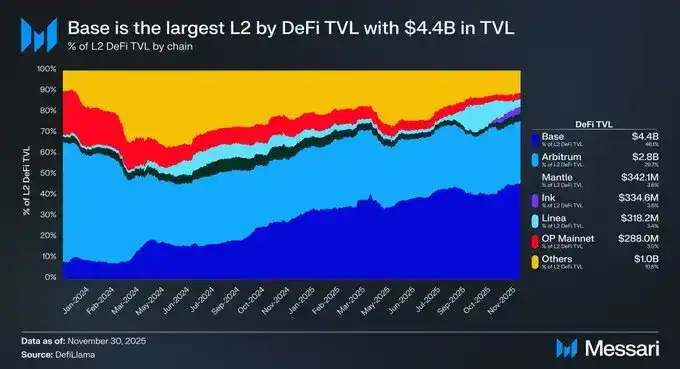
Base's leadership is not only evident at the revenue level; its DeFi TVL has also become a frontrunner in the L2 race. After surpassing Arbitrum One in January 2025, Base's current $46.3 billion DeFi TVL accounts for 46% of the entire L2 market. Of particular note, Base's DeFi TVL share has steadily increased throughout 2025, rising from 33% at the beginning of the year to the current level.
Base's most significant advantage over other L2 solutions lies in its distribution channel, a critical advantage that speaks for itself. According to Coinbase's latest 10-Q filing, with 9.3 million monthly active trading users in the third quarter, Base can directly reach a large and onboarded user base, which is challenging for other L2 networks to achieve. While most L2s must acquire users through incentives or third-party integrations, Base, thanks to its direct connection to the largest U.S. centralized exchange, enjoys a natural distribution advantage.
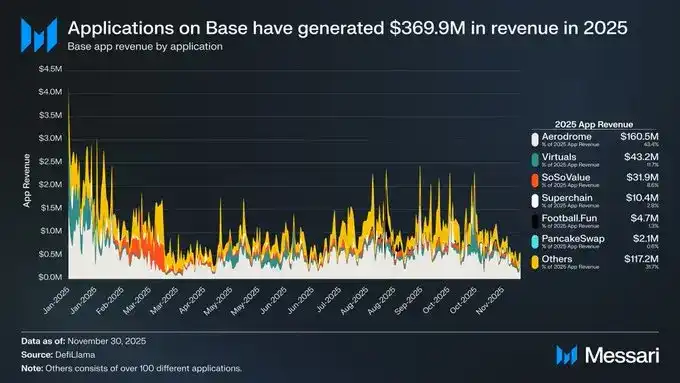
Base has also stood out for the ecosystem's application of scalable development and tangible value creation. This year, applications within the Base ecosystem have generated $369.9 million in revenue. Notably, application revenue is primarily concentrated in Aerodrome, which contributed $160.5 million, accounting for 43% of total application revenue. However, the top DEX on Base was not the only successful application in 2025.
The AI Agent Launch Platform Virtuals has achieved $43.2 million in revenue, accounting for 12% of the Base ecosystem's total revenue from applications; meanwhile, the recently launched sports prediction app Football.Fun has also generated $4.7 million in revenue. These data indicate that a diverse set of revenue-generating products has been established on Base across multiple sectors, and the ecosystem's vibrancy does not rely on a single application or use case.
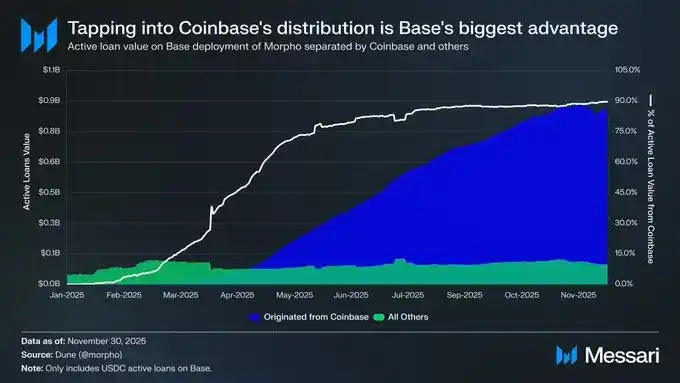
This distribution advantage was best exemplified in the Coinbase and Morpho collaboration case. This partnership allows Coinbase users to borrow USDC directly on the platform using cryptocurrency as collateral. While the user experience is embedded within the Coinbase website, collateral management and loan execution are carried out on-chain through Morpho deployed on Base. This lending product was launched less than a year ago, but its adoption rate has been quite high.
Coinbase users have borrowed $866.3 million through Morpho, currently representing 90% of active loans on Morpho on the Base network. Concurrently, Morpho's TVL on the Base chain has grown by 1906% over the year, surging from $48.2 million to $966.4 million. Base's distribution advantage means on-chain activity can serve as a byproduct for Coinbase's product usage. This user onboarding channel is not available to other L2 networks, leading them to rely mainly on incentive programs to attract liquidity and users to the DeFi ecosystem.

Although Base chain's DeFi TVL has continued to grow since 2025, and on-chain revenue remains stable, user on-chain behavior has started to shift. Based on daily filtered user statistics (referring to the number of unique addresses conducting at least two transactions in a specific contract in a day and spending more than 0.0001 gas), USDC has now become the most widely used application on the Base chain, with an average of 83,400 daily users in November, a 233% year-on-year increase from 25,100 users in the same period last year.
Meanwhile, retail and DEX interaction has significantly decreased. The daily filtered user count for Uniswap and Aerodrome has dropped by 74% and 49%, respectively. However, it is more noteworthy that DEX trading volume on the Base chain hit a record high in 2025, indicating that activity on Uniswap and Aerodrome is increasingly concentrated among traders with larger fund sizes and higher transaction volumes.
Base 2026 Key Initiative: Base App
Leveraging Coinbase's natural advantage, Base enjoys a luxury condition that other chains find hard to reach. It has established a solid moat in terms of user base, liquidity, and application ecosystem. Base leads in revenue on the L2 network, has the deepest DeFi TVL in the field, and continues to receive on-chain user traffic from Coinbase. In other words, unlike most L2 networks still struggling to establish themselves or attract users, Base has long surpassed this stage of development.
With this moat, Base's focus has shifted beyond core L2 network metrics to the creator economy sector. If this market opportunity is seized, the potential total market size is estimated to be close to $5 trillion. To seize this market direction, Base's core strategy is focused on the Base App. This "super app" aims to integrate asset custody, trading, social, and wallet core functions into one. Unlike most crypto wallets, the Base App features several innovative functions beyond basic asset management:
· Social feed based on Farcaster and Zora;
· Direct messaging and group chat functionality through XMTP (supporting interaction with other users and AI agents like Bankr);
· Built-in mini-app discovery feature, allowing users to directly access and use various mini-apps within the Base App.

The Base App launched an internal beta in July, initially only available to users invited through a whitelist. Nevertheless, the Base App has shown significant growth. A total of 148,400 users have created accounts, with accelerated registrations in November, seeing a 93% increase month-over-month. User retention is also strong, with 6,300 weekly active users (a 74% increase) and 10,500 monthly active users (a 7% increase). Although not explicitly confirmed, the Base App is likely to conclude its internal testing phase this month, paving the way for a full public launch before the new year.

The most critical goal of the on-chain economy Base is trying to build is to enable creators to directly profit from their created content. Content created in the Base App is tokenized by default (although users can opt out of this feature), turning each post into a tradable market. Creators can earn a share of the transaction fees generated by the content, specifically 1% of each transaction.
In the future, users will also be able to mint creator tokens for their accounts directly within the Base App, opening up another monetization avenue (this feature is currently in early testing). At a technical level, both creator tokens and content tokens are tokenized based on the Zora protocol. As of now, creators have cumulatively earned $6.1 million through Zora's tokenization model, with an average monthly payout of $1.1 million since July.
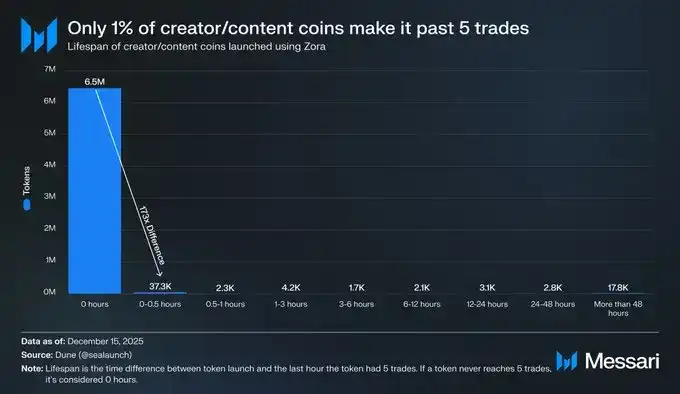
As of now, the total number of creators and content tokens tokenized through Zora has exceeded 6.52 million. Among them, 6.45 million (about 99% of the total) have failed to achieve five transactions. Only 17.8 thousand tokens (0.3% of the total) remain transactional after 48 hours of issuance.
Before interpreting this data, one must understand a fundamental fact: the vast majority of content published on the Internet is inherently worthless. From this perspective, the fact that 99% of tokens have not garnered market attention may simply reflect the natural distribution of online content, rather than a structural flaw in the Base model. What truly matters are the tokens that survive beyond 48 hours. We believe that a creator or content token being able to continue trading after 48 hours of issuance signals the genuine value of the creator or content itself.
In other words, Base has so far made little impact on the creator economy. Only 17.8 thousand creator and content tokens show ongoing activity, which is a mere drop in the ocean compared to the vast daily output of online content. Pessimists may deem this model unviable, but optimists believe that while Base has essentially achieved near-zero penetration in the creator economy, there is significant room for growth through optimizations in content distribution, content discovery, and functional tools. In any case, increasing the number of tokens that can survive beyond 48 hours should be a key focus for Base in 2026.
Lastly, Base may possess the most effective incentive mechanism in the crypto market: tokens. In September of this year, Base confirmed that it is exploring token issuance but has not yet disclosed specific details regarding allocation, utility, or potential launch dates. The most notable aspect of the Base token is not the token itself but its use cases. Unlike most L2s, Base does not rely on tokens to attract liquidity. Instead, it can use tokens to incentivize on-chain creator participation, rewarding behaviors that drive user engagement, content creation, and social activities rather than short-term trading.
In conclusion, leveraging its established L2 core ecosystem, Base is advancing through distribution channels, product coverage, and potential token incentives, exploring consumer and creator-oriented use cases. If this strategy succeeds, Base will establish a moat around the social and creator ecosystem. This moat exhibits higher user stickiness compared to DeFi TVL and stablecoin balances, areas where other L2 solutions have not yet ventured.
You may also like

Cryptocurrency CEXs are flocking to sell US stocks, and traditional brokerages are facing an "uninvited guest."

Will the SpaceX IPO Hurt Bitcoin? Here's What Traders Are Watching
Foreign selling in the South Korean stock market accelerates, with cumulative net sales reportedly reaching $75 billion this year
On June 9, The Kobeissi Letter, citing Goldman Sachs data, reported that global investors are selling South Korean stocks at an unusually rapid pace. In the latest trading session, foreign investors sold about $801 million worth of Kospi constituent stocks again; total foreign outflows last week reached about $10 billion, and the market has been in net foreign selling on nearly every trading day over the past month. According to the data cited in the report, foreign investors have sold about $75 billion worth of South Korean stocks so far this year. Meanwhile, South Korean retail and institutional investors together recorded roughly $69 billion in net buying over the same period, suggesting that the market’s main buying support has come from domestic capital rather than returning overseas funds. The information currently disclosed still mainly comes from The Kobeissi Letter’s retelling and Goldman Sachs data summaries, while public details on the statistical period and the specific definition of “selling” remain relatively limited.

Fortune Warns of Strategy’s Financing Structure Risks as Bitcoin Premium Narrows
Fortune warned that Strategy’s Bitcoin treasury model faces growing financing risks as MSTR’s net asset premium narrows and preferred stock dividend pressure increases.

Ferrari Challenge Le Mans: Carl Moon to Dominate in WEEX Livery

Sahara AI Responds to SAHARA’s Sharp Drop: No Contract or Product Security Issues Found, Internal Investigation Underway
Sahara AI responded to SAHARA’s 60% price drop, saying no token contract or product security issues have been found and an internal investigation is underway.

WEEX Deposit/Withdrawal Dynamic Island: Your Asset Status, Always in Sight

Scaling Crypto Derivatives: The Digital Asset Infrastructure Behind High-Volume Trading
In the fast-moving digital asset ecosystem, derivatives platforms face an extreme architectural test. High-leverage futures markets demand more than just standard security—they require absolute operational precision, zero-latency matching engines, and ironclad structural scalability, all while navigating intense market volatility.
As global platforms scale to meet these demands, the industry is shifting away from rigid, monolithic setups toward a more agile, "decoupled" infrastructure philosophy.
The Blueprint for High-Volume Copy TradingFor elite global exchanges like WEEX (founded in 2018), this architectural choice becomes critical when scaling high-volume retail features like social copy trading. When thousands of users automatically mirror the real-time strategies of elite traders simultaneously, it triggers sudden, monumental spikes in concurrent transactional volume.
To prevent execution latency or settlement bottlenecks during these peak volatility events, a platform's primary engine must remain entirely dedicated to risk management, copy-trade synchronization, and order matching.
The Architectural Rule: New-generation platforms must separate front-end user execution engines from heavy backend infrastructural overhead to eliminate operational friction.
By separating these layers, platforms can maintain complete sovereignty over their trading environments and user experiences while strategically aligning with institutional-grade infrastructure ecosystems. This strategic framework allows modern exchanges to leverage advanced Digital Asset Custody infrastructure such as Cobo’s behind the scenes, ensuring that backend wallet management scales elastically alongside trading spikes.
Capitalizing on Market Momentum and 400× LeverageIn a derivatives arena where platforms offer up to 400× leverage on perpetual contracts, capital efficiency and market agility are core business metrics. To capture market momentum, an exchange needs the ability to rapidly expand its asset offerings, supporting everything from legacy crypto assets to sudden, trending altcoins across a massive library of trading pairs.
Adopting a flexible, scalable Wallet-as-a-Service (WaaS) solution such as Cobo’s could completely rewrite the development timeline for high-growth exchanges. Instead of spending months of engineering capital building out custom backend wallet architectures for every new blockchain network, platforms can deploy localized infrastructure in days.
This agility allows platforms to instantly scale their listings to over a thousand trading pairs without compromising security or delaying time-to-market. It mirrors the exact operational advantages seen during high-velocity market events, similar to how advanced wallet infrastructure empowers platforms during sudden asset surges; allowing exchanges to pass that speed and liquidity directly to their global user base.
A Mature Foundation for GrowthThe synergy between trusted infrastructure ecosystems and global trading platforms represents the natural evolution of a maturing crypto market. As WEEX continues to scale its global spot and derivatives offerings for over 6 million users, adopting robust backend paradigms proves that platforms no longer have to compromise between cutting-edge trading velocity and uncompromised structural security.

Morning Report | BitMine increased its holdings by 126,971 ETH last week; trader Eugene announced his exit from the crypto market

Wang Chuan: How can one not feel anxious after the neighbor Old Wang made thirty times profit by investing in storage stocks? (Seven) - A quarter-century cycle

Get Paid to Onboard? Try WEEX’s New Homepage with Rewards for Registration, Deposit & Trade

WEEX Custom Layout: Build Your Perfect Trading Workspace in Seconds

See “Buy Walls” & “Sell Walls” Instantly: WEEX Launches the Depth Chart for Smarter Trades

What Is Quick Trade on WEEX? 2 Ways WEEX Ends Chart-Panel Jumping
Morning News | Five major virtual asset platforms in South Korea have experienced 57 incidents of hacking and system failures in six years; Grayscale submits registration application for Canton ETF

Should we escape the peak? The principle of the tail-end market in the stock market

RootData: May 2026 Cryptocurrency Exchange Transparency Research Report

Founder of Baixing.com: My Experience with Claude Code in Fourteen Points
Cryptocurrency CEXs are flocking to sell US stocks, and traditional brokerages are facing an "uninvited guest."
Will the SpaceX IPO Hurt Bitcoin? Here's What Traders Are Watching
Foreign selling in the South Korean stock market accelerates, with cumulative net sales reportedly reaching $75 billion this year
On June 9, The Kobeissi Letter, citing Goldman Sachs data, reported that global investors are selling South Korean stocks at an unusually rapid pace. In the latest trading session, foreign investors sold about $801 million worth of Kospi constituent stocks again; total foreign outflows last week reached about $10 billion, and the market has been in net foreign selling on nearly every trading day over the past month. According to the data cited in the report, foreign investors have sold about $75 billion worth of South Korean stocks so far this year. Meanwhile, South Korean retail and institutional investors together recorded roughly $69 billion in net buying over the same period, suggesting that the market’s main buying support has come from domestic capital rather than returning overseas funds. The information currently disclosed still mainly comes from The Kobeissi Letter’s retelling and Goldman Sachs data summaries, while public details on the statistical period and the specific definition of “selling” remain relatively limited.
Fortune Warns of Strategy’s Financing Structure Risks as Bitcoin Premium Narrows
Fortune warned that Strategy’s Bitcoin treasury model faces growing financing risks as MSTR’s net asset premium narrows and preferred stock dividend pressure increases.
Ferrari Challenge Le Mans: Carl Moon to Dominate in WEEX Livery
Sahara AI Responds to SAHARA’s Sharp Drop: No Contract or Product Security Issues Found, Internal Investigation Underway
Sahara AI responded to SAHARA’s 60% price drop, saying no token contract or product security issues have been found and an internal investigation is underway.


