
Bloomberg has reported twice, Hyperliquid once again in Wall Street's radar

At 1:12 AM EST on February 28, during the exchange downtime, the trading volume of the prediction contract on Polymarket regarding the US striking Iran surged.
Source: @yenwod_
At 1:13 AM, the first open-source intelligence tweet about the airstrike appeared on Twitter.

One minute later, the price and trading volume of the crude oil perpetual contract on Hyperliquid's Trade.xyz followed an anomaly.
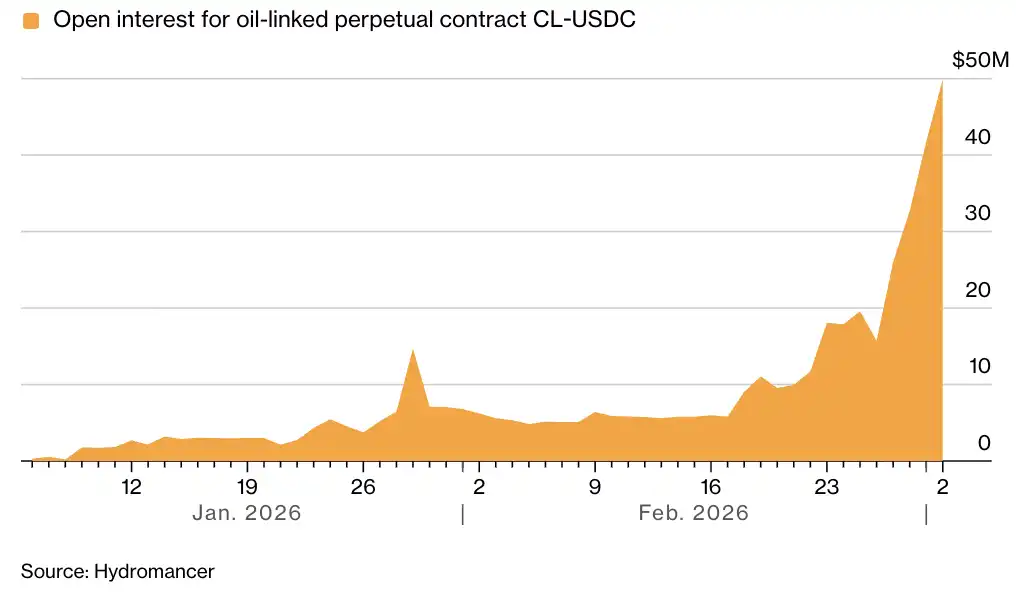
After the headline news broke, the crude oil perpetual contract on the Hyperliquid platform rose by 5%, with OI reaching $50 million. HYPE's price increased by 13%, leading the top 25 tokens by market cap.
24/7 Trading
Out of the past year's ten high-volatility macroeconomic events, eight occurred over the weekend. Hyperliquid's round-the-clock price discovery mechanism is drawing attention from the traditional financial markets.
In two recent articles about Hyperliquid, Bloomberg pointed out that as the intersection between the crypto market and traditional finance deepens, Wall Street is starting to closely watch platforms like Hyperliquid. During weekends when traditional markets are closed, on-chain derivatives offer continuous risk pricing capabilities. Bloomberg cited market participants stating that this round-the-clock pricing mechanism is a structural upgrade to enhance market efficiency. Weekend market movements validate a trend where round-the-clock on-chain trading of all asset classes is an inevitable direction for financial market development.
Decoupling
With the growth of HIP-3 supporting traditional market trading, HYPE's price performance has already begun to decouple from the default benchmark of the crypto market, Bitcoin. When news of the strike broke, the price of Bitcoin briefly fell and entered a period of volatility. In contrast, HYPE, which caters to trading demands for precious metals, stocks, and more, showed an independent trend.
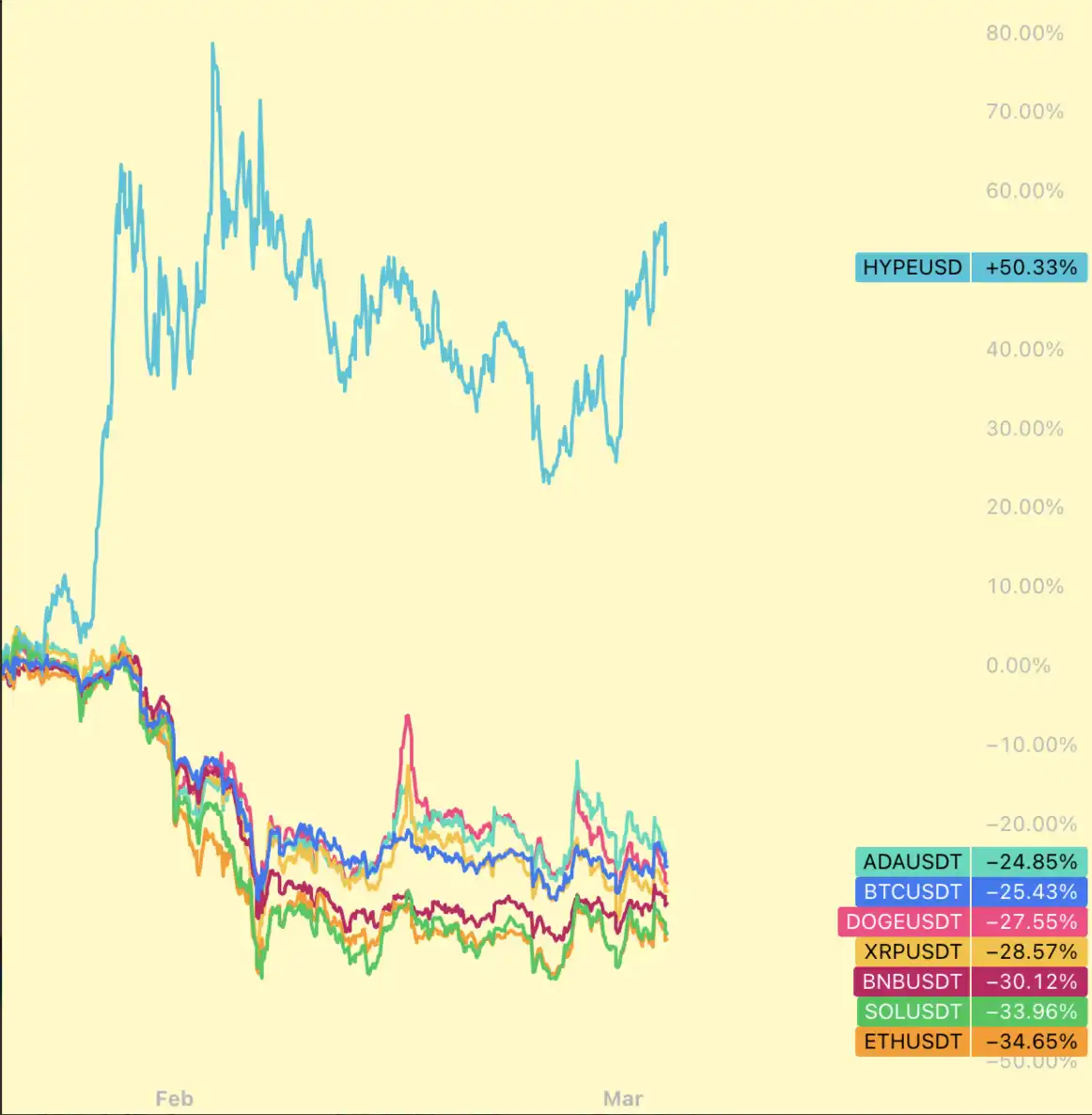
In late January, when silver broke $100 and gold broke $5500, the trading volume of silver-only contracts on the HIP-3 exchange tradexyz reached $1.2 billion, driving HYPE's 55% increase in three days, while Bitcoin only rose by 3% during that period.
Surge in Gold, Silver, and Copper Contract Trading Volume onTrade.xyz Since January
The Tokenomics explained the reason behind the HYPE surge. Hyperliquid's HIP-3 protocol dictates that 50% of all fee revenue generated by HIP-3 exchanges flows into the Hyperliquid Official Aid Fund for HYPE buybacks. Macro volatility drives up trading volume, increasing the buyback size, creating strong buying pressure for the HYPE token.
Fee Revenue Generated by HIP-3 Exchanges on
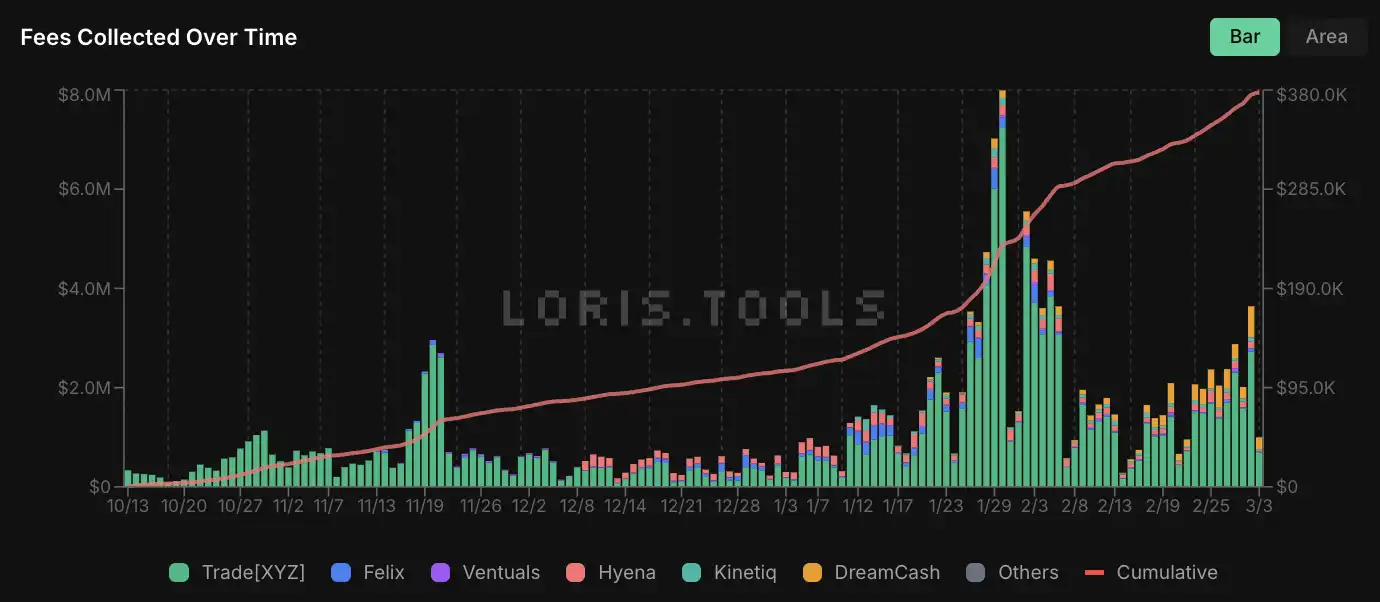
HYPE holders are not only betting on Hyperliquid's growth as an offshore Perp DEX but also on longing geopolitical uncertainty.
Hyperliquid is just the clearest expression of this narrative so far, and the market is finally starting to reflect that.
Discrepancy
Nevertheless, on-chain derivatives still have a ways to go to meet traditional institutional standards.
Hyperliquid's current edge lies in small to medium-sized retail orders. According to Blockworks Research, during normal trading hours, its Silver contract's spread is comparable to the COMEX micro contract. However, the depth discrepancy is significant. COMEX has a $13 million order book depth within ±5 bps, whereas Hyperliquid has only around $230k.
COMEX vs. Hyperliquid Order Book Depth Comparison
Source: Blockworks Research
In extreme market sell-offs, on-chain liquidity suffers from greater tail risks. 1% of Hyperliquid's Silver trades experience a slippage of over 50 bps, while COMEX still offers better execution costs in such scenarios.
COMEX vs. Hyperliquid Execution Slippage Comparison
Source: Blockworks Research
Currently, Hyperliquid's liquidity and funding rate model cannot yet meet the needs of large funds. To compete at an institutional level, on-chain platforms need to address KYC issues and may even need to establish technical and collaborative frameworks that match traditional clearing institutions. Many industry participants still believe that if the Chicago Mercantile Exchange (CME) were to launch 24/7 trading, it would have a natural hedging advantage and trust foundation.
However, the traditional financial market's reliance on a risk control model based on physical closure times has indeed shown its limitations. The ability to continuously price risk without waiting for Monday's opening is a core value proposition of offshore exchanges like Hyperliquid.
The transfer of market pricing power to the blockchain will be a long process. But we must dare to dream — just in case it comes true.
You may also like

The large models in the United States are moving towards closure in the name of security

Morning Report | CoinEx becomes a key hub for Iran to evade sanctions, involving over $3.8 billion in funds; Kalshi seeks a new round of financing, with a valuation potentially rising to $40 billion

From the white-haired stock god to the billionaire fund mogul, the smart people shorting Nvidia are all getting rich using the same framework

Why do cryptocurrency projects always like to change their names?

Global Launch: As predictions become the most scarce asset in the AI era, Manadia is defining the next generation of the value internet

Who is footing the bill for the $64 billion accounting frenzy?
I never expected that the first application of AI x Crypto would be in security auditing

What is your view on Binance's competitive advantages?

ETH has entered a non-consensus phase, and the turning point is approaching!
The shift in the cloud of the air: from despising stablecoins a year ago to the high-profile entry of capital today
The survival dilemma of small and medium exchanges behind the withdrawal anomalies exposed by AscendEX
Why Is Bitcoin Falling Below $60K? 5 Key Market Drivers Explained
Bitcoin has dropped sharply amid ETF outflows, Strategy stock weakness, AI stock rallies, and changing Fed expectations. Explore the key forces driving BTC’s latest correction and what traders should watch next.

Bitcoin vs. Gold in 2026: Which Asset Performs Better in Different Markets?

Morning News | The draft amendment to the People's Bank of China Law aims to clarify the legal status of digital renminbi; South Korea will transfer about 40 unregistered virtual asset service providers to law enforcement agencies
The cryptocurrency industry has entered the "Show Me" era: merely relying on vision is no longer enough

Interpreting the Ethereum Foundation's new structure: Reaffirming self-sovereignty amid institutional trends
Former SpaceX engineer reconstructs the financial execution system using first principles
Standard Chartered Bank sings a 50x rhapsody again, aiming for AAVE to reach 3500 USD
The large models in the United States are moving towards closure in the name of security
Morning Report | CoinEx becomes a key hub for Iran to evade sanctions, involving over $3.8 billion in funds; Kalshi seeks a new round of financing, with a valuation potentially rising to $40 billion
From the white-haired stock god to the billionaire fund mogul, the smart people shorting Nvidia are all getting rich using the same framework
Why do cryptocurrency projects always like to change their names?
Global Launch: As predictions become the most scarce asset in the AI era, Manadia is defining the next generation of the value internet
Who is footing the bill for the $64 billion accounting frenzy?


