
Breaking $500 Again, Why Can ZEC Maintain an Independent Price Action from Bitcoin's Consolidation?



Original Article Title: Zcash: A Hedge Against BTC?
Original Article Author: Messari
Original Article Translation: Ding Dang, Odaily Planet Daily
Editor's Note: As Bitcoin continues to fluctuate between $80,000 and $90,000, the market's attention may still be mostly focused on Bitcoin itself. However, the representative asset of the privacy track, ZEC, has once again shown independent price movement, breaking through $500, currently trading at $518. Starting from a recent low point, the price has increased by nearly 40%. What's more contrasting is that ZEC was once listed as a candidate for delisting in the Binance vote, but it saw its own breakout moment in late 2025, with its price surging nearly 13x.
This shift from an "edgy asset" to being "revalued by the market" has raised a more intriguing question: Is ZEC's rise merely a short-term emotional and fund concentration-driven manipulation, or is privacy as a monetary attribute being systematically reassessed? Messari, from various dimensions such as monetary attributes, regulatory environment, and structural changes in Bitcoin, tries to explain why ZEC has been rediscovered by the market at this particular time. The following content is excerpted from "The Crypto Theses 2026" published by @MessariCrypto.

Among all cryptocurrencies outside of BTC and ETH, ZEC saw the most significant shift in "2025 monetary attribute perception." For a long time, ZEC has been outside the "cryptocurrency's monetary hierarchy," seen as a niche privacy coin rather than a true monetary asset. However, as concerns about financial surveillance escalated and Bitcoin accelerated toward institutionalization, privacy was re-recognized by the market as a core monetary attribute, no longer just the preference of a few geeks or ideological groups.
Bitcoin has proven that non-sovereign digital currencies can operate on a global scale; but it did not retain the privacy attributes people had long been accustomed to when using physical cash. Every transaction is broadcasted onto a fully transparent public ledger, allowing anyone to track and analyze transactions using a block explorer. This irony is profound: a tool intended to weaken state control inadvertently built up a financial "panoptic prison."
Using zk-SNARKs, Zcash combines Bitcoin's monetary policy with the privacy attributes of physical cash. Within the current digital asset system, no asset can provide battle-tested, deterministic privacy guarantees like the latest version of the Zcash privacy pool. This makes ZEC an extremely difficult-to-replicate form of "private money."
We believe that the market is reevaluating ZEC relative to BTC based on this feature — considering it as an "ideal form of private cryptocurrency" and positioning it as a hedge tool against the rise of surveillance-oriented nations and the institutionalization process of Bitcoin.
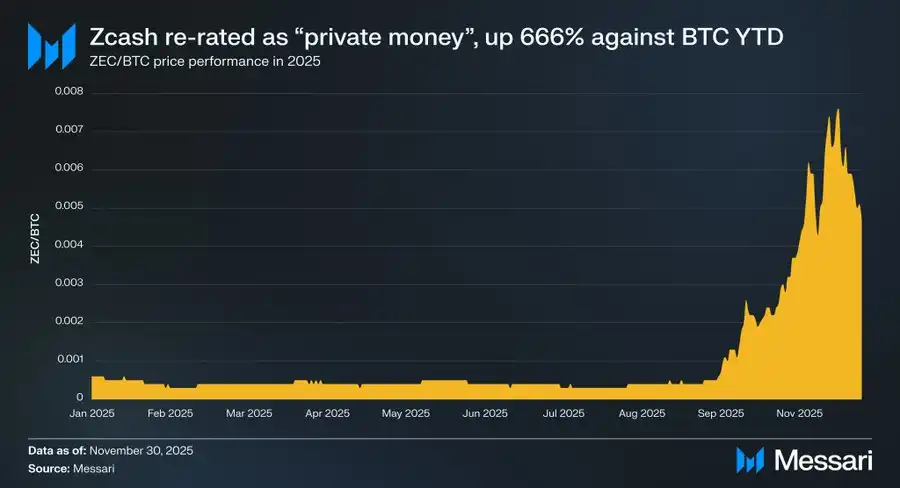
Year-to-date, ZEC has surged by 666% against BTC, reaching a market cap of around $7 billion and briefly surpassing XMR in market capitalization, becoming the highest-valued privacy coin. This relative strength indicates that the market is now viewing ZEC alongside XMR as viable forms of private cryptocurrency.
Privacy on Bitcoin: A Nearly Impossible Path
It is nearly impossible for Bitcoin to introduce a privacy pool architecture similar to Zcash at the protocol level; therefore, the assertion that "Bitcoin will eventually absorb Zcash's value proposition" does not hold.
The Bitcoin community is known for its highly conservative technical culture, prioritizing the hardening of mechanisms to minimize attack surfaces and maintain the integrity of the monetary system. Introducing privacy features at the protocol level would require modifications to Bitcoin's core architecture, introducing potential inflation vulnerability risks that could threaten its core monetary credibility. For Zcash, this risk is acceptable as privacy itself is its core value proposition.
Furthermore, integrating zero-knowledge cryptography at the base layer would significantly reduce the scalability of the blockchain. To prevent double spending, nullifiers and hashed notes structures must be used, leading to long-term concerns about "state growth." Nullifiers essentially form a list that only grows over time, potentially causing a substantial rise in the resource costs for running nodes. If nodes are forced to store an ever-expanding set of nullifiers, Bitcoin's decentralization would be substantially compromised as the barrier to entry for running nodes would continually increase over time.
As mentioned earlier, in the absence of a soft fork that supports ZK proofs (e.g., OP_CAT), no Bitcoin Layer 2 solution can achieve Zcash-level privacy while inheriting Bitcoin's security. You either introduce trusted intermediaries (such as consortium structures), accept long and highly interactive withdrawal delays (such as the BitVM model), or outright outsource execution and security to an independent system (such as Sovereign Rollup).
Until this paradigm shifts, there is no path that simultaneously addresses Bitcoin's security and Zcash's privacy. This is also the fundamental reason why ZEC, as a privacy cryptocurrency, holds unique value.
Privacy Hedge Tool Against CBDCs
The urgency of privacy needs has been further amplified against the backdrop of central bank digital currencies (CBDCs) being introduced by various countries. Currently, about half of the world's countries are researching or have already launched CBDCs.
The core feature of CBDCs is their "programmability": the issuer can not only track every transaction but also directly control how funds are used, when they are used, and where they are used. Funds can even be restricted to only be valid at specific merchants or within a particular geographic area.
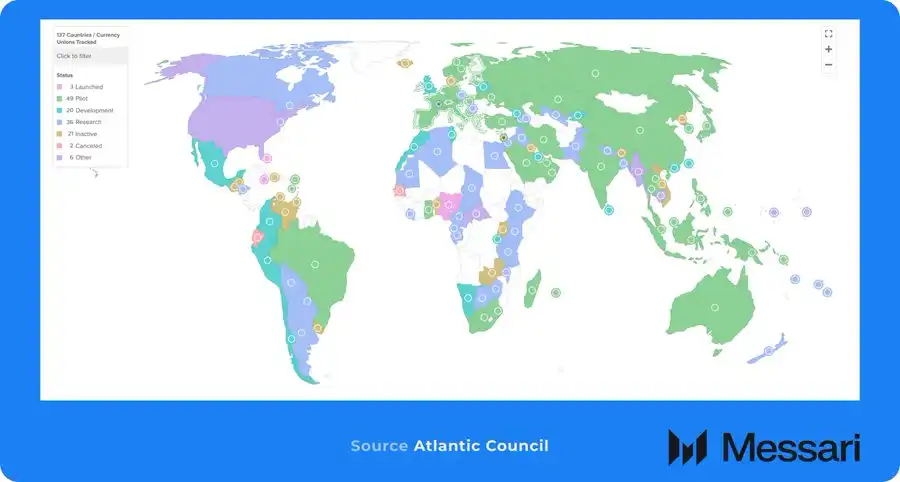
This is not a dystopian fantasy but a reality that has already occurred:
· Nigeria (2020): During the EndSARS protests against police brutality, the Central Bank of Nigeria froze bank accounts of multiple protest organizers and feminist groups, forcing the movement to rely on cryptocurrency to sustain operations.
· United States (2020–2025): Regulatory bodies and major banks, citing "reputational risk," derisked a series of legal but politically unpopular industries. This issue escalated to the extent of a White House-ordered investigation, and the OCC's 2025 research report documented systematic restrictions on the oil and gas, firearms, adult content, and crypto industries.
· Canada (2022): During the "Freedom Convoy" protests, the Canadian government invoked the Emergencies Act to freeze protesters' and small donors' bank and crypto accounts without court order. The Royal Canadian Mounted Police even blacklisted 34 self-custodied crypto wallet addresses, requiring all regulated exchanges to cease transactions with them. This event clearly demonstrates that Western democratic nations are also willing to weaponize the financial system to suppress political dissent.
In an era where "money can be programmed to control you," ZEC provides a clear "exit mechanism." However, the meaning of Zcash is not limited to escaping CBDCs; it is becoming increasingly important for protecting Bitcoin itself.
Mechanism Against Bitcoin's "Co-Option"
As emphasized by individuals such as Naval Ravikant and Balaji Srinivasan, Zcash is fundamentally an insurance policy to maintain Bitcoin's financial freedom vision.
Bitcoin is rapidly centralizing towards a single entity: centralized exchanges hold about 3 million BTC, ETFs hold about 1.3 million BTC, and publicly traded companies hold about 829,000 BTC. This totals approximately 5.1 million BTC (24% of the total supply), currently held by third-party custody providers.

This means that approximately a quarter of the BTC's total supply is theoretically at risk of being seized by regulators. This structure closely resembles the centralization conditions during the U.S. government's gold confiscation in 1933. Back then, the U.S. government issued Executive Order 6102, mandating citizens to surrender gold reserves over $100 and exchanging it for a fixed price in currency through the banking system without relying on violence.
For Bitcoin, the path is eerily similar. Regulators don't need to hold your private keys; they just need legal jurisdiction over the custodian. Once the government issues enforcement orders to institutions like BlackRock or Coinbase, these companies are legally obligated to freeze and hand over the held BTC. Without changing a single line of code, nearly a quarter of the BTC's supply could be "nationalized" overnight.
Furthermore, in a blockchain of high transparency, self-custody is no longer a sufficient defense mechanism. Any BTC withdrawn from a KYC exchange or brokerage account leaves a traceable "paper trail."
BTC holders can opt to convert to Zcash to sever this custodial and regulatory link, achieving wealth "air gap." Once funds enter Zcash's privacy pool, their destinations become a cryptographic "black hole" to observers. Regulators can see funds leaving the Bitcoin network but cannot ascertain their final destinations. Of course, the strength of this anonymity entirely depends on operational security: address reuse, acquiring assets through KYC exchanges will permanently link before entering a privacy pool.
The Path to Product-Market Fit is Being Paved
The demand for privacy coins has always been there, but Zcash has struggled to "reach the user." Historically, high memory consumption, long proof times, and complex desktop configurations have made private transactions slow and deterred ordinary users. Recent breakthroughs at the infrastructure level have systematically removed these barriers.
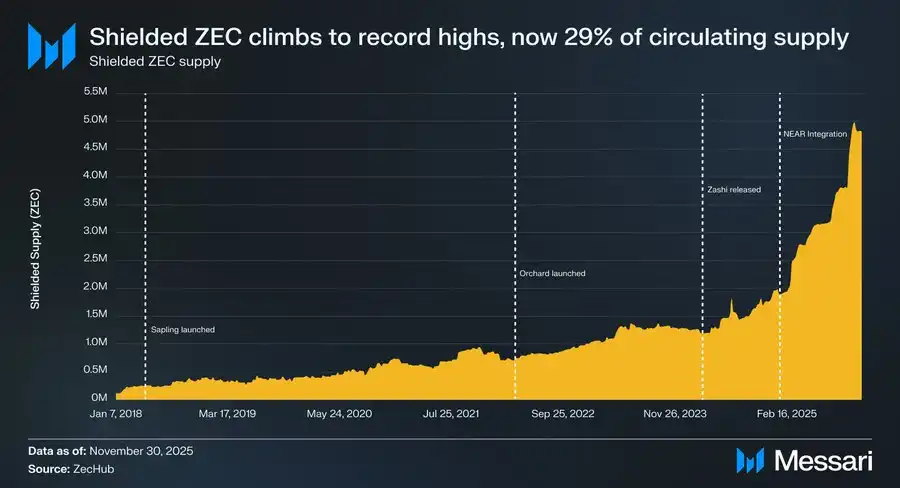
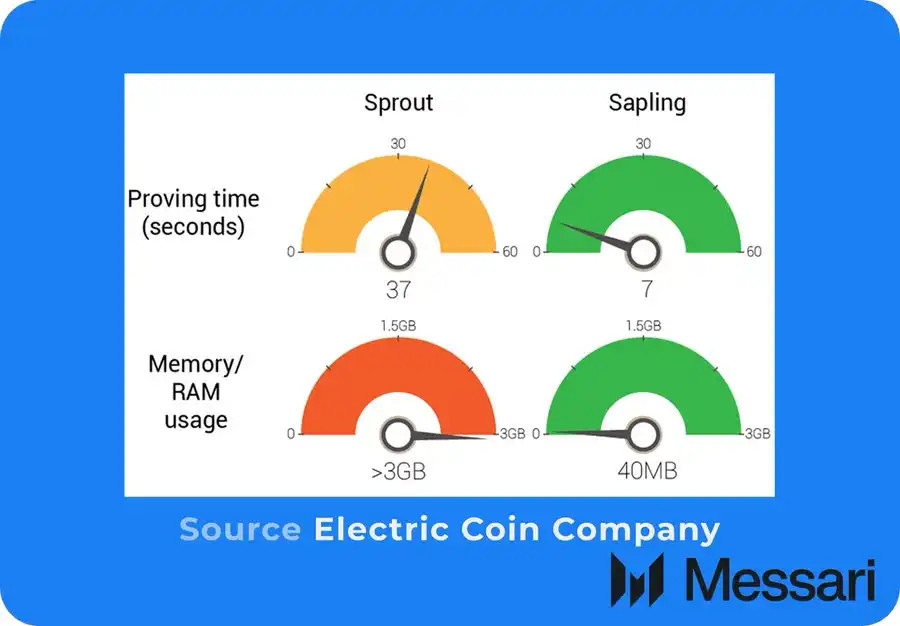
The Sapling upgrade reduced memory requirements by 97% (to about 40MB), reduced proving time by 81% (about 7 seconds), enabling private transactions on mobile.
While Sapling addressed speed, trusted setup remained a focus of the privacy community. Subsequently, Orchard, by introducing Halo 2, completely eliminated the reliance on trusted setup, and introduced Unified Addresses, integrating transparent and private addresses into a single point of entry, significantly reducing user cognitive load.
These improvements ultimately led to the release of the Zashi mobile wallet in March 2024. Leveraging the abstract design of Unified Addresses, Zashi simplified the operation of private transactions to a few clicks on the screen, making "privacy" the default experience.
After addressing UX issues, distribution became the final hurdle. Users still relied on centralized exchanges to deposit and withdraw ZEC to their wallets. The integration of NEAR Intents eliminated this reliance, allowing users to directly exchange BTC, ETH, and other assets for shielded ZEC, even making private ZEC payments to any address on 20 chains.
These measures collectively helped Zcash overcome historical friction, tap into global liquidity, and align with real market needs.
Future Outlook
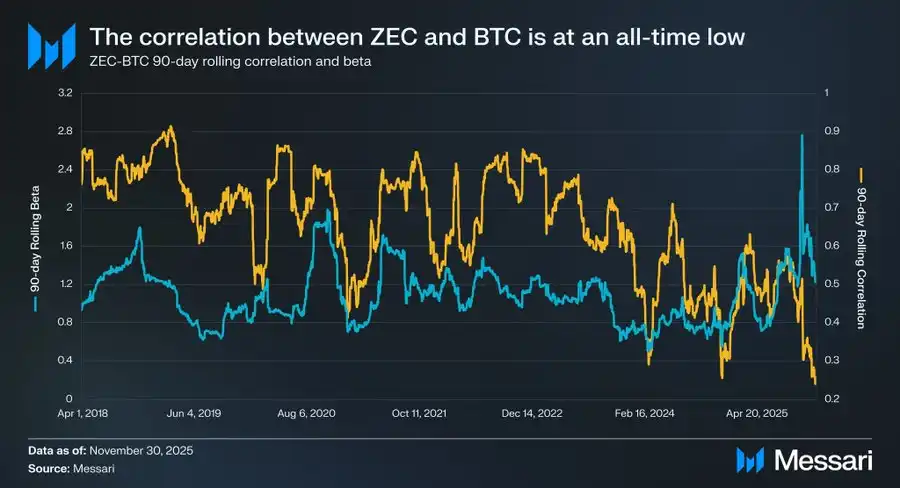
Since 2019, ZEC's rolling correlation with BTC has steadily declined, from 0.90 to a recent 0.24; meanwhile, ZEC's rolling Beta to BTC has risen to a historical high. This divergence indicates that the market is assigning an independent premium to Zcash's privacy features.
We do not believe that ZEC will surpass BTC. Bitcoin has established itself as the most reliable cryptocurrency based on its transparent supply and auditability, whereas Zcash, as a privacy coin, inevitably faces the trade-off between privacy and auditability.
However, ZEC can carve out its own niche without displacing BTC. They do not address the same issue but play different roles in the cryptocurrency ecosystem: BTC is an "robust cryptocurrency" optimized for transparency and security, while ZEC is a "privacy cryptocurrency" born for privacy and confidentiality.
In this sense, ZEC's success does not depend on beating Bitcoin, but on complementing the part of Bitcoin's deliberately abandoned attributes.
You may also like

Fortune Warns of Strategy’s Financing Structure Risks as Bitcoin Premium Narrows
Fortune warned that Strategy’s Bitcoin treasury model faces growing financing risks as MSTR’s net asset premium narrows and preferred stock dividend pressure increases.

Ferrari Challenge Le Mans: Carl Moon to Dominate in WEEX Livery

Sahara AI Responds to SAHARA’s Sharp Drop: No Contract or Product Security Issues Found, Internal Investigation Underway
Sahara AI responded to SAHARA’s 60% price drop, saying no token contract or product security issues have been found and an internal investigation is underway.

WEEX Deposit/Withdrawal Dynamic Island: Your Asset Status, Always in Sight

Scaling Crypto Derivatives: The Digital Asset Infrastructure Behind High-Volume Trading
In the fast-moving digital asset ecosystem, derivatives platforms face an extreme architectural test. High-leverage futures markets demand more than just standard security—they require absolute operational precision, zero-latency matching engines, and ironclad structural scalability, all while navigating intense market volatility.
As global platforms scale to meet these demands, the industry is shifting away from rigid, monolithic setups toward a more agile, "decoupled" infrastructure philosophy.
The Blueprint for High-Volume Copy TradingFor elite global exchanges like WEEX (founded in 2018), this architectural choice becomes critical when scaling high-volume retail features like social copy trading. When thousands of users automatically mirror the real-time strategies of elite traders simultaneously, it triggers sudden, monumental spikes in concurrent transactional volume.
To prevent execution latency or settlement bottlenecks during these peak volatility events, a platform's primary engine must remain entirely dedicated to risk management, copy-trade synchronization, and order matching.
The Architectural Rule: New-generation platforms must separate front-end user execution engines from heavy backend infrastructural overhead to eliminate operational friction.
By separating these layers, platforms can maintain complete sovereignty over their trading environments and user experiences while strategically aligning with institutional-grade infrastructure ecosystems. This strategic framework allows modern exchanges to leverage advanced Digital Asset Custody infrastructure such as Cobo’s behind the scenes, ensuring that backend wallet management scales elastically alongside trading spikes.
Capitalizing on Market Momentum and 400× LeverageIn a derivatives arena where platforms offer up to 400× leverage on perpetual contracts, capital efficiency and market agility are core business metrics. To capture market momentum, an exchange needs the ability to rapidly expand its asset offerings, supporting everything from legacy crypto assets to sudden, trending altcoins across a massive library of trading pairs.
Adopting a flexible, scalable Wallet-as-a-Service (WaaS) solution such as Cobo’s could completely rewrite the development timeline for high-growth exchanges. Instead of spending months of engineering capital building out custom backend wallet architectures for every new blockchain network, platforms can deploy localized infrastructure in days.
This agility allows platforms to instantly scale their listings to over a thousand trading pairs without compromising security or delaying time-to-market. It mirrors the exact operational advantages seen during high-velocity market events, similar to how advanced wallet infrastructure empowers platforms during sudden asset surges; allowing exchanges to pass that speed and liquidity directly to their global user base.
A Mature Foundation for GrowthThe synergy between trusted infrastructure ecosystems and global trading platforms represents the natural evolution of a maturing crypto market. As WEEX continues to scale its global spot and derivatives offerings for over 6 million users, adopting robust backend paradigms proves that platforms no longer have to compromise between cutting-edge trading velocity and uncompromised structural security.

Morning Report | BitMine increased its holdings by 126,971 ETH last week; trader Eugene announced his exit from the crypto market

Wang Chuan: How can one not feel anxious after the neighbor Old Wang made thirty times profit by investing in storage stocks? (Seven) - A quarter-century cycle

Get Paid to Onboard? Try WEEX’s New Homepage with Rewards for Registration, Deposit & Trade
WEEX Custom Layout: Build Your Perfect Trading Workspace in Seconds

See “Buy Walls” & “Sell Walls” Instantly: WEEX Launches the Depth Chart for Smarter Trades

What Is Quick Trade on WEEX? 2 Ways WEEX Ends Chart-Panel Jumping
Morning News | Five major virtual asset platforms in South Korea have experienced 57 incidents of hacking and system failures in six years; Grayscale submits registration application for Canton ETF

Should we escape the peak? The principle of the tail-end market in the stock market

RootData: May 2026 Cryptocurrency Exchange Transparency Research Report

Founder of Baixing.com: My Experience with Claude Code in Fourteen Points

Yang Ge Gary: Agent Economics and AI Microeconomics
When reasoning becomes a scarce resource, who captures its value?

Jensen Huang dramatically "rescues" the South Korean stock market
Fortune Warns of Strategy’s Financing Structure Risks as Bitcoin Premium Narrows
Fortune warned that Strategy’s Bitcoin treasury model faces growing financing risks as MSTR’s net asset premium narrows and preferred stock dividend pressure increases.
Ferrari Challenge Le Mans: Carl Moon to Dominate in WEEX Livery
Sahara AI Responds to SAHARA’s Sharp Drop: No Contract or Product Security Issues Found, Internal Investigation Underway
Sahara AI responded to SAHARA’s 60% price drop, saying no token contract or product security issues have been found and an internal investigation is underway.
WEEX Deposit/Withdrawal Dynamic Island: Your Asset Status, Always in Sight
Scaling Crypto Derivatives: The Digital Asset Infrastructure Behind High-Volume Trading
In the fast-moving digital asset ecosystem, derivatives platforms face an extreme architectural test. High-leverage futures markets demand more than just standard security—they require absolute operational precision, zero-latency matching engines, and ironclad structural scalability, all while navigating intense market volatility.
As global platforms scale to meet these demands, the industry is shifting away from rigid, monolithic setups toward a more agile, "decoupled" infrastructure philosophy.
The Blueprint for High-Volume Copy TradingFor elite global exchanges like WEEX (founded in 2018), this architectural choice becomes critical when scaling high-volume retail features like social copy trading. When thousands of users automatically mirror the real-time strategies of elite traders simultaneously, it triggers sudden, monumental spikes in concurrent transactional volume.
To prevent execution latency or settlement bottlenecks during these peak volatility events, a platform's primary engine must remain entirely dedicated to risk management, copy-trade synchronization, and order matching.
The Architectural Rule: New-generation platforms must separate front-end user execution engines from heavy backend infrastructural overhead to eliminate operational friction.
By separating these layers, platforms can maintain complete sovereignty over their trading environments and user experiences while strategically aligning with institutional-grade infrastructure ecosystems. This strategic framework allows modern exchanges to leverage advanced Digital Asset Custody infrastructure such as Cobo’s behind the scenes, ensuring that backend wallet management scales elastically alongside trading spikes.
Capitalizing on Market Momentum and 400× LeverageIn a derivatives arena where platforms offer up to 400× leverage on perpetual contracts, capital efficiency and market agility are core business metrics. To capture market momentum, an exchange needs the ability to rapidly expand its asset offerings, supporting everything from legacy crypto assets to sudden, trending altcoins across a massive library of trading pairs.
Adopting a flexible, scalable Wallet-as-a-Service (WaaS) solution such as Cobo’s could completely rewrite the development timeline for high-growth exchanges. Instead of spending months of engineering capital building out custom backend wallet architectures for every new blockchain network, platforms can deploy localized infrastructure in days.
This agility allows platforms to instantly scale their listings to over a thousand trading pairs without compromising security or delaying time-to-market. It mirrors the exact operational advantages seen during high-velocity market events, similar to how advanced wallet infrastructure empowers platforms during sudden asset surges; allowing exchanges to pass that speed and liquidity directly to their global user base.
A Mature Foundation for GrowthThe synergy between trusted infrastructure ecosystems and global trading platforms represents the natural evolution of a maturing crypto market. As WEEX continues to scale its global spot and derivatives offerings for over 6 million users, adopting robust backend paradigms proves that platforms no longer have to compromise between cutting-edge trading velocity and uncompromised structural security.
Morning Report | BitMine increased its holdings by 126,971 ETH last week; trader Eugene announced his exit from the crypto market


