
Economic Fault Lines Deepen, Bitcoin Could Become the Next Liquidity "Release Valve"


Original Title: The Two-Tier K-Shaped Economy
Original Author: arndxt
Original Translation: AididiaoJP, Foresight News
The U.S. economy has split into two worlds: one side sees a thriving financial market, while the other side experiences a slow decline in the real economy.
The Manufacturing PMI Index has been contracting for over 18 months, marking the longest record since World War II, yet the stock market continues to rise as profits become increasingly concentrated in tech giants and financial companies. (Note: The full name of "Manufacturing PMI Index" is "Purchasing Managers' Index for Manufacturing" and it serves as a barometer of the manufacturing sector's health.)
This is essentially an "asset price inflation."
Liquidity continues to drive up prices of similar assets, while wage growth, credit creation, and small business vitality remain stagnant.
The result is an economic divide, where in recovery or economic cycles, different sectors move in completely opposite directions:
On one side: capital markets, asset holders, the tech industry, and large corporations surge rapidly (profits, stock prices, wealth).
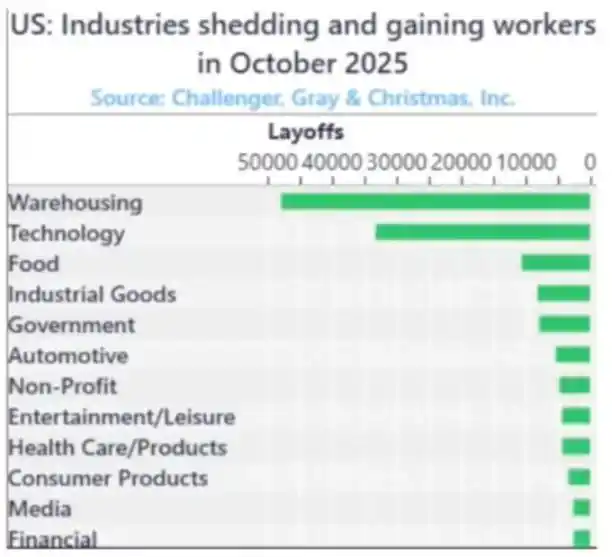
On the other side: the working class, small businesses, blue-collar industries → decline or stagnation.
Growth and distress coexist.
Policy Failure
Monetary policy has been unable to truly benefit the real economy.
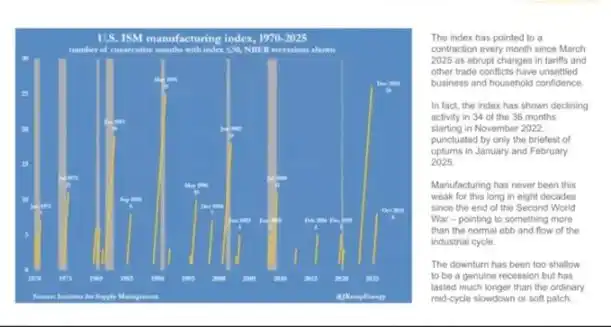
The Federal Reserve's interest rate cuts have pushed up stock and bond prices but have not brought about new employment and wage growth. Quantitative easing has made it easier for large corporations to borrow money but has not aided in small business development.
Fiscal policy is also reaching its limits.
Today, nearly a quarter of government revenue is solely used to pay interest on national debt.
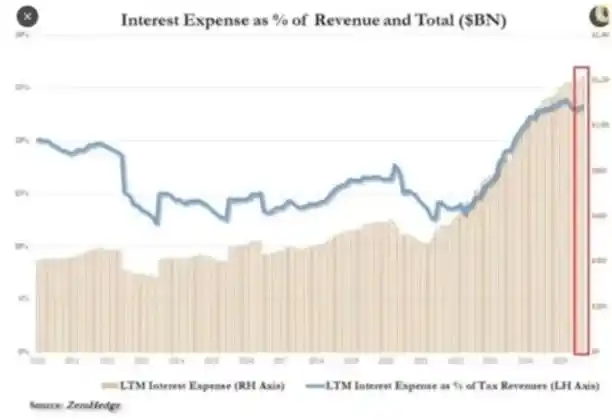
Policymakers are thus caught in a dilemma:
Tighten policies to combat inflation, and the market stagnates; loosen policies to stimulate growth, and prices rise again. This system has entered a self-reinforcing cycle: any attempt to deleverage or reduce the balance sheet will impact the very asset values it relies on for stability.
Market Structure: Efficient Harvesting
Passive fund flows and high-frequency data arbitrage have turned the public market into a closed-loop liquidity machine.
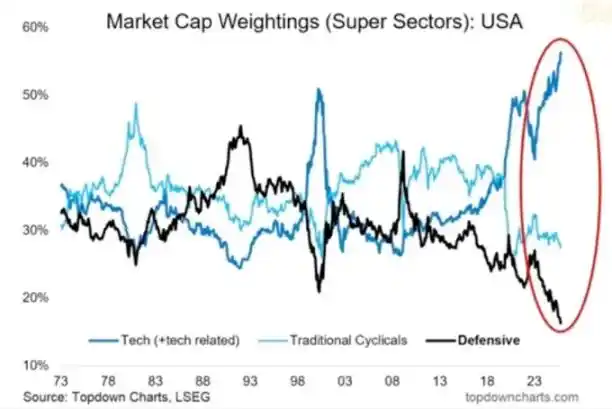
Positioning and volatility provisioning are more important than fundamentals. Retail investors have effectively become counterparties to institutions. This explains why defensive sectors have been abandoned, tech stock valuations have skyrocketed, market structure rewards chasing momentum, not value.
We have created a market with extremely high price efficiency but very low capital efficiency.
The public market has become a self-reinforcing liquidity machine.
Funds flow automatically → through index funds, ETFs, and algorithmic trading → creating sustained buying pressure, regardless of fundamentals.
Price changes are driven by fund flows, not value.
High-frequency trading and systematic funds dominate daily trading, with retail investors effectively standing on the other side of trades. Stock movements depend on positioning and volatility mechanisms.
Hence, tech stocks continue to expand, while defensive sectors lag behind.
Backlash: The Political Cost of Liquidity
The wealth created in this cycle is concentrated at the top.
The richest 10% of the population hold over 90% of financial assets, as the stock market rises, wealth inequality grows. Policies that drive asset prices higher also erode the purchasing power of the majority.
With no real wage growth, housing unaffordability, voters will eventually seek change, either through wealth redistribution or political upheaval. Both exacerbate fiscal pressures and drive inflation.
For policymakers, the strategy is clear: maintain abundant liquidity, boost the market, claim economic recovery. Substitute substantive reform with surface-level prosperity. The economy remains fragile, but at least the data can hold up until the next election.
Cryptocurrency as a Pressure Valve
Cryptocurrency is one of the few areas that doesn't rely on banks or governments but can still hold and transfer value.
The traditional market has become a closed system, with large capital taking most of the profits through private placements even before listing. For the younger generation, Bitcoin is no longer just speculation but an opportunity for participation. When the entire system seems manipulated, at least there is opportunity here.
While many retail investors have been hurt by overvalued tokens and VC sell-offs, the core demand remains strong: people crave an open, fair, self-sovereign financial system.
Outlook
The U.S. economy is caught in a “reflex” cycle: tightening → recession → policy panic → easing → inflation → rinse and repeat.
2026 may usher in the next round of loose monetary policy as growth slows and deficits widen. The stock market will briefly party, but the real economy won’t truly improve unless capital shifts from asset propping to productive investment.
Currently, we are witnessing the late-stage form of a financialized economy:
· Liquidity masquerading as GDP
· Markets being used as a policy tool
· Bitcoin serving as a societal pressure valve
As long as the system continues to loop debt into asset bubbles, we will not achieve a genuine recovery, only a slow stagnation masked by nominal upticks.
You may also like

How much longer can Ethereum's last big buyer hold on?

The pricing controversy of Trade.xyz exposes the fatal weakness of Pre-IPO perpetual contracts

World Cup 2026 Coming – WEEX Celebrates with $1M Prize Pool & Michael Owen Live

Galaxy in-depth report: Is Solana still worth paying attention to?
Young people in South Korea make a "final effort" in the epic bull market

Dialogue with OmenX Founder: Why does the prediction market need an evolution from "spot" to "derivatives"?
When the P2P illicit funds from ten years ago turned into 60,000 bitcoins

Morning News | CME Group launches Nasdaq Cryptocurrency Index futures; Asset management giant Janus Henderson strategically invests in Ethena
Why did Oracle deliver the strongest financial report in history, yet its stock price fell?

Bitcoin Layer 2 Network Botanix: Why Did We Choose to Dissolve?

Morning Report | OpenAI has submitted an S-1 registration statement draft to the U.S. SEC; Morpho completes $175 million financing

Galaxy Deep Research Report: How Hyperliquid's HIP-4 Upgrade Changes the Landscape of Prediction Markets?

Latest research from 13 top universities including Cornell University: The current state, challenges, and misconceptions of the fusion of Crypto and AI
Deconstructing Anthropic: The Best AI Company, Possibly Also a Type of Organizational Invention

Every exchange is a "Universal Exchange."

The counterattack of traditional finance: Alliance chains are quietly reviving
Pantera Capital Partner: How Tokenization is Restructuring the Private Equity and Early Investment Ecosystem?

Mastercard Launches Agent Pay for AI, Plans to Record AI Agent Payment Authorizations on Polygon
Mastercard launched Agent Pay for AI, a new payment protocol designed to help AI agents make small payments such as pay-per-use access to data and APIs. The system plans to record human-granted AI agent permissions on Polygon, focusing on verifiable authorization, identity, and payment controls.
How much longer can Ethereum's last big buyer hold on?
The pricing controversy of Trade.xyz exposes the fatal weakness of Pre-IPO perpetual contracts
World Cup 2026 Coming – WEEX Celebrates with $1M Prize Pool & Michael Owen Live
Galaxy in-depth report: Is Solana still worth paying attention to?
Young people in South Korea make a "final effort" in the epic bull market
Dialogue with OmenX Founder: Why does the prediction market need an evolution from "spot" to "derivatives"?


