
From the Pokémon Scandal to Doubling Trading Volume, Unveiling the Logic Behind Sui's Recent Strong Rally


Original Article Title: "The Multiple Catalysts Behind Sui's Surge: From Pokémon Collaboration Rumors to DEX Trading Volume Spike"
Original Source: PANews
Recently, the Sui governance token and its ecosystem have experienced a notable surge, with the SUI token itself increasing by over 75% in a week, far outperforming the market during the same period. Behind this phenomenon lies a complex interweaving of driving factors, including speculative enthusiasm triggered by market rumors, significant changes in fund flows, and ongoing improvements in the ecosystem's fundamentals. In this article, PANews delves into the funding trends, key news catalysts, on-chain data performance, and potential risks behind SUI's recent surge, aiming to comprehensively interpret the logic behind this ecosystem frenzy.
Exchange Hot Money Influx, Contract Holdings Surge
Looking at the on-chain fund flows in recent months, the changes in Sui's funds are not significant. Over a three-month period, Sui has seen a net outflow of $32 million, which is not a high amount. However, taking a closer look at the changes in on-chain fund flows over the past month and week, Sui's fund flows have changed very little and have not even made it into the top twenty on the public chain.
Nevertheless, there has been a noticeable influx of funds from exchanges into the Sui ecosystem. According to Coinglass data, in the last seven days, SUI's spot funding inflow reached $62.86 million, ranking fourth among all currencies, only behind USDT, ETH, and FUSD. In the past seven days, several Sui network ecosystem tokens such as WAL, MEMEFI, and CETUS have also ranked in the top ten for contract funding inflows, further reflecting the ecosystem's funding activity.
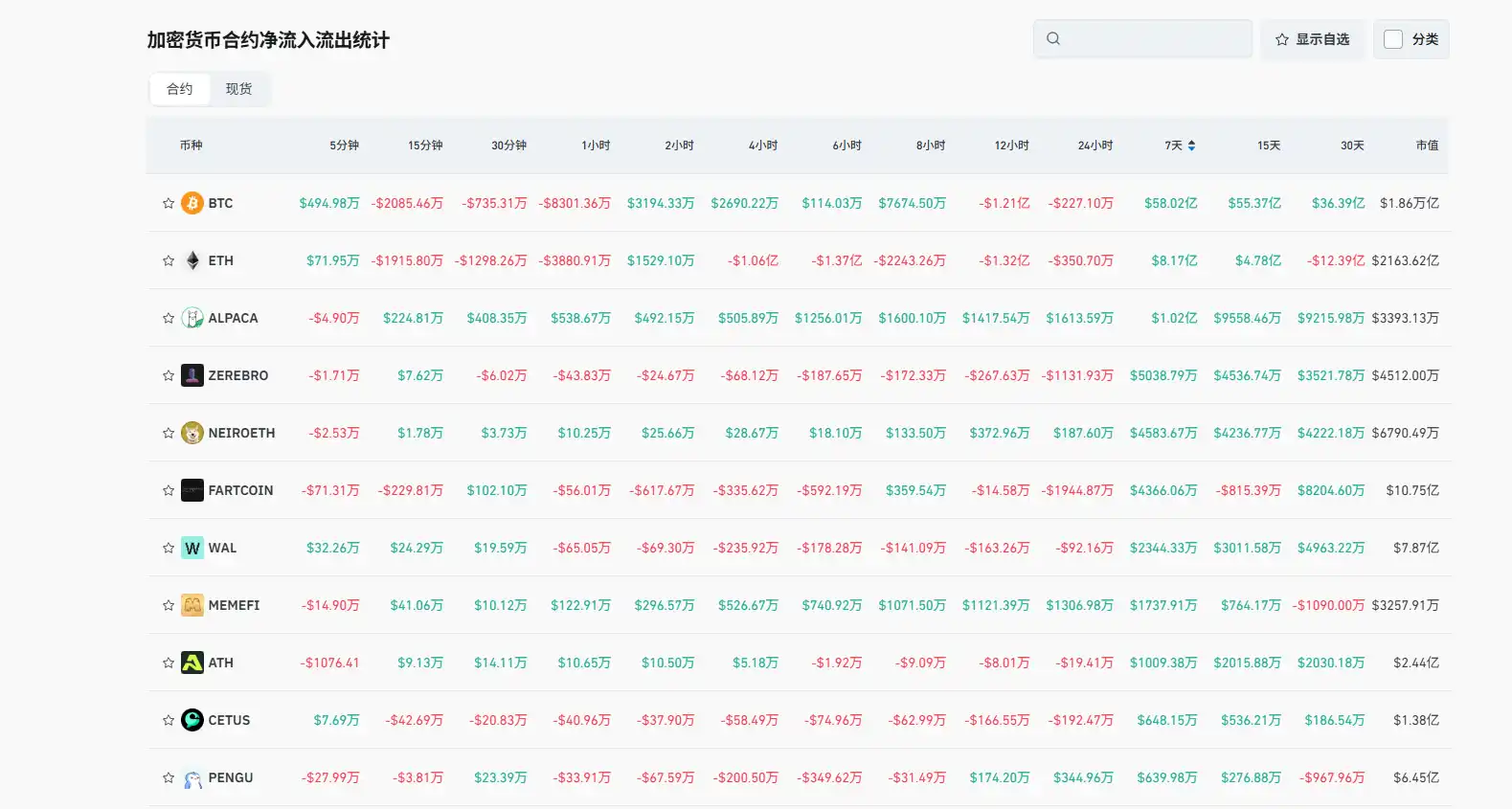
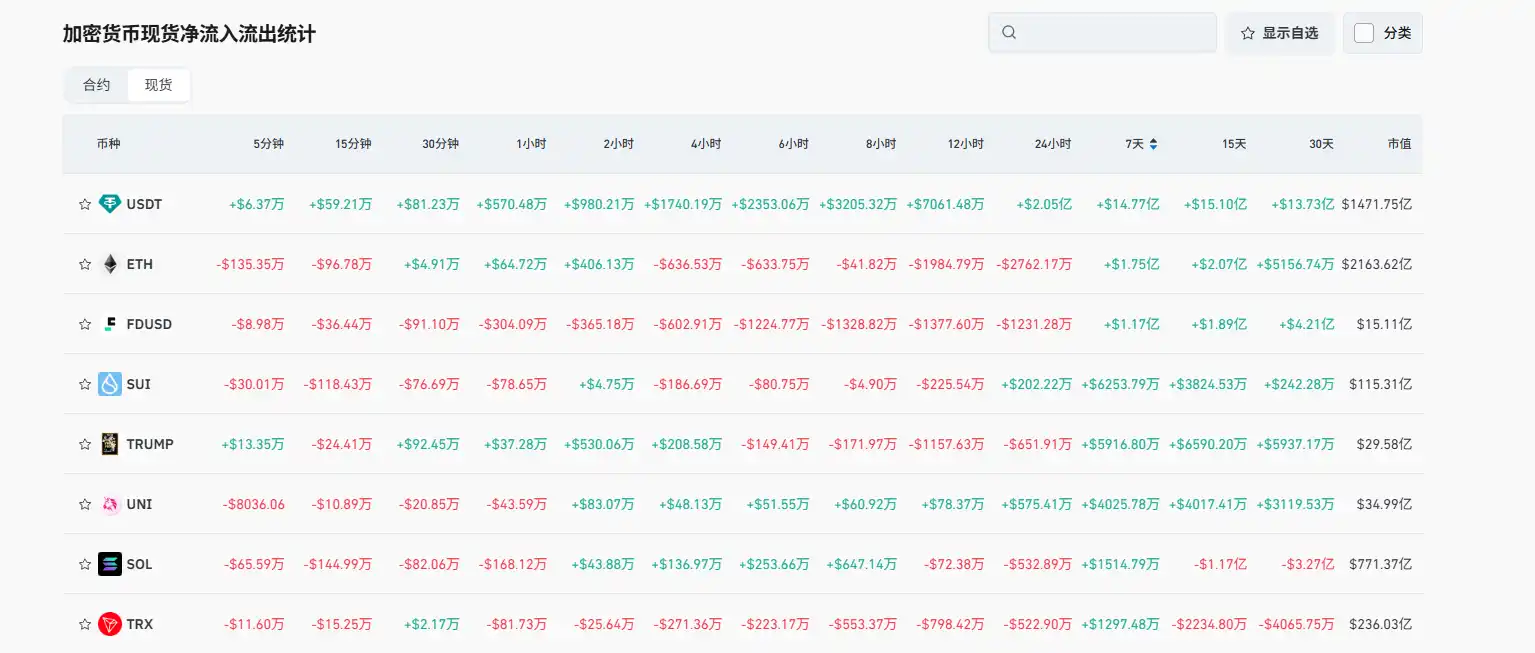
In terms of contract holdings data, the SUI token's holdings have experienced a sharp increase since April 21, doubling in just a week from $700 million to $1.419 billion, approaching the previous high of $1.5 billion.
In addition to SUI, most tokens in its ecosystem have also seen significant increases in the past week. Among the Sui ecosystem tokens listed on CoinGecko, 35 tokens have surged by over 100% in the past week, accounting for 20% of the Sui ecosystem projects. 37.5% of the tokens have surged by over 50%, indicating a widespread uptrend.
From a fund perspective, this surge represents a comprehensive collective rise across the Sui ecosystem. While most projects have not seen any actual positive developments, the price movements on the charts have been very apparent.
Multiple Catalysts Boost Market Sentiment
On April 21, almost all major tokens began a synchronous rebound, and Sui's initial rebound also started in line with the overall market trend, followed by a number of positive news releases. However, it is challenging to confirm whether these pieces of news were the true "engine" behind Sui's surge or just "smoke bombs" released to drive up the price.
On one hand, Sui saw several ecosystem partnership announcements. For example, the Pokémon collaboration rumor: This rumor originated on April 23, 2025, when the PokémonHOME app updated its privacy policy, listing "Parasol Technologies" as one of the authorized developers allowed to receive user data. Parasol Technologies is a blockchain gaming studio that was acquired by Sui's core development team Mysten Labs in March 2025. This direct connection quickly sparked the market's imagination, with crypto influencers and social media users speculating that Pokémon may be planning to integrate its IP into the Sui blockchain. The market narrative focused on potential NFT integration or blockchain-based collectibles, and it may even be related to the new "medal" feature launched on PokémonHOME.
It is worth noting that the official blog post from the Sui Foundation on April 23 about Parasol launching a trading card game on Sui did not mention Pokémon. However, some users claimed that an early version of this blog post did mention Pokémon NFTs but was later edited to remove the reference, further fueling market speculation.
Another example is the xMoney/xPortal collaboration: On April 24, Sui announced a partnership with the financial platform xMoney and the crypto super app xPortal. The core of this collaboration is to launch a Sui-branded virtual Mastercard in Europe, integrated within the xPortal app, which has 2.5 million users. Users can add this virtual card to ApplePay or GooglePay and use SUI and other cryptocurrencies to make payments at tens of thousands of merchants, similar to using cash. The physical card is planned to be released later in 2025.
On the other hand, the ETF narrative is also considered a key factor driving Sui's rise. Recently, news of 21Shares establishing the "SUI ETF" statutory trust entity circulated. This news is not actually new as, according to Delaware company registration information, the "21SHARES SUI ETF" statutory trust entity with registration number 10058451 was already established on January 7, 2025, with the registration type being a common law statutory trust. With this news being exposed recently, it also seems to have supported SUI's uptrend.
In addition, the Sui Network has also received a lot of positive news in the past month or two. For example, the Athens Stock Exchange Group announced on April 16 that they had completed the technical design of an on-chain fundraising platform on Sui; Nautilus launched a verifiable off-chain privacy solution for Sui on April 15; Canary Capital submitted an application for a SUI ETF, and so on.
Overall, the recent progress made by Sui in various areas such as Web3 games, privacy, and development environment has come together to form an overall positive outlook. At this point, it is different from the previous single news events that triggered spikes in the market.
Airdrop Event Drives DEX Trading Volume Surge, Facing Dual Pressure of Token Unlocking and Application Development
Since April, the DEX trading volume on the Sui Network has consistently remained at a high level, especially when it hit a historical peak of $9.98 billion on March 29, followed by several days of over $4 billion in daily trading volume. The ecosystem's leading DEX project, Cetus Protocol, drove the overall growth, with its trading volume growing by 84.5% in the past week, and the CETUS token almost doubling in a week.
Another significant contributor is Kriya, on the day when the Sui Network's trading volume broke the record on March 29, Kriya contributed $780 million, accounting for a significant share of the daily trading volume. This data represents a growth of over 100 times compared to the previous day's $7.28 million.
When combined, the surge in trading volume of these two DEXs on March 28 may have been primarily due to the spike in volume caused by Walrus's airdrop. On March 27, Walrus, a decentralized storage project that raised $140 million, conducted an airdrop, and the token's trading volume that day reached $380 million. This may have been a key factor in the recent increase in trading volume on the Sui Network.
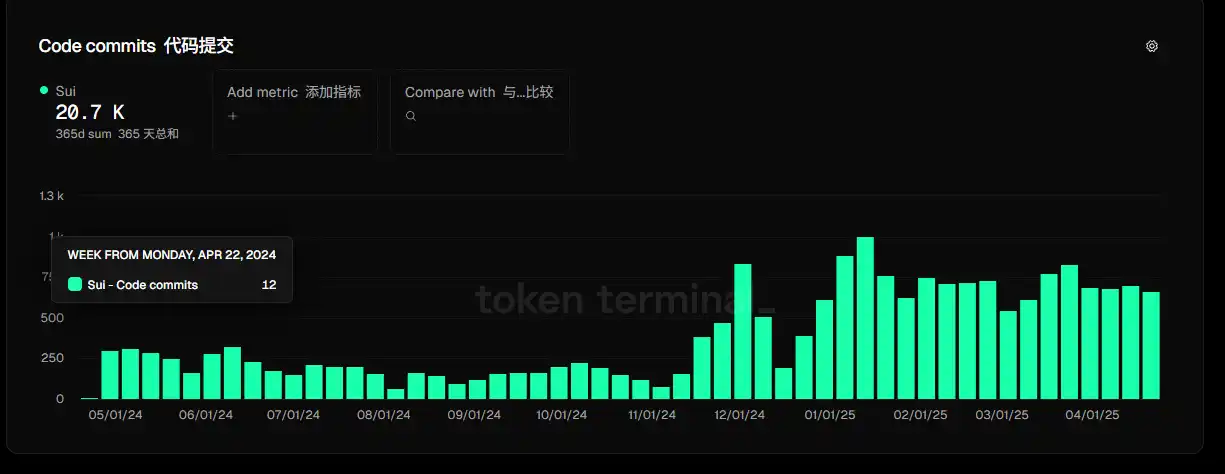
Additionally, developer activity is also one of the underlying reasons for Sui Network's growth. On GitHub, the Sui Network's code commits have been relatively frequent recently. Starting from December 2024, the frequency of Sui Network's code commits reached a peak, mostly maintaining over 500 times per week, whereas this data used to be around 250 times. For comparison, Solana and Aptos' code commit frequency is mostly around 100.
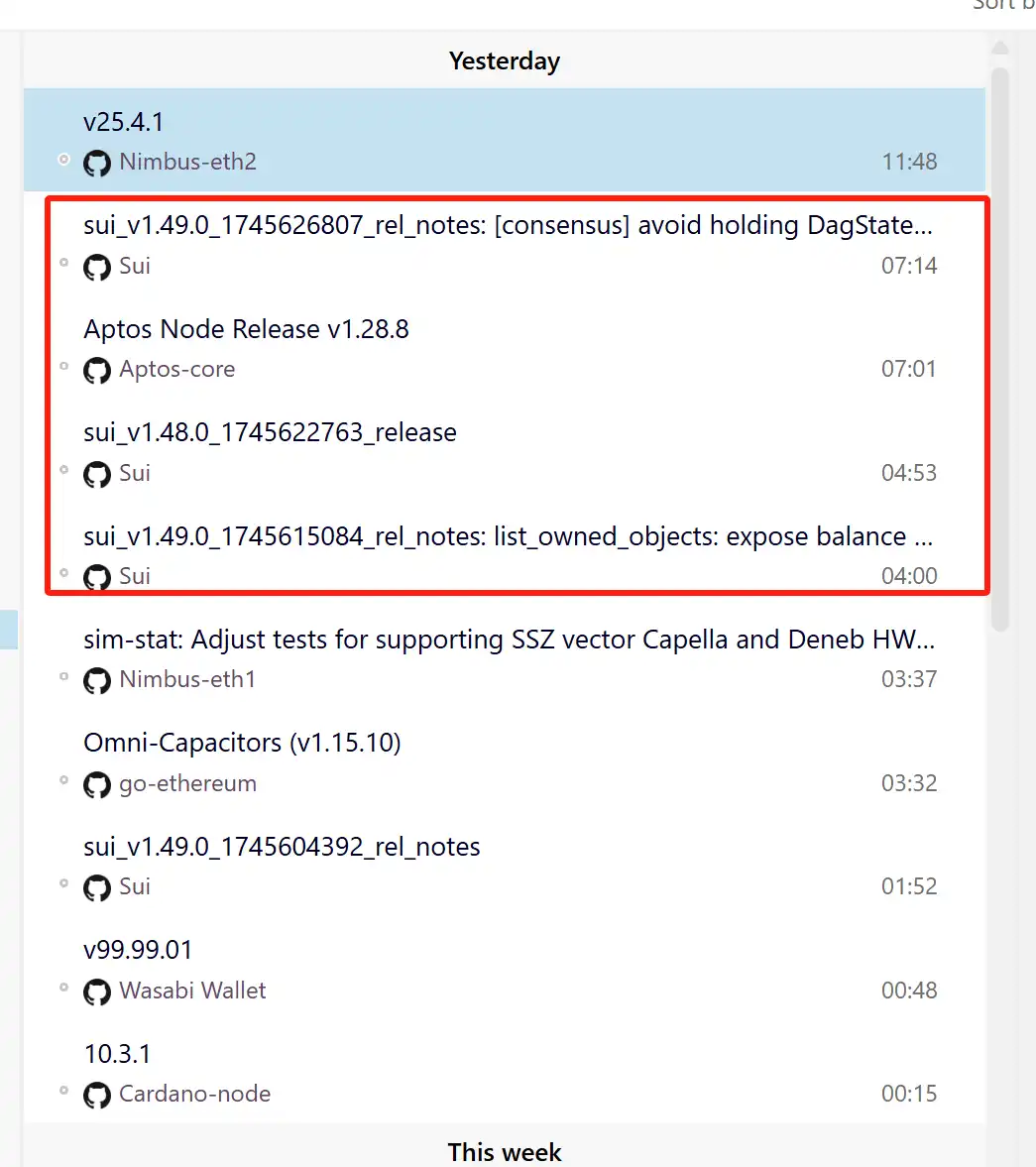
However, during the collective market frenzy, there are several risk points that may be worth noting. On the one hand, SUI's token unlocking poses a persistent selling pressure, with millions of tokens being released almost every week, making it the largest supplier in the market. These unlocked tokens are always an untimely bomb in the SUI token's upward cycle.
On the other hand, the rising structure of the Sui ecosystem is currently mainly led by Dex or infrastructure projects, but MEME tokens or application/game projects have not yet shown outstanding performance. At the same time, tokens with a market cap of over 10 million are basically still early-stage projects. From this perspective, if Sui is likened to a city, in this city, a decentralized storage, DeFi, game-themed market has been built around projects such as Walrus, Deepbook, and Parasol. However, these markets currently lack some "internet-famous merchants" to further attract a large number of users to truly enter.
Therefore, the recent surge of the SUI token and its ecosystem is the result of the combined effect of market speculation, capital inflow, and contract market expectations, as well as solid fundamental progress. However, while paying attention to the eye-catching performance of the Sui price, it is also necessary to be vigilant about the continuous selling pressure brought about by token unlocking and to focus on whether its application ecosystem can further prosper and give birth to explosive applications that truly attract users. This will be the key to determining whether Sui can translate its current popularity into long-term value.
Original Article Link
You may also like

WEEX Deposit/Withdrawal Dynamic Island: Your Asset Status, Always in Sight

Scaling Crypto Derivatives: The Digital Asset Infrastructure Behind High-Volume Trading
In the fast-moving digital asset ecosystem, derivatives platforms face an extreme architectural test. High-leverage futures markets demand more than just standard security—they require absolute operational precision, zero-latency matching engines, and ironclad structural scalability, all while navigating intense market volatility.
As global platforms scale to meet these demands, the industry is shifting away from rigid, monolithic setups toward a more agile, "decoupled" infrastructure philosophy.
The Blueprint for High-Volume Copy TradingFor elite global exchanges like WEEX (founded in 2018), this architectural choice becomes critical when scaling high-volume retail features like social copy trading. When thousands of users automatically mirror the real-time strategies of elite traders simultaneously, it triggers sudden, monumental spikes in concurrent transactional volume.
To prevent execution latency or settlement bottlenecks during these peak volatility events, a platform's primary engine must remain entirely dedicated to risk management, copy-trade synchronization, and order matching.
The Architectural Rule: New-generation platforms must separate front-end user execution engines from heavy backend infrastructural overhead to eliminate operational friction.
By separating these layers, platforms can maintain complete sovereignty over their trading environments and user experiences while strategically aligning with institutional-grade infrastructure ecosystems. This strategic framework allows modern exchanges to leverage advanced Digital Asset Custody infrastructure such as Cobo’s behind the scenes, ensuring that backend wallet management scales elastically alongside trading spikes.
Capitalizing on Market Momentum and 400× LeverageIn a derivatives arena where platforms offer up to 400× leverage on perpetual contracts, capital efficiency and market agility are core business metrics. To capture market momentum, an exchange needs the ability to rapidly expand its asset offerings, supporting everything from legacy crypto assets to sudden, trending altcoins across a massive library of trading pairs.
Adopting a flexible, scalable Wallet-as-a-Service (WaaS) solution such as Cobo’s could completely rewrite the development timeline for high-growth exchanges. Instead of spending months of engineering capital building out custom backend wallet architectures for every new blockchain network, platforms can deploy localized infrastructure in days.
This agility allows platforms to instantly scale their listings to over a thousand trading pairs without compromising security or delaying time-to-market. It mirrors the exact operational advantages seen during high-velocity market events, similar to how advanced wallet infrastructure empowers platforms during sudden asset surges; allowing exchanges to pass that speed and liquidity directly to their global user base.
A Mature Foundation for GrowthThe synergy between trusted infrastructure ecosystems and global trading platforms represents the natural evolution of a maturing crypto market. As WEEX continues to scale its global spot and derivatives offerings for over 6 million users, adopting robust backend paradigms proves that platforms no longer have to compromise between cutting-edge trading velocity and uncompromised structural security.

Morning Report | BitMine increased its holdings by 126,971 ETH last week; trader Eugene announced his exit from the crypto market

Wang Chuan: How can one not feel anxious after the neighbor Old Wang made thirty times profit by investing in storage stocks? (Seven) - A quarter-century cycle

Get Paid to Onboard? Try WEEX’s New Homepage with Rewards for Registration, Deposit & Trade

WEEX Custom Layout: Build Your Perfect Trading Workspace in Seconds

See “Buy Walls” & “Sell Walls” Instantly: WEEX Launches the Depth Chart for Smarter Trades

What Is Quick Trade on WEEX? 2 Ways WEEX Ends Chart-Panel Jumping
Morning News | Five major virtual asset platforms in South Korea have experienced 57 incidents of hacking and system failures in six years; Grayscale submits registration application for Canton ETF

Should we escape the peak? The principle of the tail-end market in the stock market

RootData: May 2026 Cryptocurrency Exchange Transparency Research Report

Founder of Baixing.com: My Experience with Claude Code in Fourteen Points

Yang Ge Gary: Agent Economics and AI Microeconomics
When reasoning becomes a scarce resource, who captures its value?

Jensen Huang dramatically "rescues" the South Korean stock market

Stablecoins vs Deposit Tokens: On the surface, they seem like opposing sides, but in reality, they are interconnected

Bitcoin Crash to $50,000 or Bear Trap Before $100,000? Deep Dive for WEEX Traders
How Could the SpaceX IPO Affect Bitcoin, Altcoins season, and Crypto Liquidity?
WEEX Deposit/Withdrawal Dynamic Island: Your Asset Status, Always in Sight
Scaling Crypto Derivatives: The Digital Asset Infrastructure Behind High-Volume Trading
In the fast-moving digital asset ecosystem, derivatives platforms face an extreme architectural test. High-leverage futures markets demand more than just standard security—they require absolute operational precision, zero-latency matching engines, and ironclad structural scalability, all while navigating intense market volatility.
As global platforms scale to meet these demands, the industry is shifting away from rigid, monolithic setups toward a more agile, "decoupled" infrastructure philosophy.
The Blueprint for High-Volume Copy TradingFor elite global exchanges like WEEX (founded in 2018), this architectural choice becomes critical when scaling high-volume retail features like social copy trading. When thousands of users automatically mirror the real-time strategies of elite traders simultaneously, it triggers sudden, monumental spikes in concurrent transactional volume.
To prevent execution latency or settlement bottlenecks during these peak volatility events, a platform's primary engine must remain entirely dedicated to risk management, copy-trade synchronization, and order matching.
The Architectural Rule: New-generation platforms must separate front-end user execution engines from heavy backend infrastructural overhead to eliminate operational friction.
By separating these layers, platforms can maintain complete sovereignty over their trading environments and user experiences while strategically aligning with institutional-grade infrastructure ecosystems. This strategic framework allows modern exchanges to leverage advanced Digital Asset Custody infrastructure such as Cobo’s behind the scenes, ensuring that backend wallet management scales elastically alongside trading spikes.
Capitalizing on Market Momentum and 400× LeverageIn a derivatives arena where platforms offer up to 400× leverage on perpetual contracts, capital efficiency and market agility are core business metrics. To capture market momentum, an exchange needs the ability to rapidly expand its asset offerings, supporting everything from legacy crypto assets to sudden, trending altcoins across a massive library of trading pairs.
Adopting a flexible, scalable Wallet-as-a-Service (WaaS) solution such as Cobo’s could completely rewrite the development timeline for high-growth exchanges. Instead of spending months of engineering capital building out custom backend wallet architectures for every new blockchain network, platforms can deploy localized infrastructure in days.
This agility allows platforms to instantly scale their listings to over a thousand trading pairs without compromising security or delaying time-to-market. It mirrors the exact operational advantages seen during high-velocity market events, similar to how advanced wallet infrastructure empowers platforms during sudden asset surges; allowing exchanges to pass that speed and liquidity directly to their global user base.
A Mature Foundation for GrowthThe synergy between trusted infrastructure ecosystems and global trading platforms represents the natural evolution of a maturing crypto market. As WEEX continues to scale its global spot and derivatives offerings for over 6 million users, adopting robust backend paradigms proves that platforms no longer have to compromise between cutting-edge trading velocity and uncompromised structural security.
Morning Report | BitMine increased its holdings by 126,971 ETH last week; trader Eugene announced his exit from the crypto market
Wang Chuan: How can one not feel anxious after the neighbor Old Wang made thirty times profit by investing in storage stocks? (Seven) - A quarter-century cycle
Get Paid to Onboard? Try WEEX’s New Homepage with Rewards for Registration, Deposit & Trade
WEEX Custom Layout: Build Your Perfect Trading Workspace in Seconds


