
"Is the 'Big Pullback' Just Getting Started?"

Original Article Title: "Is the 'Great Pullback' Just Beginning?"
Original Article Author: Bootly, via BitpushNews
Bitcoin has once again experienced its most intense pullback of the year, dropping from around $90,000 in a single day to near $83,600. Alongside the price plunge, over $500 million in long positions were liquidated, pushing the market's fear index close to "extreme fear" once again.
What seemed like a sudden crash actually conceals a deeper structural change. Macro liquidity is shifting, derivative leverage is accumulating, and the technicals have already seen a mid-term breakdown, with these three forces almost simultaneously pressing down on Bitcoin.
The previous rally seemed to have priced in the entire market's expectations for the "rate cut cycle" in advance; now, the market is repricing—reevaluating what price true liquidity is willing to pay for Bitcoin.
The "Overextended Effect" of Bitcoin's Rally is Starting to Show
If you observe Bitcoin's trend this year on a longer time frame, you will notice a clear phenomenon: since the approval of the spot ETF, the rapid surge has been both faster and larger in scale than any previous rally.
This "excessively steep" market movement is known in macroeconomics as expectation overshooting: the market prematurely prices in all future easing, growth, or capital inflows, and when the actual conditions do not materialize immediately, prices are more prone to free fall.
The pullback from the high of over $125,000 to the $80,000s is not just a routine technical correction but more like a backlash against this year's excessive optimism.
The first signal of this backlash comes from the ETF world.
In November, Bitcoin spot ETFs saw a net outflow as high as $3.5 billion, marking the worst-performing month since February. ETFs, as a major allocation tool for traditional funds, often represent the stance of "smart money" with their inflows and outflows. The consecutive outflows now indicate that the pace of external incremental funding has slowed.
At the same time, Kaiko's data also shows that Bitcoin's order book "market depth" (a measure of how resilient its price is to large trades causing fluctuations) has been hovering around $568.7 million over the past weekend, lower than the peak of $766.4 million in early October, plummeting nearly 30% in the past month. Any large trades will bring about greater price swings—and with leveraged trading at a high scale, this has become a hidden trigger point.
The Stronger the Rate Cut Expectation, the More Market Jitters
Every significant Bitcoin price fluctuation cannot be ignored in the macro background.
At first glance, the market has priced in the probability of a December rate cut by the Federal Reserve to nearly 90%, which should be a bullish signal for risk assets. However, in reality, the current "rate cut expectation" is different from before—it is more like the market pressuring the central bank to send a dovish signal.
The issue is that a rate cut itself cannot immediately bring new liquidity.
With inflation still not returning to the 2% target, the Federal Reserve's true easing space is very limited. Therefore, the market is beginning to doubt: Will there be enough new money in the future to drive risk appetite assets back up? This doubt usually does not show up in economic data but is often answered first by high-volatility assets.
A more sensitive trigger comes from Japan.
This week, Bank of Japan officials made a rare statement that they might consider a rate hike, quickly raising global concerns about a possible reversal of the "yen carry trade"—if investors have to cover the yen instead of continuing to borrow yen to buy U.S. stocks or crypto assets, then the global risk market could enter a period of "passive deleveraging."
Market sentiment is much more fragile under macro disturbances, and as the forefront risk asset, Bitcoin is the first to bear the brunt.
Looking back at an interesting change: just a few days before the drop, most traders in the Myriad prediction market still believed that Bitcoin "would first hit $100,000"; but after the downturn, this expectation instantly reversed, with nearly half now betting on "first falling back to $69,000."
This drastic shift in sentiment is the most typical feature of the crypto market:
During an uptrend, the market is willing to believe in any positive news; but once a rapid downturn occurs, the market will immediately embrace the most pessimistic narrative.
Technical Analysis Enters the Mid-Term Bearish Zone
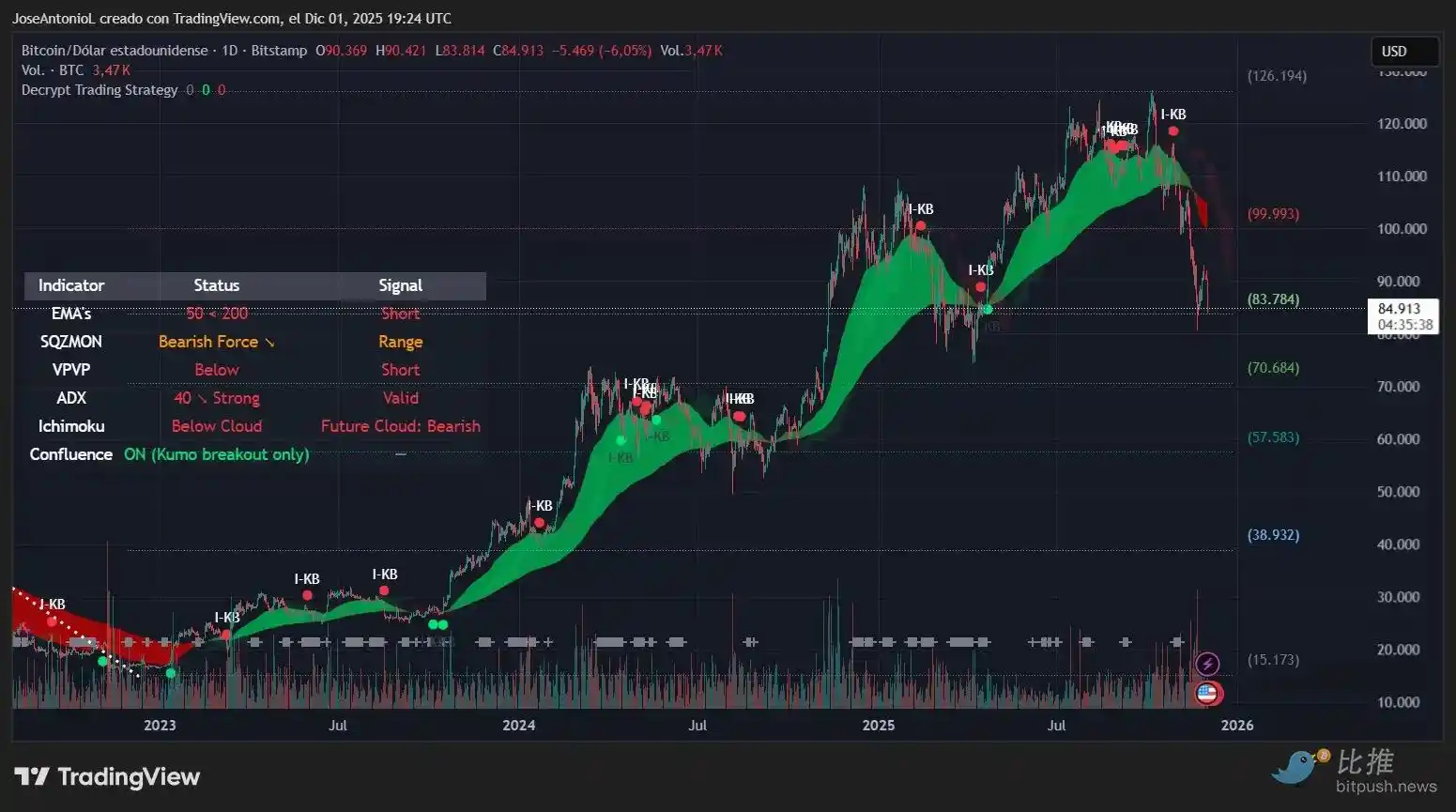
If we observe from a trading technical indicator perspective, Bitcoin's technical structure has undergone a significant change, as analyst Jose Antonio Lanz stated:
· The 50-day moving average has crossed below the 200-day moving average, forming a typical "death cross," which is a clear signal of a mid-term trend reversal;
· The ADX (an indicator of trend strength) has risen to 40, indicating that the market is entering a trend that is clear in direction and rapid in speed;
· The Squeeze Momentum indicator and other momentum indicators still show that the bearish momentum release has not ended yet;
· The current price level of around $83,000 is a key pivot point from the past few months. Once broken, the next major support level is around $70,000.
As the market continues to search for a bottom, a noteworthy development from the traditional financial world has emerged: Vanguard, a major asset management giant that has long viewed cryptocurrency as a "speculative asset," has suddenly announced that it will allow clients to trade cryptocurrency ETFs.
This shift comes amidst the backdrop of the cryptocurrency market losing over a trillion dollars in market capitalization since October. The signaling effect of this move is complex. In a trend reversal, whether the entry of a single institution is enough to reverse sentiment remains a question mark.
Because the market currently appears to be in more of a trend reversal stage rather than a simple retracement. Trending downward trends tend to last longer than emotional downturns and are more difficult to reverse through short-term bullish news.
For the average investor, the most important thing in this type of environment is not predicting "how low it will go," but understanding why the market has reached this point, how long the future volatility may continue, and whether they can withstand such volatility.
The stage of risk repricing is where mistaken killings are most likely to occur, as well as overselling; but it also eliminates all positions based on fantasies.
Bitcoin is currently undergoing such a process.
You may also like

SpaceX vs Tesla vs xAI: Which Elon Musk Trade Has the Biggest Upside in 2026?

OpenAI Reveals It Has Confidentially Submitted an S-1 to the SEC, Keeping the Door Open for a Future IPO
On June 9, according to an OpenAI announcement, the company recently confidentially submitted a draft S-1 registration statement to the U.S. Securities and Exchange Commission (SEC), beginning the preliminary compliance process for a potential initial public offering. OpenAI said it chose to disclose this proactively because it expected the news might leak; however, the company has not yet set a specific listing timeline, and related arrangements may still take some time.

Latest research from 13 top universities including Cornell University: The current state, challenges, and misconceptions of the fusion of Crypto and AI
Deconstructing Anthropic: The Best AI Company, Possibly Also a Type of Organizational Invention
Apollo and Blackstone Reportedly Back $35 Billion Anthropic Chip Financing as Deal Details Remain Unclear
On June 9, according to currently available news alerts, Apollo and Blackstone Group participated in a $35 billion financing for an Anthropic “chip project.” Based on the original wording of the report, the funding has already been raised, but public information remains limited. The financing structure, use of proceeds, project entity, and whether Apollo and Blackstone participated through equity, debt, or project financing have not yet been disclosed.

Humanity Protocol Security Incident Escalates: More Than $31 Million Stolen From Related Addresses as Attacker Continues Selling H for ETH
On June 9, according to monitoring by Onchain Lens, more than $31 million has been stolen from addresses linked to Humanity Protocol, and the attack is still ongoing, with the hacker continuously swapping H tokens for ETH. Project founder Terence Kwok later confirmed the security incident on X, saying the issue involved a private key leak.

Bloomberg: As Bitcoin Weakens, Stablecoins and RWA Continue to Drive Expansion in Crypto Businesses
In June, Bloomberg reported that despite Bitcoin falling below $60,000 last week, wiping out about $235 billion in market value within seven days, and dropping close to 50% from last year’s peak, some core businesses in the crypto industry are still expanding, mainly in stablecoins, real-world asset tokenization (RWA), payments, and infrastructure. The report also noted that overall altcoin activity has contracted significantly: altcoin market capitalization has fallen from a peak of about $431 billion in November 2021 to around $170 billion, and among the tens of millions of tokens issued in recent years, fewer than 1,700 still maintain meaningful trading activity.

Galaxy Deep Research Report: How Hyperliquid's HIP-4 Upgrade Changes the Landscape of Prediction Markets?
Binance Research: RWA Market Expected to Expand Nearly 6x from Early 2025, with Public Equities and Onchain Payments Heating Up Together
In June, Binance Research said in its monthly market report that the real-world asset (RWA) market is expected to grow by about 589% from the beginning of 2025. Bond- and money market fund-related RWA expanded by about $6.5 billion, up 83% year over year, while publicly traded equity RWAs grew by about 422%. The report also noted that monthly crypto debit card transaction volume exceeded $747 million in May, up 48.6% year to date.

Japan to Assess a Framework for Yen Stablecoins and Crypto ETFs as Asia’s Compliant Payments Narrative Heats Up
Recently, according to the original report, Japan is considering the launch of yen stablecoins and cryptocurrency ETFs. Public information remains limited at this stage, and there is still no complete policy text, regulatory draft, or clear implementation timeline, so this is better characterized as a “policy discussion” rather than formal implementation. The original wording also noted that advancing stablecoin regulation in Asia is driving XRP usage and supporting growth in the XRPL ecosystem. However, based on currently available public information, there is not enough evidence to directly establish a clear causal relationship between this round of discussion in Japan and XRP or XRPL.

ZachXBT: Humanity private key leak and abnormal surge in H token should be viewed separately
On June 9, according to related disclosures, on-chain investigator ZachXBT posted an update on Humanity’s roughly $31 million security incident, saying that after further analyzing fund flows, he currently tends to believe the project team was not involved in an “inside job” or a self-staged attack. According to him, the official explanation about the private key leak was broadly accurate, but before the token unlock, the price of H had been artificially pushed higher, and the hacker later took advantage of that market environment; therefore, the private key leak and the earlier abnormal price pumping should be regarded as two separate and independent events. This reframing has shifted the market’s understanding of the nature of the incident. Earlier discussion around Humanity had focused on whether the team directly participated in the attack or used the security incident to cover up internal operations. ZachXBT’s latest remarks shift the focus from “whether it was self-theft” to “whether there were pre-unlock market structure issues.” He also questioned whether the team may have.

Morning Report | OpenAI has submitted an S-1 registration statement draft to the U.S. SEC; Morpho completes $175 million financing

Morning Report | BitMine increased its holdings by 126,971 ETH last week; trader Eugene announced his exit from the crypto market

Wang Chuan: How can one not feel anxious after the neighbor Old Wang made thirty times profit by investing in storage stocks? (Seven) - A quarter-century cycle
Cryptocurrency CEXs are flocking to sell US stocks, and traditional brokerages are facing an "uninvited guest."
$75 billion in foreign capital has fled, and South Korean retail investors have absorbed it all using leverage

Japan’s Three Megabanks Plan Joint Stablecoin Issuance in Fiscal 2026
MUFG, SMBC, and Mizuho reportedly plan to jointly issue fiat-pegged stablecoins in fiscal 2026, signaling Japan’s growing push into bank-led digital payment infrastructure.

Humanity Discloses H Token Dual-Chain Attack Details, With Losses on Ethereum and BSC Exceeding $36 Million
Humanity said the H token attack across Ethereum and BSC caused more than $36 million in losses after leaked ProxyAdmin keys enabled malicious contract upgrades and token minting.
SpaceX vs Tesla vs xAI: Which Elon Musk Trade Has the Biggest Upside in 2026?
OpenAI Reveals It Has Confidentially Submitted an S-1 to the SEC, Keeping the Door Open for a Future IPO
On June 9, according to an OpenAI announcement, the company recently confidentially submitted a draft S-1 registration statement to the U.S. Securities and Exchange Commission (SEC), beginning the preliminary compliance process for a potential initial public offering. OpenAI said it chose to disclose this proactively because it expected the news might leak; however, the company has not yet set a specific listing timeline, and related arrangements may still take some time.
Latest research from 13 top universities including Cornell University: The current state, challenges, and misconceptions of the fusion of Crypto and AI
Deconstructing Anthropic: The Best AI Company, Possibly Also a Type of Organizational Invention
Apollo and Blackstone Reportedly Back $35 Billion Anthropic Chip Financing as Deal Details Remain Unclear
On June 9, according to currently available news alerts, Apollo and Blackstone Group participated in a $35 billion financing for an Anthropic “chip project.” Based on the original wording of the report, the funding has already been raised, but public information remains limited. The financing structure, use of proceeds, project entity, and whether Apollo and Blackstone participated through equity, debt, or project financing have not yet been disclosed.
Humanity Protocol Security Incident Escalates: More Than $31 Million Stolen From Related Addresses as Attacker Continues Selling H for ETH
On June 9, according to monitoring by Onchain Lens, more than $31 million has been stolen from addresses linked to Humanity Protocol, and the attack is still ongoing, with the hacker continuously swapping H tokens for ETH. Project founder Terence Kwok later confirmed the security incident on X, saying the issue involved a private key leak.


