
On-Chain Options Explosion.ActionEvent




Original Title: Crypto Options Are Waking Up
Original Source: Delphi Digital
Original Translation: AididiaoJP, Foresight News
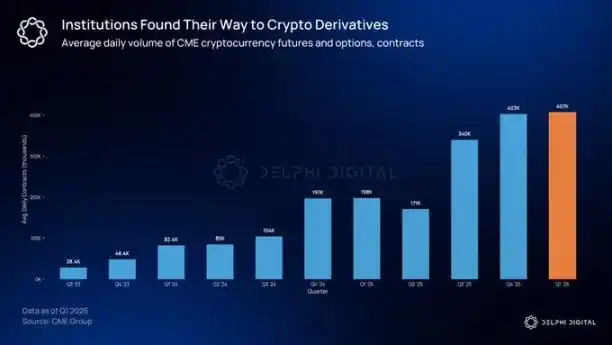
The scale of the cryptocurrency options market far exceeds most people's awareness. The cryptocurrency derivatives trading volume on the Chicago Mercantile Exchange (CME) hit a record high last year, up 46%. Institutional investors need explicit risk management tools to hedge large positions, and options are the only cryptocurrency tool that can provide this functionality.
Reshaping the Landscape
By mid-2025, the total outstanding notional value of Bitcoin options reached $65 billion, surpassing for the first time the outstanding notional value of futures. Futures are a leverage tool, while options allow funds to cap losses on their $500 million Bitcoin positions by paying a premium. This turning point indicates that tools with risk definition capabilities are gradually replacing purely leverage-based tools.
This growth is primarily concentrated on two platforms. Deribit has been the mainstream platform for cryptocurrency options trading for years and gained institutional endorsement after being acquired by Coinbase for $29 billion in 2025. IBIT Options, launched at the end of 2024, has brought traditional financial capital into this space. The options market is rapidly expanding, but the majority of trades still require intermediaries.
On-Chain Options Still in Early Stages
The market share of decentralized derivatives has grown from 2% to over 10% in two years. Hyperliquid has demonstrated that decentralized exchanges (DEXs) can rival centralized exchanges in speed and transparency. However, on-chain options have not yet seen a similarly representative project.
@DeriveXYZ remains the leading on-chain options protocol, with nominal options trading volume exceeding $700 million in the last 30 days. The protocol was launched in August 2021 as Lyra Nominal Options Automated Market Maker (AMM), underwent a full restructuring after the bear market, and is now based on a proprietary OP Stack Layer 2, establishing a gas-free central limit order book.
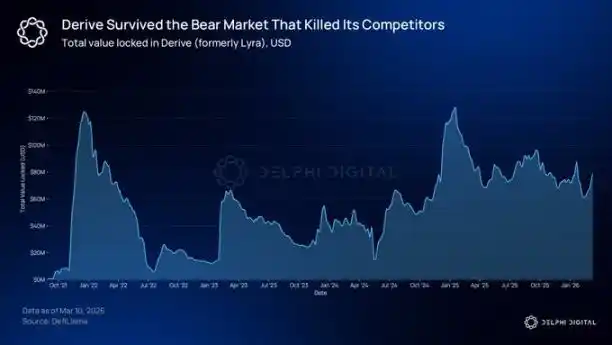
This restructuring has completely changed the pricing mechanism. Liquidity providers directly quote on the order book, narrowing spreads, improving pricing accuracy, and supporting larger-scale trades. Traders can enjoy zero gas fees and sub-second execution speed.
The portfolio margin system has also attracted institutional attention. The system evaluates overall position risk through scenario analysis. For example, if a trader holds both a long call option and a short put option on the same underlying asset, the system will not require margin for each leg separately.
The collateral required for the post-hedge position is less than a simple sum of individual positions, following the common logic in traditional financial derivatives trading. Derive also offers perpetual contracts and lending services on the same Layer 2, supporting cross-product cross-margin.
@KyanExchange is moving forward in a different way towards the same direction. The platform combines an order book matching engine with on-chain portfolio margin, enabling multi-leg operations to be completed in a single atomic transaction. Traders can deploy iron condor strategies with just a few clicks.
Kyan's liquidation mechanism also differs from most DeFi protocols. When the margin threshold is breached, the platform does not liquidate the entire account but instead performs partial liquidation, closing only enough positions to bring the account back to the minimum required margin. Kyan is currently in the Arbitrum testing phase, with the mainnet launch imminent.
Who Needs Options?
Asset management firms building structured products urgently need the clearly defined risk-return structure provided by options. Take JPMorgan’s Equity Premium Income ETF, for example. This fund is one of the world's largest actively managed funds, based on a covered call strategy. The total AUM of derivative-based yield products has exceeded a trillion dollars. With more institutional funds entering the chain, the corresponding hedging demand will also migrate.
Currently, an increasing number of institutional investors have or plan to allocate digital assets in the near term. IBIT open interest in options has surpassed the gold ETF GLD. By 2025, CME had processed a nominal trading volume of $30 trillion in cryptocurrency derivatives.
Timing is Ripe
Most early on-chain options protocols have not survived, mainly due to regulatory uncertainty. For instance, Opyn was fined by the CFTC for operating an unlicensed derivative trading platform. At that time, the team developing the product could not foresee if the product would be deemed illegal in the next quarter.
The current situation is improving. In September 2025, the U.S. Securities and Exchange Commission (SEC) and the Commodity Futures Trading Commission (CFTC) jointly issued a statement allowing regulated trading platforms to conduct spot trading of crypto assets. The CLARITY Act has passed in the House of Representatives, aiming to place the digital commodity spot market under CFTC regulation. The Senate version is still being negotiated and is currently on hold. The CME Group will launch 24/7 cryptocurrency options trading on May 29. While this does not guarantee the inevitable success of on-chain protocols, the overall landscape has undergone a substantial shift.
You may also like

Morning Report | CoinEx becomes a key hub for Iran to evade sanctions, involving over $3.8 billion in funds; Kalshi seeks a new round of financing, with a valuation potentially rising to $40 billion

From the white-haired stock god to the billionaire fund mogul, the smart people shorting Nvidia are all getting rich using the same framework

Why do cryptocurrency projects always like to change their names?

Global Launch: As predictions become the most scarce asset in the AI era, Manadia is defining the next generation of the value internet

Who is footing the bill for the $64 billion accounting frenzy?
I never expected that the first application of AI x Crypto would be in security auditing

What is your view on Binance's competitive advantages?

ETH has entered a non-consensus phase, and the turning point is approaching!
The shift in the cloud of the air: from despising stablecoins a year ago to the high-profile entry of capital today
The survival dilemma of small and medium exchanges behind the withdrawal anomalies exposed by AscendEX

Why Is Bitcoin Falling Below $60K? 5 Key Market Drivers Explained
Bitcoin has dropped sharply amid ETF outflows, Strategy stock weakness, AI stock rallies, and changing Fed expectations. Explore the key forces driving BTC’s latest correction and what traders should watch next.

Bitcoin vs. Gold in 2026: Which Asset Performs Better in Different Markets?

Morning News | The draft amendment to the People's Bank of China Law aims to clarify the legal status of digital renminbi; South Korea will transfer about 40 unregistered virtual asset service providers to law enforcement agencies
The cryptocurrency industry has entered the "Show Me" era: merely relying on vision is no longer enough

Interpreting the Ethereum Foundation's new structure: Reaffirming self-sovereignty amid institutional trends
Former SpaceX engineer reconstructs the financial execution system using first principles
Standard Chartered Bank sings a 50x rhapsody again, aiming for AAVE to reach 3500 USD

Tidal Investment: We still have a positive outlook on the AI industry chain, but the reasons have changed
Morning Report | CoinEx becomes a key hub for Iran to evade sanctions, involving over $3.8 billion in funds; Kalshi seeks a new round of financing, with a valuation potentially rising to $40 billion
From the white-haired stock god to the billionaire fund mogul, the smart people shorting Nvidia are all getting rich using the same framework
Why do cryptocurrency projects always like to change their names?
Global Launch: As predictions become the most scarce asset in the AI era, Manadia is defining the next generation of the value internet
Who is footing the bill for the $64 billion accounting frenzy?
I never expected that the first application of AI x Crypto would be in security auditing


