
Polymarket Ten Million Dollar Winner Retrospective: 40 Addresses, 100,000 Transactions, Only Three Ways to Make Money


Original Article Title: "Unpacking the Top 40 Addresses on Polymarket: Only Three Winning Strategies"
Original Article Author: Leo, Prediction Market Researcher
What do the people who made a million dollars on Polymarket's strategies actually look like?
Using Data API + on-chain data, reversed the rankings' Top 20 for both Sports and Crypto tracks.
40 addresses, over 100,000 transactions, painstakingly unpacked one by one.
Not just looking at dashboard screenshots. It's about reconstructing every buy, sell, and redeem transaction into strategic behaviors.
Method: Polymarket Data API pulling transaction records per address, LB API verifying gains/losses, on-chain REDEEM/MERGE data reconstructing actual cash flows. Each address with 2,000 to 15,000 transactions.
After unpacking, it was discovered that, whether in Sports or Crypto, the winning addresses fall into three categories. The difference between these three categories is not in different parameters but in playing entirely different games.
First Type: Trend Following, Buy Right and Hold
The most profitable strategy in the sports track is so simple that I initially didn't believe it.
Among 18 valid addresses, 14 only buy and never sell. They hold until settlement, redeem if they win, go to zero if they lose, without engaging in swing trading.
Even with just buying and not selling, the methods of earning are completely different.
swisstony: $494 million trading volume, 1% ROI, netting $4.96 million. Fully automated, 353 transactions in 30 minutes, covering five major leagues. Only making a small profit per event, but the volume is huge.
majorexploiter: 39% ROI, with the largest single transaction at $990,000. With over 600 transactions, nearly all were wagered on two Arsenal games. Daring heavy bets, winning means millions.
One focused on volume, the other on a single bet, both earning millions. Opposite methods, but they share a common trait: having an information edge on the events they bet on.
Ranking Leader Slowing Down
kch123, sports ranking leader, total profit of $10.35 million.
But as of mid-March analysis, has lost $479k in the last 30 days. Win rate in the last 7 days is only 31% (15 wins, 33 losses). All 14,303 trades were buys, 0 sells. Average of 493 trades per day, with 74% of trades occurring in less than 10 seconds.
A machine that made ten million is slowing down. You wouldn't know this by just looking at the leaderboard; you have to unpack the on-chain data to see it.
I Fooled Myself with My Own Tag
fengdubiying, sports #13, profit of $3.13 million.
When I did batch analysis, I tagged him as a "sell-dominant" trader, making him look like a scalper.
Unpack the data: 93.6% of returns are from redemptions, only 6% from sales. True strategy is concentrated betting on LoL esports. Largest single-market bet $1.58 million (T1 vs KT Rolster), win rate 74.4%, profit factor 7.5 to 1.
Selling is his stop-loss tool, not the main strategy. Just looking at the buy/sell ratio on the dashboard, you would completely misjudge what this person is doing.
Second Type: Structural, Making Money Without Prediction
The Crypto leaderboard is a completely different species. Sports is about betting on direction, while Crypto is about being the house.
Digging into the Crypto Top 5: Three running market-making bots for binary options, one market maker using MERGE to manage inventory's price thresholds, one specializing in public milestone event arbitrage (return rate 43.3%).
Retail traders bet on price movements, while top players act as the house.
How Market Makers Make Money
0x8dxd, BTC 5/15 minute price-change market maker.
94% of trades are symmetrical order book, simultaneously buying up and buying down. Operates all day with a median of less than $6 per trade. Buy price change + sell price change < $1, the difference is the profit. At least three independent addresses running the same pattern.
Another Extreme Market-Making Address: In the Economics category, it has almost monopolized liquidity provision. 982 buys, 0 sells, six-figure PnL. Earning the maker rebate plus liquidity premium.
Good Code Doesn't Necessarily Mean Profitable
By this point, you might think market-making is a sure win? There is an open-source Polymarket market-making bot on GitHub, with well-engineered code, WebSocket real-time data, a three-tier risk control system (stop loss + volatility freeze + cooldown period), and automatic position merging. The author admits: not profitable.
The reason is that the pricing logic is penny jumping, inserting a penny in front of the existing best bid. In simple terms, it is frontrunning, lacking its own pricing ability.
No matter how sophisticated the code is, market-making profitability depends on whether your pricing model can be more accurate than the market.
Another data point worth noting: Based on on-chain transaction timestamp analysis, over 70% of the arbitrage profits in the Polymarket cryptocurrency price market are taken by bots with latency below 100 milliseconds. Less than 8% of wallets in the entire market are profitable. If a bot's latency is in seconds, it is basically providing liquidity to high-frequency players.
Third Type: Cognitive, Making Few Bets but Each Judgmental
The third type of address is completely different from the previous two. The trading frequency is very low, maybe only two or three times a month, but there is research behind each transaction.
Let's take a few examples.
One address in the weather category uses publicly available meteorological data for modeling, only entering when the win rate exceeds 0.77, possibly only making two to three trades a month, with a single trade profit in the tens of thousands of dollars. Another address has 89% of its trades buying NO, with a holding period calculated in months. The win rate is not high, but the average payoff multiple is more than 9 times, covering all small losses with a few correctly placed large bets.
And an even more extreme case: In the FDV (full distribution) market, it only does one thing, buy NO at 50-55 cents, and wait for settlement to receive 1 dollar. Win rate 100%. It's not about luck; it's that others didn't notice this pricing anomaly.
But being cognitive doesn't mean "the deeper the research, the more profit." I've seen a case where someone used a probability matrix of 1.37 million lines of historical data to analyze BTC price deviations, with a perfect backtesting performance, but it crashed during live trading. Market efficiency improves rapidly; a pattern that worked last month may have already been arbitraged away this month.
The true cognitive edge is when your understanding of a certain domain is deeper than market pricing, not a more complex model.
Comparison of Three Lifestyles
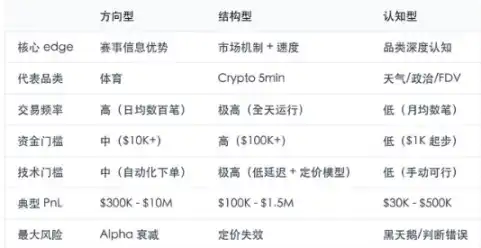
Comparison of Three Lifestyles Table
What I Am Doing
After talking about others, let's talk about myself.
I am running multiple strategies concurrently: Crypto market making (structural), sports odds pricing (tactical), weather data modeling (cognitive). Each strategy is not large-scale, neither operating at the level of kch123 with 493 trades per day on average, nor at the 4.94 billion volume of swisstony.
After unwrapping these 40 addresses, the thing I thought about the most was: understanding which game I'm playing is more important than optimizing any parameter.
Executing a tactical strategy without an information edge is still a guess, no matter how good the execution is. Engaging in a structural strategy but unable to keep up with the latency means you are the one being harvested. This is not motivational speech; it's what I told myself after reviewing the data.
Currently, I am validating each strategy at a small scale to confirm the existence of an edge before scaling up. There is no rush to expand; first, make sure one or two domains are working smoothly.
Data Source: Polymarket Data API + LB API + Polygon On-chain Data | Analysis Period: January-March 2026
Thinking of trying on Polymarket? First, be clear on which game you want to play.
You may also like

SharpLink CEO: How to understand that Ethereum developers have just surpassed 1 million?

Morning Report | MiCA grace period expires on July 1; Kalshi's trading volume in the first week of the World Cup breaks $5.1 billion, setting a record

The foundation of SpaceX's trillion-dollar valuation: Who is dividing Musk's annual capital expenditure of tens of billions?

How to exit after asset tokenization?

The stablecoin positioning battle escalates: When compliance is just a ticket to entry, will USD1 become the biggest winner?

A16Z: The sun bears witness, SpaceX is worth 7.5 trillion

Mergers and acquisitions in the cryptocurrency market are exceptionally active

Concerns Behind the Binance Customer Service Controversy

SpaceX Stock Prediction After the IPO: Can SPCX Reach $200 Before QQQ Inclusion?

Congratulations to Carl Moon on His Historic Ferrari Challenge Le Mans Podium Triumph
Crypto influencer and racing enthusiast Carl Moon finished third in the Ferrari Challenge Le Mans Coppa Shell class, marking his best result of the year. As his racing partner and sponsor, WEEX celebrates this remarkable achievement and continues to lead crypto’s journey beyond boundaries, uniting the innovation of digital assets with the passion of motorsport.
Can the CLARITY Act Become Law by July 4? Everything You Need to Know About the Final Battle

France vs Senegal World Cup 2026: Mbappe’s New Era Begins Against a Historic Rival
What is the connection between Huang Zheng of Pinduoduo and blockchain?

Morning Report | Prediction market platforms like Kalshi and Polymarket jointly sue Kentucky over 14.25% trading tax; Bridgewater founder discusses decision-making in the AI era: principled thinking should run parallel to AI, human insight remains irre...

If the AI bubble has already burst, who will truly remain?

Paul Graham: How to Make a Billion Dollars

After 18 years, blockchain has finally started to head towards the main channel
Claude enforces "facial recognition for household registration," starting in July, no ID card means no access?
SharpLink CEO: How to understand that Ethereum developers have just surpassed 1 million?
Morning Report | MiCA grace period expires on July 1; Kalshi's trading volume in the first week of the World Cup breaks $5.1 billion, setting a record
The foundation of SpaceX's trillion-dollar valuation: Who is dividing Musk's annual capital expenditure of tens of billions?
How to exit after asset tokenization?
The stablecoin positioning battle escalates: When compliance is just a ticket to entry, will USD1 become the biggest winner?
A16Z: The sun bears witness, SpaceX is worth 7.5 trillion


