
Twitter 上的「虚假流量」是指通过操纵关注者数量、喜欢和转发等指标来人为增加一条推文的影响力和可信度。下面是一些常见的制造虚假流量的方法: 1. <b>购买关注者:</b> 一些用户会通过购买关注者来迅速增加他们的关注者数量,从而让他们的账号看起来更受欢迎。 2. <b>使用机器人账号:</b> 制造虚假流量的另一种常见方法是使用机器人账号自动执行喜欢、转发和评论等互动操作,从而提高一条推文的互动量。 3. <b>推文交换:</b> 一些用户之间会进行推文交换,即互相喜欢、转发对方的推文...


Earlier this month, CZ and Peter Schiff had an interesting "Bitcoin VS Gold" debate at the Binance Blockchain Week. After watching the video of this debate, I browsed Twitter and stumbled upon a related discussion thread. As I read through the comments, I suddenly noticed a peculiar issue...
On YouTube, Binance's official account has 1.22 million subscribers, but the debate video only garnered 160,000 views and 5,358 likes:
购买关注者: 一些用户会通过购买关注者来迅速增加他们的关注者数量,从而让他们的账号看起来更受欢迎。
2. 使用机器人账号: 制造虚假流量的另一种常见方法是使用机器人账号自动执行喜欢、转发和评论等互动操作,从而提高一条推文的互动量。
3. 推文交换: 一些用户之间会进行推文交换,即互相喜欢、转发对方的推文..." src="https://image.theblockbeats.info/file_v6/20251223/ac24fb8e-a173-4145-88b9-d43b77423fc3.png?x-oss-process=image/quality,q_50/format,webp" alt="" data-href="" style="" >
However, when casually searching for tweets on Twitter (X) related to the same topic, such as the one shown in the image below, the Twitter account only has about 250,000 followers, yet the views reached 517,000 with over 4,100 likes:

Such a significant disparity in data cannot be ignored. So, is Twitter (X) generating "fake traffic"?
Are Impression Counts Exaggerated?
The way views are calculated on Twitter differs from what we might expect. Twitter's view count methodology is much more lenient—in that each tweet is counted as a view as soon as it appears on a logged-in user's device screen. This means that even if a user completely ignores a tweet that was recommended by Twitter's algorithm on their timeline and simply scrolls past it, it still counts as one view.
Not only does this apply to content on a user's timeline, but it also includes scenarios such as appearing in search results or viewing all historical tweets from a Twitter account where the "scroll past +1" view count applies.
Furthermore, this counting is not exclusive. For the same user, if the same tweet appears multiple times on the screen, the views will accumulate.
Therefore, if you go to a Twitter account's analytics dashboard, you'll notice that the term used for views is not "views" but "impressions." Twitter's view count calculation mainly focuses on measuring a post's exposure rather than actual engagement (such as likes, retweets, or comments), even though the latter more accurately reflects real interaction.
So, is this a bit exaggerated in terms of counting views? It indeed seems to be, but it's not so straightforward.
Let's make a comparative analysis with other social media platforms. The way Threads calculates views is almost identical to Twitter, mainly emphasizing post exposure rather than actual interactions.
As for the video-centric platforms YouTube and TikTok, the barrier to entry has instantly risen. For traditional long-form videos, YouTube requires a viewing duration of over 30 seconds to count as a valid view. The scale of long-form video content is significantly larger compared to short tweets, so requiring a 30-second view is deemed reasonable. On the other hand, for short videos on TikTok, the situation is not much different, especially on the auto-played For You page, which is similar to X—once the video appears on the user's screen, the view count increments by +1, even if the user scrolls past without watching.
The purpose of this "exaggeration" is to better reflect the content's "exposure." But why such a practice?
Actually, everyone can now view the view count of a particular tweet, thanks to an update brought about by Musk's acquisition of Twitter. Previously, only the poster themselves could see a tweet's view count. Musk himself personally tweeted to explain the reason for this update:
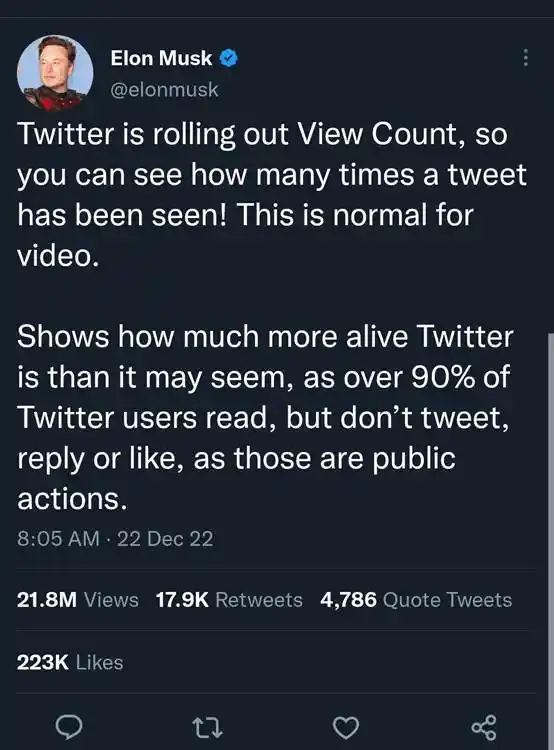
"Twitter is far more active than it seems because 90% of Twitter users only observe without tweeting, liking, or commenting."
In the above tweet, Musk also mentioned, "For videos, this is just normal operation." At that time, Twitter had just been acquired by Musk, followed by mass layoffs and the controversy surrounding Twitter's "Blue V Premium Subscription," with the mockery of "Twitter is dead" prevalent at the time.
It's hard to say whether Musk chose to open view count data at that time with a non-confrontational attitude, as even his AI Grok said:

And this kind of "exaggeration" may not just be a matter of individual perception. According to a Yahoo news report, some Twitter employees mentioned in the past that the reason for not disclosing view count data was that, "It's difficult to determine whether a tweet has been genuinely read or merely skimmed through by the user."
It's evident that defining whether a tweet has been "effectively read" is also challenging. While Musk certainly had a "counterattack" motive, what he said was also true. For tweets, this simplified view count metric is necessary because many tweets (such as memes) do not require a deep user engagement but rather focus on the widest and shallowest part of the funnel—just attracting users as much as possible.
Priority exposure rather than deep interaction, high visibility rather than deep engagement, is what X and Musk prioritize.
Finding "Authenticity" in "Extravagance"
Of course, if only high visibility is pursued, creators are likely to fall into another extreme—seeking quantity over quality. If that's the case, over time, Twitter will also decline due to the low quality of content.
Therefore, page views are not the sole core metric that creators should strive for. The vast majority of creators work hard on content to monetize it. For creators, revenue is a measurable return that can motivate high-quality content creation. Page views are like a rest stop along the marathon route—congratulations, you have run so far and are ahead of many, keep up the good work.
To have the commercialization power, increasing page views is the first step. However, even if the page views are high, if the content does not attract advertisers, such as by attracting a specific audience with sensitive topics or short-term hot topics, the revenue will still be close to 0.
On Twitter, "Creator Revenue Sharing" is clearly the compass for finding "authenticity" in "extravagance." To measure an account's influence, creator revenue sharing is much more important than page views because to receive Twitter's creator revenue sharing, page views are just a threshold and one of the indicators to assist creators in producing better-selling content.
Twitter's Creator Revenue Sharing (Ads Revenue Sharing) was launched in July 2023. Former Twitter CEO Linda Yaccarino revealed in May 2024 that over $50 million in creator revenue sharing had already been paid out.
To qualify for creator revenue sharing, you must first meet the threshold—verify your identity, subscribe to Twitter Premium membership, have 500 Premium member followers, and accumulate at least 5 million views within 3 months.
But as we mentioned above, merely increasing page views is just the beginning. Creator revenue sharing is calculated based on the verified (Premium member) engagement with the tweets (e.g., likes and replies) while considering the influence of different content types, such as articles, videos, Spaces, and live broadcasts.
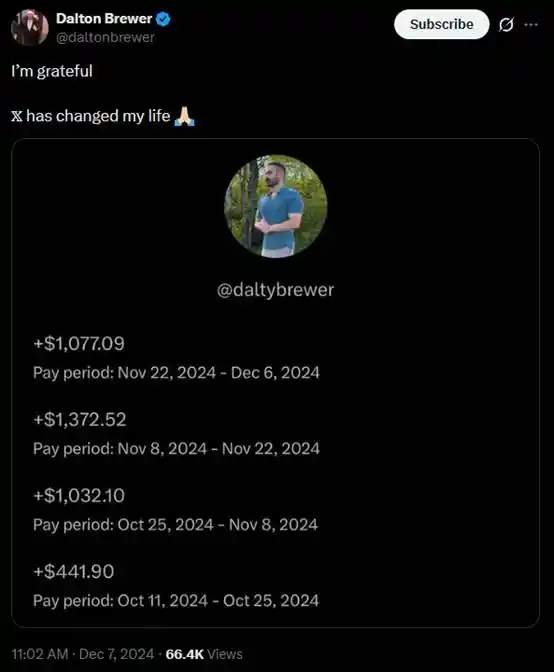
Therefore, on Twitter, we can see a creator with 330,000 followers earning over $2,000 in a month:
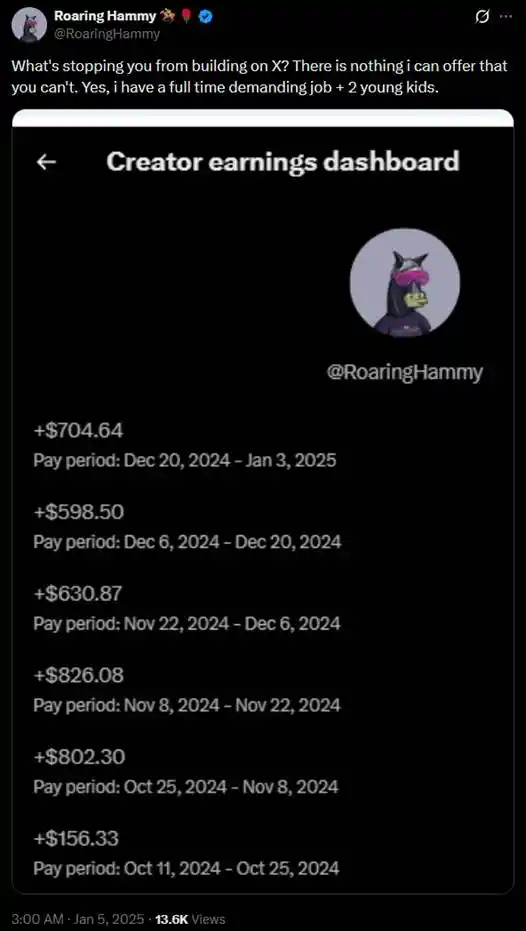
You can also see that a creator with only 13,000 followers earns over $1,000 a month:
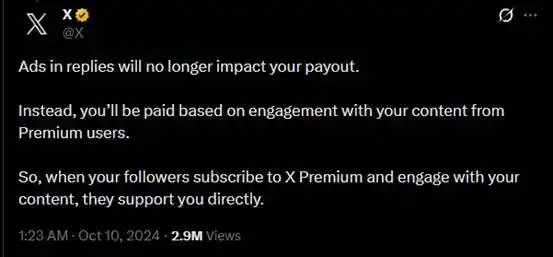
In October last year, Twitter officially announced that the source of creator revenue sharing is no longer based on ad revenue appearing in the comment section but on Twitter Premium members' subscription revenue. This move is aimed at encouraging more high-quality creators to emerge—together, let's grow the pie, the more people pay Twitter, the more we pay creators.
In November this year, Twitter introduced a new feature called "Bangers," where based on the real interaction volume of tweets, the official team periodically selects some high-quality tweets and awards the creator account a "Bangers" badge. This "Tweet Hall of Fame" feature provides another criterion for us to find "authenticity" in all the "hype."

Conclusion
Perhaps the present moment we are in is the most capable of proving the point that "courage is the most important quality for success." The first step for a creator is precisely to "bravely express oneself," which is also a core quality of a qualified creator.
In the current era where live streaming sales and self-media have quietly changed the work ecosystem for many years, we all say, "traffic equals money." However, the first step to making money is precisely the view count behind the screen, plus one, plus one, and another plus one, and you, who bravely express yourself, are already at the starting line.
Now that you have seen how Twitter manufactures "fake traffic," will you start today to generate your own authentic traffic?
You may also like

Bitcoin Trading Guide 2026: Strategies for Experienced Traders

What Is XAUT and PAXG? Why Tokenized Gold Is Booming in 2026

Cryptocurrency CEXs are flocking to sell US stocks, and traditional brokerages are facing an "uninvited guest."

Will the SpaceX IPO Hurt Bitcoin? Here's What Traders Are Watching
Foreign selling in the South Korean stock market accelerates, with cumulative net sales reportedly reaching $75 billion this year
On June 9, The Kobeissi Letter, citing Goldman Sachs data, reported that global investors are selling South Korean stocks at an unusually rapid pace. In the latest trading session, foreign investors sold about $801 million worth of Kospi constituent stocks again; total foreign outflows last week reached about $10 billion, and the market has been in net foreign selling on nearly every trading day over the past month. According to the data cited in the report, foreign investors have sold about $75 billion worth of South Korean stocks so far this year. Meanwhile, South Korean retail and institutional investors together recorded roughly $69 billion in net buying over the same period, suggesting that the market’s main buying support has come from domestic capital rather than returning overseas funds. The information currently disclosed still mainly comes from The Kobeissi Letter’s retelling and Goldman Sachs data summaries, while public details on the statistical period and the specific definition of “selling” remain relatively limited.

Fortune Warns of Strategy’s Financing Structure Risks as Bitcoin Premium Narrows
Fortune warned that Strategy’s Bitcoin treasury model faces growing financing risks as MSTR’s net asset premium narrows and preferred stock dividend pressure increases.

Ferrari Challenge Le Mans: Carl Moon to Dominate in WEEX Livery

Sahara AI Responds to SAHARA’s Sharp Drop: No Contract or Product Security Issues Found, Internal Investigation Underway
Sahara AI responded to SAHARA’s 60% price drop, saying no token contract or product security issues have been found and an internal investigation is underway.

WEEX Deposit/Withdrawal Dynamic Island: Your Asset Status, Always in Sight

Scaling Crypto Derivatives: The Digital Asset Infrastructure Behind High-Volume Trading
In the fast-moving digital asset ecosystem, derivatives platforms face an extreme architectural test. High-leverage futures markets demand more than just standard security—they require absolute operational precision, zero-latency matching engines, and ironclad structural scalability, all while navigating intense market volatility.
As global platforms scale to meet these demands, the industry is shifting away from rigid, monolithic setups toward a more agile, "decoupled" infrastructure philosophy.
The Blueprint for High-Volume Copy TradingFor elite global exchanges like WEEX (founded in 2018), this architectural choice becomes critical when scaling high-volume retail features like social copy trading. When thousands of users automatically mirror the real-time strategies of elite traders simultaneously, it triggers sudden, monumental spikes in concurrent transactional volume.
To prevent execution latency or settlement bottlenecks during these peak volatility events, a platform's primary engine must remain entirely dedicated to risk management, copy-trade synchronization, and order matching.
The Architectural Rule: New-generation platforms must separate front-end user execution engines from heavy backend infrastructural overhead to eliminate operational friction.
By separating these layers, platforms can maintain complete sovereignty over their trading environments and user experiences while strategically aligning with institutional-grade infrastructure ecosystems. This strategic framework allows modern exchanges to leverage advanced Digital Asset Custody infrastructure such as Cobo’s behind the scenes, ensuring that backend wallet management scales elastically alongside trading spikes.
Capitalizing on Market Momentum and 400× LeverageIn a derivatives arena where platforms offer up to 400× leverage on perpetual contracts, capital efficiency and market agility are core business metrics. To capture market momentum, an exchange needs the ability to rapidly expand its asset offerings, supporting everything from legacy crypto assets to sudden, trending altcoins across a massive library of trading pairs.
Adopting a flexible, scalable Wallet-as-a-Service (WaaS) solution such as Cobo’s could completely rewrite the development timeline for high-growth exchanges. Instead of spending months of engineering capital building out custom backend wallet architectures for every new blockchain network, platforms can deploy localized infrastructure in days.
This agility allows platforms to instantly scale their listings to over a thousand trading pairs without compromising security or delaying time-to-market. It mirrors the exact operational advantages seen during high-velocity market events, similar to how advanced wallet infrastructure empowers platforms during sudden asset surges; allowing exchanges to pass that speed and liquidity directly to their global user base.
A Mature Foundation for GrowthThe synergy between trusted infrastructure ecosystems and global trading platforms represents the natural evolution of a maturing crypto market. As WEEX continues to scale its global spot and derivatives offerings for over 6 million users, adopting robust backend paradigms proves that platforms no longer have to compromise between cutting-edge trading velocity and uncompromised structural security.

Morning Report | BitMine increased its holdings by 126,971 ETH last week; trader Eugene announced his exit from the crypto market

Wang Chuan: How can one not feel anxious after the neighbor Old Wang made thirty times profit by investing in storage stocks? (Seven) - A quarter-century cycle

Get Paid to Onboard? Try WEEX’s New Homepage with Rewards for Registration, Deposit & Trade

WEEX Custom Layout: Build Your Perfect Trading Workspace in Seconds

See “Buy Walls” & “Sell Walls” Instantly: WEEX Launches the Depth Chart for Smarter Trades

What Is Quick Trade on WEEX? 2 Ways WEEX Ends Chart-Panel Jumping
Morning News | Five major virtual asset platforms in South Korea have experienced 57 incidents of hacking and system failures in six years; Grayscale submits registration application for Canton ETF
Should we escape the peak? The principle of the tail-end market in the stock market
Bitcoin Trading Guide 2026: Strategies for Experienced Traders
What Is XAUT and PAXG? Why Tokenized Gold Is Booming in 2026
Cryptocurrency CEXs are flocking to sell US stocks, and traditional brokerages are facing an "uninvited guest."
Will the SpaceX IPO Hurt Bitcoin? Here's What Traders Are Watching
Foreign selling in the South Korean stock market accelerates, with cumulative net sales reportedly reaching $75 billion this year
On June 9, The Kobeissi Letter, citing Goldman Sachs data, reported that global investors are selling South Korean stocks at an unusually rapid pace. In the latest trading session, foreign investors sold about $801 million worth of Kospi constituent stocks again; total foreign outflows last week reached about $10 billion, and the market has been in net foreign selling on nearly every trading day over the past month. According to the data cited in the report, foreign investors have sold about $75 billion worth of South Korean stocks so far this year. Meanwhile, South Korean retail and institutional investors together recorded roughly $69 billion in net buying over the same period, suggesting that the market’s main buying support has come from domestic capital rather than returning overseas funds. The information currently disclosed still mainly comes from The Kobeissi Letter’s retelling and Goldman Sachs data summaries, while public details on the statistical period and the specific definition of “selling” remain relatively limited.
Fortune Warns of Strategy’s Financing Structure Risks as Bitcoin Premium Narrows
Fortune warned that Strategy’s Bitcoin treasury model faces growing financing risks as MSTR’s net asset premium narrows and preferred stock dividend pressure increases.


