
Understand Tokenization, Differentiating Between the DTCC Model and the Direct Ownership Model

Original Article Title: DTCC Isn't Tokenizing Shares, Here is What's Actually Changing
Original Article Author: @ingalvarezsol
Translation: Peggy, BlockBeats
Editor's Note: The "tokenization" promoted by DTCC is not about putting shares on the blockchain, but rather a digital upgrade of security entitlements, with the core goal of enhancing the efficiency and settlement capabilities of the existing market system. Running parallel to this is a more radical path that involves tokenizing share ownership itself, reshaping self-custody and on-chain composability.
These two modes are not mutually exclusive but rather serve stable scalability and functional innovation respectively. This article attempts to clarify this difference and point out that the real change lies not in who replaces whom but in investors gaining the right to choose different ownership models.
Below is the full text:
Introduction: Tokenization, but Not as You Think
The Depository Trust & Clearing Corporation (DTCC) has received a no-action letter from the U.S. Securities and Exchange Commission (SEC), allowing it to start tokenizing its own securities infrastructure. This marks a significant upgrade to the "underlying plumbing" of the U.S. capital markets: DTCC holds around $99 trillion in securities assets and supports transaction volumes of tens of trillions of dollars annually.
However, the market reaction to this news has revealed a clear gap between expectations and reality. What has been tokenized is not "shares" but security entitlements, and this difference determines the nature of almost all subsequent questions.
The current discussion around "tokenized securities" is not about a single future that is universally arriving but rather about two different models emerging at different levels simultaneously: one that transforms the holding and transfer of securities within the existing indirect ownership system and another that fundamentally reshapes what it means to "hold a share of stock."
Note: For ease of expression, the following text will no longer differentiate between DTCC's subsidiary DTC (Depository Trust Company) and its parent company DTCC.
How Securities Ownership Actually Works Today
In the U.S. public markets, investors do not hold shares of stock directly from the issuing companies. Ownership of shares is held within a chain of multiple intermediaries.
At the lowest level is the issuer's shareholder register, usually maintained by a transfer agent. For almost all listed stocks, this register typically only lists one name: Cede & Co., the DTCC-designated nominal holder. This is done to avoid the issuer having to maintain records of millions of individual shareholders.
One level up is the DTCC itself. It centrally holds these shares in a process called immobilization. The DTCC's direct participants are known as clearing brokers, representing retail brokers serving end customers, responsible for custody and settlement. The DTCC records in the system: how many shares each party is entitled to.
At the top level is the investor themselves. The investor does not hold specific, identifiable shares but holds a legally protected security entitlement — their claim against a broker; and the broker, in turn, holds the corresponding entitlement within the DTCC system through a clearing broker.
What has been tokenized this time are these "entitlements" within the DTCC system, not the shares themselves.
This upgrade can indeed improve system efficiency, but it cannot address the fundamental limitations inherent in the multi-layered intermediary structure.
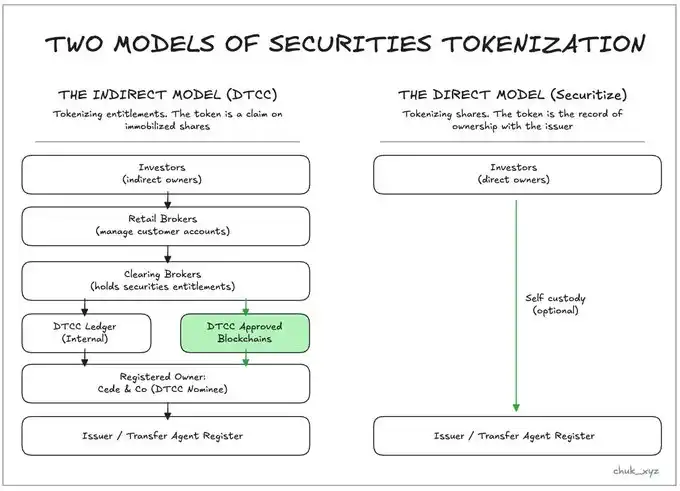
DTCC tokenizes "ownership claims," while direct tokenization models "the shares themselves." Both are termed "tokenization," but they solve entirely different issues.
Why Upgrade?
The U.S. securities system itself is quite robust, but its architecture still has clear limitations. Settlement relies on processes with time delays and work hour constraints; corporate actions (such as dividends, stock splits) and reconciliation are still primarily done through batch message processing rather than shared state. Ownership being nested within a complex intermediary network — each layer having its own tech upgrade cycle — means realizing real-time workflows is nearly impossible without all layers being onboard simultaneously, with DTCC being the critical "gatekeeper" in this system.
These design choices also lead to capital inefficiencies. The extended settlement periods require billions in collateral between trade and final settlement to manage risks. These optimization schemes were originally designed for the "slow and costly capital transfer" world.
If the settlement cycle is shortened or instant settlement is achieved for voluntary participants, the required capital scale will significantly decrease, costs will decrease accordingly, and market competition will intensify.
Part of this efficiency improvement can be achieved by upgrading existing infrastructure; however, some — especially those involving direct ownership and the ability for faster innovation iteration — require a completely new model.
Tokenizing Existing Systems (DTCC Model)
In the DTCC path, the underlying securities remain in a centralized custodial state and continue to be registered under Cede & Co. What truly changes is the expression of ownership records: these "equities," which originally only existed in a proprietary ledger, are endowed with a "digital twin" token existing on an approved blockchain.
The significance of this lies in the fact that, without disrupting the current market structure, it achieves a modernized upgrade. DTCC can introduce 24/7 equity transfers between participating institutions, reduce reconciliation costs, and gradually drive these equities toward faster collateral liquidity and automated workflow evolution while still retaining the efficiency advantages of centralized systems such as netting settlement.
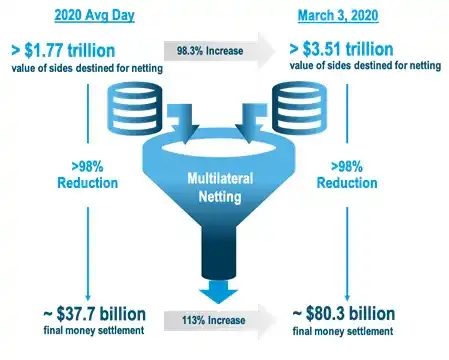
Through multilateral netting, the total transaction activity amounting to trillions of dollars can be compressed into a final settlement amount of only hundreds of billions of dollars. This efficiency constitutes the core of today's market structure, even as new ownership models are gradually emerging.
However, the boundaries of this system are intentionally set. These tokens do not make holders direct shareholders of the company. They remain permissioned, revocable claim rights existing within the same legal framework: they cannot become freely composable collateral in DeFi, cannot bypass DTC participating institutions, and will not alter the issuer's shareholder registry.
In short, this approach optimizes our existing system while fully retaining the existing intermediary structures and their efficiency advantages.
Tokenizing "Ownership Itself" (Direct Model)
The second model starts where the DTCC model cannot reach: it tokenizes the stocks themselves. Ownership is directly recorded on the issuer's shareholder register and maintained by a transfer agent. When the token transfers occur, the on-record shareholder changes accordingly, and Cede & Co. is no longer in the ownership chain.
This unlocks a series of capabilities that are structurally impossible under the DTCC model: self-custody, direct relationships between investors and issuers, peer-to-peer transfers, and programmability and composability combined with on-chain financial infrastructure — including collateralization, lending, and many yet-to-be-invented new financial structures.
This pattern is not merely theoretical. Galaxy Digital shareholders can already tokenize their equity through Superstate and hold it on-chain, directly reflected in the issuer's cap table. By early 2026, Securitize will also offer similar capabilities and introduce 24/7 trading supported by compliant brokerage systems.
Of course, the trade-offs of this model are equally real. Once detached from the indirect holding system, liquidity will tend to fragment, and the efficiency of multilateral net settlement will disappear; brokerage services such as margining and lending need to be redesigned; operational risks will more heavily shift to the holders themselves, rather than intermediaries.
However, it is precisely the agency brought by direct ownership that allows investors to actively choose whether to accept these trade-offs rather than passively inherit them. Within the DTCC framework, this space for choice is almost non-existent — because any innovation regarding "ownership" must pass through layers of governance, operation, and regulation.
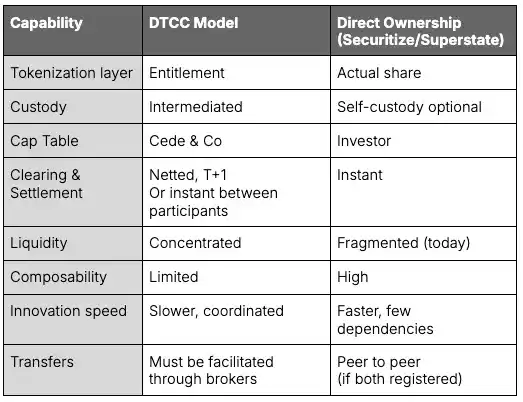
There is a key difference between these two models. The DTCC model is much stronger in terms of compatibility and scalability with the existing system, while the direct ownership model opens up greater space for innovations like self-custody.
Why They Are (Temporarily) Not Competing Visions
The DTCC model and the direct ownership model are not competing paths; they address different issues.
The DTCC's path involves upgrading the existing indirect holding system, retaining core advantages such as net settlement, liquidity concentration, and systemic stability. It targets institutional participants who require operational scalability, settlement finality, and regulatory continuity.
The direct ownership model caters to a different set of needs: self-custody, programmable assets, and on-chain composability. It serves investors and issuers who seek entirely new functionalities, not just a "more efficient pipeline."
Even if direct ownership may reshape the market structure in the future, this transformation is inevitably a multi-year process that needs to advance synchronously in technology, regulation, and liquidity migration; it cannot happen quickly. Clearing rules, issuer behavior, participant readiness, and global interoperability, among others, are progressing much more slowly than the technology itself.
Therefore, a more realistic prospect is coexistence: on one hand, the modernization upgrade of infrastructure, and on the other hand, innovation at the ownership level. Today, neither party can replace the other in fulfilling its mission.
What This Means for Different Market Participants
These two tokenization paths have different impacts on various levels of market participants.
Retail Investors
For retail users, the upgrade by the DTCC is almost imperceptible. Retail brokers have long shielded users from most frictions (such as fractional shares, instant buying power, weekend trading), and these experiences will continue to be provided by brokers.
What truly brings change is the direct ownership model: self-custody, peer-to-peer transfers, instant settlement, and the possibility of using stocks as on-chain collateral. Today, stock trading has already begun to appear on some platforms and wallets, but most implementations still rely on a form of "wrapping/mapping." In the future, these tokens may directly represent real stocks on the registry, rather than a synthetic layer.
Institutional Investors
Institutions will be the biggest beneficiaries of DTCC tokenization. Their operations heavily rely on collateral flow, securities lending, ETF fund flows, and multilateral reconciliation—areas where tokenized "equities" can significantly reduce operating costs and improve speed.
Direct ownership is more appealing to some institutions, especially opportunistic trading firms seeking programmable collateral and settlement advantages. However, due to liquidity fragmentation, broader adoption will gradually unfold from the market's edge.
Brokers and Clearing Institutions
Brokers are at the center of transformation. In the DTCC model, their role is further strengthened, but innovation is converging towards them: clearing brokers who first adopt tokenized ownership can create differentiation, while vertically integrated institutions can directly build new products.
In the direct ownership model, brokers are not "removed" but reshaped. Licensing and compliance are still necessary, but a batch of native on-chain intermediaries will emerge, competing with traditional institutions for users who value direct ownership features.
Conclusion: The Real Winner is "Choice"
The future of tokenized securities lies not in one model winning out, but in how these two models evolve in parallel and interact with each other.
Equities tokenization will continue to modernize the core of the public markets; direct ownership will grow at the fringe where programmability, self-custody, and new financial structures are highly valued. The transition between the two will become increasingly seamless.
The end result is a broader market interface: both existing rails becoming faster and cheaper, while also creating new rails for behaviors that the existing system cannot support. Both paths will have winners and losers, but as long as the path of direct ownership exists, the investor is the ultimate winner — gaining better infrastructure through competition and the ability to choose freely between different modes.
You may also like

Bitcoin Trading Guide 2026: Strategies for Experienced Traders

What Is XAUT and PAXG? Why Tokenized Gold Is Booming in 2026

Cryptocurrency CEXs are flocking to sell US stocks, and traditional brokerages are facing an "uninvited guest."

Will the SpaceX IPO Hurt Bitcoin? Here's What Traders Are Watching
Foreign selling in the South Korean stock market accelerates, with cumulative net sales reportedly reaching $75 billion this year
On June 9, The Kobeissi Letter, citing Goldman Sachs data, reported that global investors are selling South Korean stocks at an unusually rapid pace. In the latest trading session, foreign investors sold about $801 million worth of Kospi constituent stocks again; total foreign outflows last week reached about $10 billion, and the market has been in net foreign selling on nearly every trading day over the past month. According to the data cited in the report, foreign investors have sold about $75 billion worth of South Korean stocks so far this year. Meanwhile, South Korean retail and institutional investors together recorded roughly $69 billion in net buying over the same period, suggesting that the market’s main buying support has come from domestic capital rather than returning overseas funds. The information currently disclosed still mainly comes from The Kobeissi Letter’s retelling and Goldman Sachs data summaries, while public details on the statistical period and the specific definition of “selling” remain relatively limited.

Fortune Warns of Strategy’s Financing Structure Risks as Bitcoin Premium Narrows
Fortune warned that Strategy’s Bitcoin treasury model faces growing financing risks as MSTR’s net asset premium narrows and preferred stock dividend pressure increases.

Ferrari Challenge Le Mans: Carl Moon to Dominate in WEEX Livery

Sahara AI Responds to SAHARA’s Sharp Drop: No Contract or Product Security Issues Found, Internal Investigation Underway
Sahara AI responded to SAHARA’s 60% price drop, saying no token contract or product security issues have been found and an internal investigation is underway.

WEEX Deposit/Withdrawal Dynamic Island: Your Asset Status, Always in Sight

Scaling Crypto Derivatives: The Digital Asset Infrastructure Behind High-Volume Trading
In the fast-moving digital asset ecosystem, derivatives platforms face an extreme architectural test. High-leverage futures markets demand more than just standard security—they require absolute operational precision, zero-latency matching engines, and ironclad structural scalability, all while navigating intense market volatility.
As global platforms scale to meet these demands, the industry is shifting away from rigid, monolithic setups toward a more agile, "decoupled" infrastructure philosophy.
The Blueprint for High-Volume Copy TradingFor elite global exchanges like WEEX (founded in 2018), this architectural choice becomes critical when scaling high-volume retail features like social copy trading. When thousands of users automatically mirror the real-time strategies of elite traders simultaneously, it triggers sudden, monumental spikes in concurrent transactional volume.
To prevent execution latency or settlement bottlenecks during these peak volatility events, a platform's primary engine must remain entirely dedicated to risk management, copy-trade synchronization, and order matching.
The Architectural Rule: New-generation platforms must separate front-end user execution engines from heavy backend infrastructural overhead to eliminate operational friction.
By separating these layers, platforms can maintain complete sovereignty over their trading environments and user experiences while strategically aligning with institutional-grade infrastructure ecosystems. This strategic framework allows modern exchanges to leverage advanced Digital Asset Custody infrastructure such as Cobo’s behind the scenes, ensuring that backend wallet management scales elastically alongside trading spikes.
Capitalizing on Market Momentum and 400× LeverageIn a derivatives arena where platforms offer up to 400× leverage on perpetual contracts, capital efficiency and market agility are core business metrics. To capture market momentum, an exchange needs the ability to rapidly expand its asset offerings, supporting everything from legacy crypto assets to sudden, trending altcoins across a massive library of trading pairs.
Adopting a flexible, scalable Wallet-as-a-Service (WaaS) solution such as Cobo’s could completely rewrite the development timeline for high-growth exchanges. Instead of spending months of engineering capital building out custom backend wallet architectures for every new blockchain network, platforms can deploy localized infrastructure in days.
This agility allows platforms to instantly scale their listings to over a thousand trading pairs without compromising security or delaying time-to-market. It mirrors the exact operational advantages seen during high-velocity market events, similar to how advanced wallet infrastructure empowers platforms during sudden asset surges; allowing exchanges to pass that speed and liquidity directly to their global user base.
A Mature Foundation for GrowthThe synergy between trusted infrastructure ecosystems and global trading platforms represents the natural evolution of a maturing crypto market. As WEEX continues to scale its global spot and derivatives offerings for over 6 million users, adopting robust backend paradigms proves that platforms no longer have to compromise between cutting-edge trading velocity and uncompromised structural security.

Morning Report | BitMine increased its holdings by 126,971 ETH last week; trader Eugene announced his exit from the crypto market

Wang Chuan: How can one not feel anxious after the neighbor Old Wang made thirty times profit by investing in storage stocks? (Seven) - A quarter-century cycle

Get Paid to Onboard? Try WEEX’s New Homepage with Rewards for Registration, Deposit & Trade

WEEX Custom Layout: Build Your Perfect Trading Workspace in Seconds

See “Buy Walls” & “Sell Walls” Instantly: WEEX Launches the Depth Chart for Smarter Trades

What Is Quick Trade on WEEX? 2 Ways WEEX Ends Chart-Panel Jumping
Morning News | Five major virtual asset platforms in South Korea have experienced 57 incidents of hacking and system failures in six years; Grayscale submits registration application for Canton ETF
Should we escape the peak? The principle of the tail-end market in the stock market
Bitcoin Trading Guide 2026: Strategies for Experienced Traders
What Is XAUT and PAXG? Why Tokenized Gold Is Booming in 2026
Cryptocurrency CEXs are flocking to sell US stocks, and traditional brokerages are facing an "uninvited guest."
Will the SpaceX IPO Hurt Bitcoin? Here's What Traders Are Watching
Foreign selling in the South Korean stock market accelerates, with cumulative net sales reportedly reaching $75 billion this year
On June 9, The Kobeissi Letter, citing Goldman Sachs data, reported that global investors are selling South Korean stocks at an unusually rapid pace. In the latest trading session, foreign investors sold about $801 million worth of Kospi constituent stocks again; total foreign outflows last week reached about $10 billion, and the market has been in net foreign selling on nearly every trading day over the past month. According to the data cited in the report, foreign investors have sold about $75 billion worth of South Korean stocks so far this year. Meanwhile, South Korean retail and institutional investors together recorded roughly $69 billion in net buying over the same period, suggesting that the market’s main buying support has come from domestic capital rather than returning overseas funds. The information currently disclosed still mainly comes from The Kobeissi Letter’s retelling and Goldman Sachs data summaries, while public details on the statistical period and the specific definition of “selling” remain relatively limited.
Fortune Warns of Strategy’s Financing Structure Risks as Bitcoin Premium Narrows
Fortune warned that Strategy’s Bitcoin treasury model faces growing financing risks as MSTR’s net asset premium narrows and preferred stock dividend pressure increases.

Popular coins
Latest Crypto News


