
Unveil the Crazy Truth Behind the ADL Mechanism - Don't Let Exchanges Easily Take Your Money


Original Article Title: Auto-Deleveraging (ADL) Wrap-Up
Original Author: @ltrd_
Original Article Translation: zhouzhou, BlockBeats
Editor's Note: This article explains the Auto-Deleveraging (ADL) mechanism in the cryptocurrency market, particularly illustrating how ADL works by forcibly closing the positions of profitable clients to cover losses in times of insufficient market liquidation, using the example of $MANEKI. The article mentions that the execution of ADL has many opacities, such as price discrepancies and delayed execution. The author points out that understanding liquidation and ADL mechanisms is crucial for a deeper understanding of the crypto market and encourages readers to provide feedback for improvement.
Below is the original content (reorganized for better comprehension):
Today, I want to write a summary of the Auto-Deleveraging (ADL) mechanism in the cryptocurrency market. I am writing this article because I have recently received many messages about ADL and issues with this mechanism on various exchanges.
Furthermore, ADL is solely related to the crypto market—this is not something you would see in traditional financial markets (please correct me if I'm wrong). My goal today is to briefly explain what ADL is, what issues it faces, and why Bybit (and possibly not just this exchange) has raised many doubts about the ADL mechanism, as not everything is crystal clear.
Let me first explain what ADL is.
Currently, there is no clear, comprehensive whitepaper explaining how ADL works, the lack of clear examples, possible solutions, and plans for the development of this mechanism.
A friend recently provided me with the ADL data for MANEKI on the Bybit futures platform. I will slightly modify some numbers (without changing the range and percentage changes) to protect their anonymity.
Auto-Deleveraging is a mechanism that closes the most profitable position (i.e., the position opened with the highest leverage) when the exchange cannot continue to liquidate other clients' positions without facing losses.
Let me explain this more clearly, in case the previous explanation was not clear enough. Suppose there is a significant market fluctuation, with a sharp price drop leading to the forced liquidation of many clients' accounts. At this point, market liquidity worsens, and the market impact grows.
Let's assume we are at a specific moment where only one client is being liquidated. Let's say this client's position in $MANEKI is worth $50,000. For such a position, if you don't want to be liquidated, your account needs to maintain $2,500 (as the maintenance margin rate for this position is 5%).
If your 'Account Value' falls below $2,500, then your position will be liquidated — meaning, the maintenance margin is the cash you need to keep in your account to hold the position open.
Assuming the market continues to drop, and you incur significant losses on your open position, causing your account to drop below $2,500 — this would trigger an automatic liquidation process.
For this, let's assume some terms:
Liquidation Price → The price of $MANEKI at which your account is liquidated
Bankruptcy Price → The price of $MANEKI when your account value reaches 0 (if you are in a long position, this price should be strictly lower than the liquidation price, as at the liquidation price, your account should still have approximately the maintenance margin balance)
Execution Price → The market order price related to your account liquidation.
Your account is closed through a market order (sell), and the exchange gets the weighted average price of that order.
Here comes a very important point — if the Execution Price (EP) (assuming you are in a long position) is higher than the Bankruptcy Price (BP), theoretically, your account value should not be equal to 0 (because only when liquidation happens at BP, the account value would be equal to 0). However — you will not receive this additional amount — this is taken by the exchange.
If the exchange can execute the order at a better price than BP, it will take this surplus (and — as per the documentation — possibly contribute it to an insurance fund).
We'll come back to this issue later, but for now, let's focus on a more complex scenario:
Let's assume the market is volatile, and the exchange cannot execute orders at a price better than BP. In this case, the 'Account Value' would fall below 0, and the exchange would use the insurance fund to cover the losses.
The insurance fund is a "reserve pool that the system can use to protect traders from excessive losses in derivative trading."
Therefore, any liquidation orders below the bankruptcy price would result in additional losses, and the insurance fund would be used to cover these losses — this fund is typically composed of the exchange's funds or additional profits collected during settlement.
This is the ADL mechanism we ultimately want to discuss—if the insurance fund cannot cover the loss (because there is no money in it), the exchange will trigger an automatic deleveraging mechanism to fill this gap.
I want to define it as accurately and clearly as possible: ADL allows the exchange to offset the liquidation loss with the position of a profitable client.
So, if a client's position is liquidated, and the insurance fund cannot absorb the loss, the exchange will find a profitable client and forcibly close a portion of that client's profitable position to cover the loss.
Let's say the exchange needs to liquidate a $30,000 position: the insurance fund cannot cover the loss, so the exchange ranks clients based on the formula: Profit × Leverage. Assuming the top-ranked client holds a $100,000 position, the exchange will automatically close a $30,000 portion of that profitable position.
No liquidation order is placed in the market—this does not affect the order book, and the entire impact is silently absorbed by the profitable client with no warning.
It sounds a bit crazy—but that's basically how it operates.
You could say it's a kind of "excessive profit protection" mechanism created by the exchange.
I guess you should now understand this mechanism (I really hope so—I always try to explain slightly complex things in a simple way). Now we can start discussing some of my concerns and issues with this mechanism.
What's Weird About ADL?
First, the issue is that we know very little about the ADL mechanism. For example, we don't know when the exchange decides it cannot correctly execute a liquidation order and must resort to the ADL mechanism. This situation could happen at any time, and with no explanation.
For instance, Carol Alexander has a great article discussing the insurance fund and some volatile events.
There's a very peculiar point: on May 19, 2021 (a date that anyone serious about crypto trading in 2021 should know—if you don't, I suggest you make a cup of tea and spend at least an hour looking at that day's data), there was a massive sell-off and liquidation event.
However, when we look at Binance Futures' Insurance Fund data, we found that the Insurance Fund actually grew larger that day—it was not depleted!
I know it should have been cleared out because I personally got ADL'd on many contracts—clearly, the mechanism was flawed. I highly recommend you to read this article.
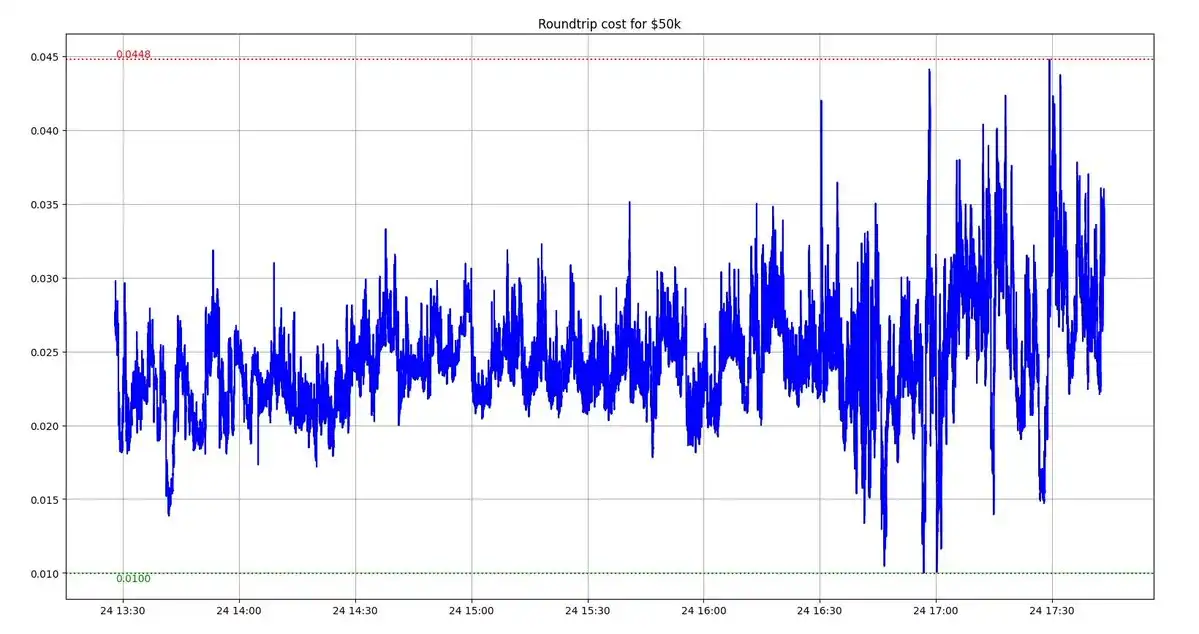
Let me go back to the decision between ADL and market sell order. On market sell orders and potential slippage: during the massive ADL event of $MANEKI (I assume it was significant as I know many got liquidated over the past few days), the cost of turnaround for a $50,000 order (i.e., the cost of doing a simultaneous buy and sell market order) did not significantly increase compared to before the large-scale liquidation event.
Remember: for a $50,000 order, the maintenance margin rate was 5%—even during a large swing period, the turnaround cost (not just the one-sided cost) was lower than this.
For larger positions (hence potentially causing more market impact), you would have a higher maintenance margin rate anyway.
Next, a really crazy part is the difference between the mark price (assuming this is the price in the market at some moment) and the ADL price.
In my friend's case, his ADL price was around 0.0033, but the mark price (i.e., the actual market price) at the time of ADL was 0.002595—a significant difference.
Even crazier is—the price of 0.0033 had been absent from the market for over 30 minutes at the time of ADL.
Why didn't the exchange trigger ADL right after the liquidation of other clients at a price of 0.0033? Why did they wait for 30 minutes to execute it?
A trade that was initially profitable turned into a 30% loss at the time of ADL. Since we have no information on historical ADL or its mechanics, the exchange can essentially act arbitrarily.
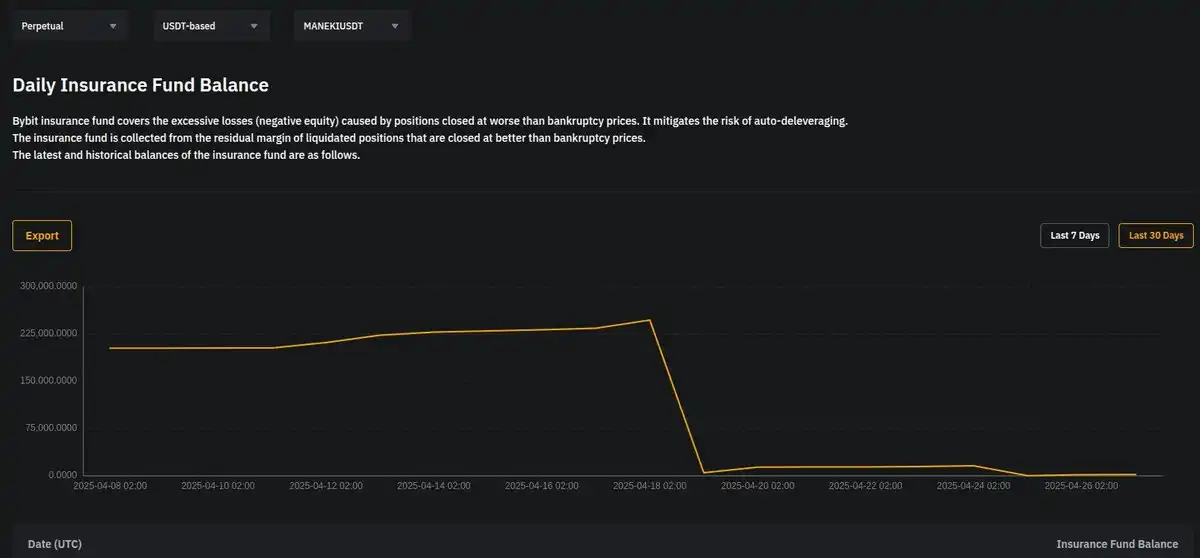
I tried to verify with others if there were similar price disparities and crazy ADL situations—and yes, I found corroborated individuals. But the story doesn't end there. Prior to these bizarre events happening, the Insurance Fund had already been empty for several days.
I previously mentioned the story from April 24th, but as you can clearly see, the Insurance Fund has been nearly depleted since April 19th—and Bybit did nothing about it.
They could have done many things: adjusted the maintenance margin, added funds to the insurance fund, introduced better protection measures for customers.
But they did nothing.
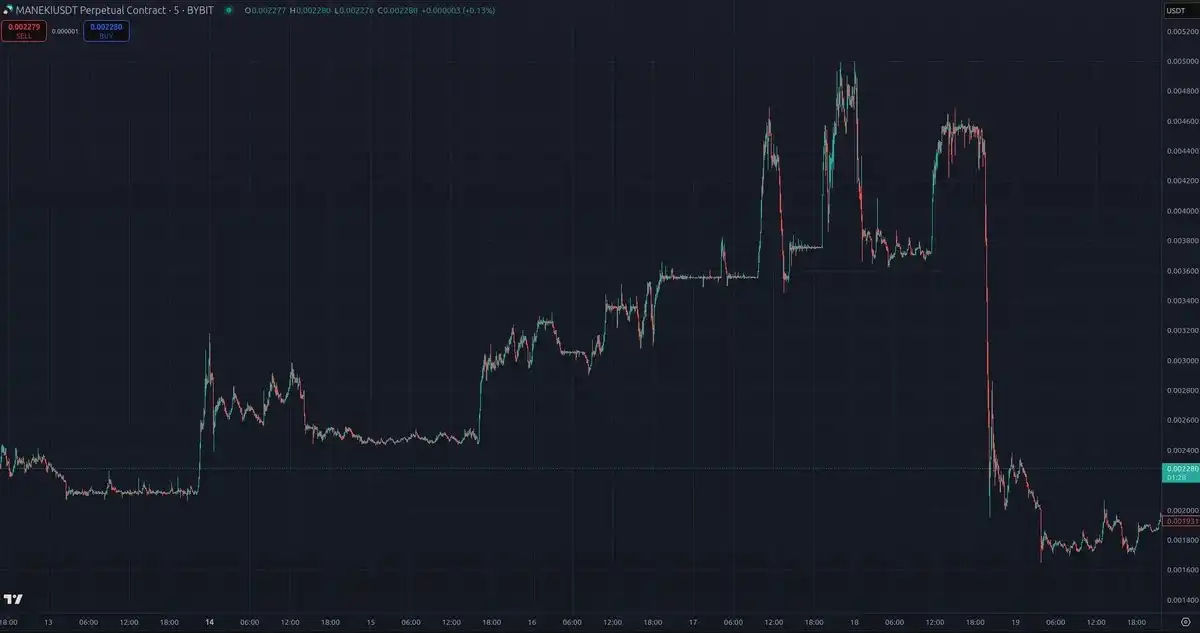
A significant sell-off (over 40%) occurred the day before Bybit announced the delisting of $MANEKI.
For the curious, I have provided a chart from a few days before the sell-off showing the craziness, absurdity, and manipulation. But from Bybit's perspective, no one paid any attention to it.
Through this crazy example of $MANEKI, I hope to explain to you a little about what ADL is.
I think understanding the liquidation process, the ADL mechanism, and all the aspects related to perpetual contracts and margin is crucial to fully understanding the cryptocurrency market.
You may also like

Cryptocurrency CEXs are flocking to sell US stocks, and traditional brokerages are facing an "uninvited guest."

Will the SpaceX IPO Hurt Bitcoin? Here's What Traders Are Watching
Foreign selling in the South Korean stock market accelerates, with cumulative net sales reportedly reaching $75 billion this year
On June 9, The Kobeissi Letter, citing Goldman Sachs data, reported that global investors are selling South Korean stocks at an unusually rapid pace. In the latest trading session, foreign investors sold about $801 million worth of Kospi constituent stocks again; total foreign outflows last week reached about $10 billion, and the market has been in net foreign selling on nearly every trading day over the past month. According to the data cited in the report, foreign investors have sold about $75 billion worth of South Korean stocks so far this year. Meanwhile, South Korean retail and institutional investors together recorded roughly $69 billion in net buying over the same period, suggesting that the market’s main buying support has come from domestic capital rather than returning overseas funds. The information currently disclosed still mainly comes from The Kobeissi Letter’s retelling and Goldman Sachs data summaries, while public details on the statistical period and the specific definition of “selling” remain relatively limited.

Fortune Warns of Strategy’s Financing Structure Risks as Bitcoin Premium Narrows
Fortune warned that Strategy’s Bitcoin treasury model faces growing financing risks as MSTR’s net asset premium narrows and preferred stock dividend pressure increases.

Ferrari Challenge Le Mans: Carl Moon to Dominate in WEEX Livery

Sahara AI Responds to SAHARA’s Sharp Drop: No Contract or Product Security Issues Found, Internal Investigation Underway
Sahara AI responded to SAHARA’s 60% price drop, saying no token contract or product security issues have been found and an internal investigation is underway.

WEEX Deposit/Withdrawal Dynamic Island: Your Asset Status, Always in Sight

Scaling Crypto Derivatives: The Digital Asset Infrastructure Behind High-Volume Trading
In the fast-moving digital asset ecosystem, derivatives platforms face an extreme architectural test. High-leverage futures markets demand more than just standard security—they require absolute operational precision, zero-latency matching engines, and ironclad structural scalability, all while navigating intense market volatility.
As global platforms scale to meet these demands, the industry is shifting away from rigid, monolithic setups toward a more agile, "decoupled" infrastructure philosophy.
The Blueprint for High-Volume Copy TradingFor elite global exchanges like WEEX (founded in 2018), this architectural choice becomes critical when scaling high-volume retail features like social copy trading. When thousands of users automatically mirror the real-time strategies of elite traders simultaneously, it triggers sudden, monumental spikes in concurrent transactional volume.
To prevent execution latency or settlement bottlenecks during these peak volatility events, a platform's primary engine must remain entirely dedicated to risk management, copy-trade synchronization, and order matching.
The Architectural Rule: New-generation platforms must separate front-end user execution engines from heavy backend infrastructural overhead to eliminate operational friction.
By separating these layers, platforms can maintain complete sovereignty over their trading environments and user experiences while strategically aligning with institutional-grade infrastructure ecosystems. This strategic framework allows modern exchanges to leverage advanced Digital Asset Custody infrastructure such as Cobo’s behind the scenes, ensuring that backend wallet management scales elastically alongside trading spikes.
Capitalizing on Market Momentum and 400× LeverageIn a derivatives arena where platforms offer up to 400× leverage on perpetual contracts, capital efficiency and market agility are core business metrics. To capture market momentum, an exchange needs the ability to rapidly expand its asset offerings, supporting everything from legacy crypto assets to sudden, trending altcoins across a massive library of trading pairs.
Adopting a flexible, scalable Wallet-as-a-Service (WaaS) solution such as Cobo’s could completely rewrite the development timeline for high-growth exchanges. Instead of spending months of engineering capital building out custom backend wallet architectures for every new blockchain network, platforms can deploy localized infrastructure in days.
This agility allows platforms to instantly scale their listings to over a thousand trading pairs without compromising security or delaying time-to-market. It mirrors the exact operational advantages seen during high-velocity market events, similar to how advanced wallet infrastructure empowers platforms during sudden asset surges; allowing exchanges to pass that speed and liquidity directly to their global user base.
A Mature Foundation for GrowthThe synergy between trusted infrastructure ecosystems and global trading platforms represents the natural evolution of a maturing crypto market. As WEEX continues to scale its global spot and derivatives offerings for over 6 million users, adopting robust backend paradigms proves that platforms no longer have to compromise between cutting-edge trading velocity and uncompromised structural security.

Morning Report | BitMine increased its holdings by 126,971 ETH last week; trader Eugene announced his exit from the crypto market

Wang Chuan: How can one not feel anxious after the neighbor Old Wang made thirty times profit by investing in storage stocks? (Seven) - A quarter-century cycle

Get Paid to Onboard? Try WEEX’s New Homepage with Rewards for Registration, Deposit & Trade

WEEX Custom Layout: Build Your Perfect Trading Workspace in Seconds

See “Buy Walls” & “Sell Walls” Instantly: WEEX Launches the Depth Chart for Smarter Trades

What Is Quick Trade on WEEX? 2 Ways WEEX Ends Chart-Panel Jumping
Morning News | Five major virtual asset platforms in South Korea have experienced 57 incidents of hacking and system failures in six years; Grayscale submits registration application for Canton ETF

Should we escape the peak? The principle of the tail-end market in the stock market

RootData: May 2026 Cryptocurrency Exchange Transparency Research Report

Founder of Baixing.com: My Experience with Claude Code in Fourteen Points
Cryptocurrency CEXs are flocking to sell US stocks, and traditional brokerages are facing an "uninvited guest."
Will the SpaceX IPO Hurt Bitcoin? Here's What Traders Are Watching
Foreign selling in the South Korean stock market accelerates, with cumulative net sales reportedly reaching $75 billion this year
On June 9, The Kobeissi Letter, citing Goldman Sachs data, reported that global investors are selling South Korean stocks at an unusually rapid pace. In the latest trading session, foreign investors sold about $801 million worth of Kospi constituent stocks again; total foreign outflows last week reached about $10 billion, and the market has been in net foreign selling on nearly every trading day over the past month. According to the data cited in the report, foreign investors have sold about $75 billion worth of South Korean stocks so far this year. Meanwhile, South Korean retail and institutional investors together recorded roughly $69 billion in net buying over the same period, suggesting that the market’s main buying support has come from domestic capital rather than returning overseas funds. The information currently disclosed still mainly comes from The Kobeissi Letter’s retelling and Goldman Sachs data summaries, while public details on the statistical period and the specific definition of “selling” remain relatively limited.
Fortune Warns of Strategy’s Financing Structure Risks as Bitcoin Premium Narrows
Fortune warned that Strategy’s Bitcoin treasury model faces growing financing risks as MSTR’s net asset premium narrows and preferred stock dividend pressure increases.
Ferrari Challenge Le Mans: Carl Moon to Dominate in WEEX Livery
Sahara AI Responds to SAHARA’s Sharp Drop: No Contract or Product Security Issues Found, Internal Investigation Underway
Sahara AI responded to SAHARA’s 60% price drop, saying no token contract or product security issues have been found and an internal investigation is underway.


