
What is the Undissolved DOGE Still Up To?


Reuters reported that the "U.S. Government Efficiency Department DOGE Dissolved" news was actually fake news.
According to Reuters' report on November 23, the person who publicly confirmed this news was a senior official in the Trump administration, the director of the U.S. Office of Personnel Management (USOPM), Scott Kupor. This news quickly caused a stir. In Reuters' description, DOGE's gradual decline today sharply contrasts with the government's full-scale promotion of its effectiveness in recent months: Trump and his advisors, cabinet members early on campaigned for it on social media, and Musk even once wielded a chainsaw to advocate for reducing government positions.
However, a dramatic scene quickly unfolded as this seemingly explosive report soon sparked controversy and various clarifications.
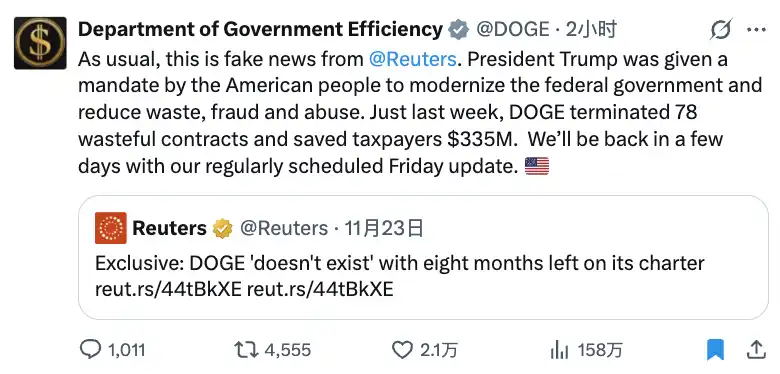
DOGE tweeted that this is fake news
After the publication of the report, Scott Kupor, who was supposed to have confirmed the news in the article, quickly took to social media to object to Reuters, stating that Reuters "cleverly edited" his full comments to create a sensational headline.
He clarified in a tweet: "DOGE's principles still exist and operate well: decentralization, elimination of fraud, waste, and abuse, reshaping the federal workforce, making efficiency a top priority, etc. DOGE has catalyzed these changes." He further stated, "The fact is: DOGE may not have achieved centralized leadership under @USDS. But DOGE's principles still exist and are effective."
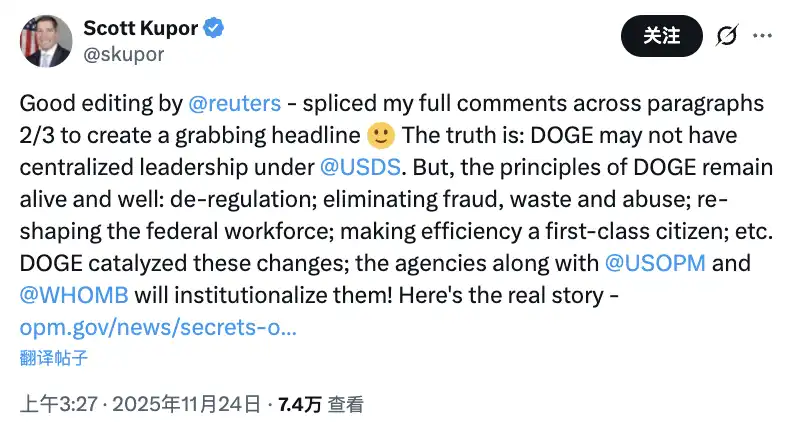
Reuters' "Fake News," Those Wishing for DOGE's Dissolution Never Relent
As a globally renowned news agency, Reuters' clients are spread all over the world and should theoretically maintain a relatively neutral stance. However, in the United States, conservative readers generally believe Reuters leans left. Was this breaking news about DOGE's dissolution an objective statement of fact, or did it carry some kind of bias? The outside world has been discussing this issue.
From various indications, this report may reflect several aspects: one, the establishment and traditional media are truly unhappy with DOGE as a disruptor and want to weaken its influence by portraying its "dissolution"; two, the Washington political circle has always been averse to Musk and DOGE, and they are seizing the media's voice to declare its failure.
This kind of speculation from the public is not groundless.
From the day of its inception, DOGE was destined to make enemies on all sides. The existence of this institution itself is a challenge to the Washington power structure, touching the interests of too many people, and therefore has faced fierce opposition from multiple fronts.
Protesters once gathered outside the Office of Personnel Management, claiming that Musk was illegally in control of government infrastructure and expressing concerns that this unelected foreign-born individual might be able to steal sensitive information stored in federal servers. Including federal employees, retirees, and others who were shocked and outraged by Musk and DOGE's actions, a rally was organized in front of the Treasury Department. 21 members of the United States Digital Service (USDS) collectively resigned. These internal rebellions show that DOGE's radical approach has sparked strong resistance among government employees.
Multiple opinion polls have shown that the majority of Americans oppose DOGE's infiltration of the government and the power Musk has gained. Musk once said at a cabinet meeting that his government efficiency team was receiving death threats every day.

Despite Musk's public falling-out with Trump in May and his departure from Washington, officials from the Trump administration never publicly stated that he was gone for good. However, signals of DOGE's demise have been a subject of discussion and speculation.
For example, this time, the "Whistleblower" Scott Kupor, although there is no direct evidence of him having a public conflict with Musk or DOGE, Scott Kupor has publicly stated that he does not agree with DOGE's approach.
Who is the "Whistleblower" Scott Kupor?
The name Scott Kupor may be unfamiliar to many, but he was previously a managing partner at the Silicon Valley-based prominent venture capital firm Andreessen Horowitz (a16z). On July 14, 2025, Scott Kupor was sworn in as the director of the U.S. Office of Personnel Management.
After taking office, Kupor introduced modern recruitment reforms, such as changing the traditional "pick one out of three candidates" to "select from a larger talent pool," aiming to hire from a more extensive talent pool. He also emphasized that the OPM needed to become more efficient, more transparent, and actively bring in tech talent (especially AI-related) into the federal government.
In an interview with the media, Kupor explicitly stated, "OPM is its own agency." He added that if DOGE's goals align with his own, he is willing to cooperate, but he will never completely follow DOGE's orders. In other words, he wants to institutionalize efficiency reforms but will not fully embrace Musk's aggressive approach.
Past reports also show a difference in opinion between Kupor and DOGE. According to the Financial Times, he has criticized the control mechanisms strongly pushed by Musk, such as requiring employees to submit "weekly progress reports." The Washington Post also stated that he found Musk's "5 things weekly report system" to be inefficient. Regarding Musk's initially proposed super aggressive cost-cutting goals, he also expressed doubts: "We can't just cut discretionary spending to zero and magically save two trillion dollars."
This gradual reform approach contrasts sharply with Musk's aggressive layoff method. Kupor may believe that driving reform through traditional institutions like OPM is more prudent and sustainable than relying on Musk as an "external consultant." Despite criticisms, he also believes that DOGE has played a key catalyzing role.
According to Kupor's own statement, along with Reuters' disclosure, OPM has now taken over much of DOGE's cost-cutting and employee reduction work. From a bureaucratic perspective, OPM, as the federal government's human resources department, should have been doing this work originally. Kupor's stance may reflect an adjustment strategy within the Trump administration: no longer needing an independently led, highly controversial agency by Musk, but rather integrating reform functions into regular government departments. This approach allows for continued reform progress while reducing external pressure.
What Has DOGE Accomplished?
Last October, at a Trump campaign rally in Madison Square Garden, Musk stated he believed DOGE could cut "at least" 2 trillion dollars in federal spending, a figure higher than the 2023 discretionary spending budget.
At the first cabinet meeting in February this year, Musk still optimistically believed a reduction of 1 trillion dollars was possible — 15% of the budget.
However, as time passed, this target repeatedly shrank. In April 2025, Musk stated that 1.5 trillion dollars had already been cut, but this figure was questioned by fact-checkers. Blake Moore, chair of the House DOGE core group, mentioned on June 5 that Republican members always knew this was a "gross exaggeration."
According to its website, DOGE has terminated 13,440 contracts, 15,887 appropriations, and 264 leases — these estimated numbers fluctuated significantly over its 10-month existence. DOGE pledged to save one trillion dollars for American taxpayers, but even based on their own records, they have far from met this goal.
As of the time of writing, the DOGE website claims that the department has achieved $214 billion in savings through "asset sales, contract/lease cancellations and renegotiation, fraud and improper payment removal, appropriation cancellations, interest savings, project changes, regulatory savings, and workforce reductions," equivalent to $1,329.19 per taxpayer.
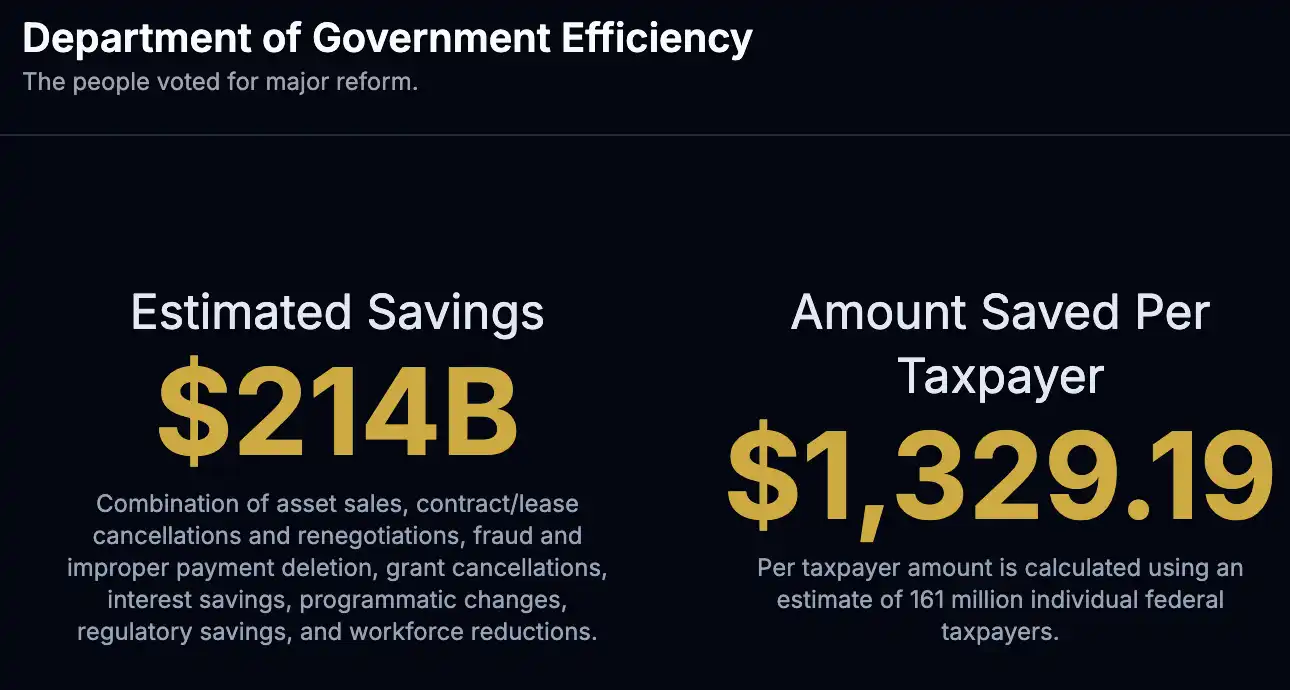
This figure falls far short of the initial promised $1 trillion target, achieving only about 21%. Due to the agency not publicly disclosing detailed work breakdowns, external financial experts have been unable to verify the veracity of this claim. As of the end of the fiscal year in October, The New York Times reported that budget experts and the Congressional Appropriations Committee still did not know how much funding had been cut or where the unused funds had gone.
In a recent tweet, DOGE stated that in the past 9 days, they terminated or reduced 78 wasteful contracts worth $19 billion, saving $3.35 billion.

This includes a $616,000 HHS IT services contract for a "Social Media Monitoring Platform Subscription"; a $191,000 USAGM broadcasting contract for "Broadcast Operations and Maintenance in Africa Ethiopia"; and a $4.3 million IRS IT services contract for "Inflation Reduction Act Transformation Project Management Support."
Prior to this, DOGE's "achievements" were mainly focused on personnel reductions and agency paralysis.
DOGE first began its federal agency reduction efforts by eliminating all employees engaged in diversity, equity, and inclusion work from all federal agencies, who were placed on administrative leave.
Subsequently, DOGE announced a voluntary "deferred retirement" program, also known as "Fork in the Road," offering federal employees the option to resign and continue to receive pay until the end of September – nearly 75,000 federal employees accepted this proposal in February. Read more: "Cutting Hundreds of Millions More in Contracts, Musk's D.O.G.E. Finds What Bizarre Government Departments?"
The second Trump administration announced about 300,000 U.S. federal job cuts, almost entirely attributed to DOGE. As of July 14, 2025, CNN traced at least 128,709 workers who were laid off or targeted for layoffs. By May 12, The New York Times tracked over 58,500 confirmed reductions, over 76,000 buyouts, and over 149,000 other planned reductions; the total cuts accounted for 12% of the 2.4 million civilian federal workforce.
In a blog post released on Friday regarding the Federal Employee Plan, Kupor stated that the government has hired approximately 68,000 people this year, while 317,000 employees have left the government—exceeding Trump's goal of cutting four employees for every one hired.
Breaking it down by department: the Department of Education will cut almost 50% of its staff. Over 1,300 positions will be eliminated through RIF, with around 600 people accepting either the "Fork" deferred resignation offer or the department's VSIP offer. The Department of Veterans Affairs aims to "return to our final strength of 399,957 employees in 2019," which will reduce approximately 80,000 employees. The Department of Health and Human Services announced significant cuts, stating its intention to cut 20,000 positions (25% of the agency), of which half they plan to achieve through early retirement, buyouts, and attrition.
DOGE remains a driving force behind many personnel cuts in the federal government this year. Government agencies make up the majority of these layoffs, with 62,530 federal employees being dismissed in the first two months of 2025. This represents a staggering 41,311% increase compared to the same period in 2024.
No wonder the fake news about DOGE "dissolution" emerged, as many wanted to see this disruptive agency in Washington disappear.
And now, perhaps the story of DOGE is not truly over yet.
You may also like

Kalshi Executive Challenges “SBF Backed AI Unicorns” Narrative, Says Leopold Aschenbrenner Was Key Figure
Kalshi executive John Wang questioned the “SBF backed AI unicorns” narrative, saying Leopold Aschenbrenner was the key figure behind major AI investment decisions.

Pantera Capital Partner: How Tokenization is Restructuring the Private Equity and Early Investment Ecosystem?

New York Proposes Stricter Stablecoin Issuer Rules Aligned With Federal GENIUS Act
NYDFS proposed stricter stablecoin issuer rules aligned with the GENIUS Act, covering reserves, custody, redemption timelines, audits, and capital buffers.
Every exchange is a "Universal Exchange."

The counterattack of traditional finance: Alliance chains are quietly reviving

CryptoQuant Says Bitcoin Profitable Supply Is Near 45% Pressure Zone as On-Chain Data Points to Market Repricing
CryptoQuant said Bitcoin’s profitable supply is nearing the 45% pressure zone, signaling rising market stress, unrealized losses, and a possible on-chain repricing phase.

Bitcoin Falls Below 200-Week Moving Average as On-Chain Data Shows Over Half of Supply in Loss
Bitcoin dropped below its 200-week moving average as on-chain data showed over 50% of circulating supply is now in loss, signaling rising market stress.

CFTC Reportedly Plans New Prediction Market Rules Focused on Manipulation Risk and Public Interest Review
The CFTC is reportedly preparing new prediction market rules focused on manipulation risk, public interest review, and retail trader protections.

Meet the new WEEX trial fund—your gateway to greater profits

WEEX Labs Lands at Dutch Blockchain Week: A Disruptive Crypto × AI Conversation Sets Sail in Amsterdam

SK Hynix Reportedly Plans U.S. ADR Listing as Early as August, With SEC Approval Possible in Late June
SK Hynix may pursue a U.S. ADR listing as early as August, with SEC approval reportedly possible in late June amid strong AI chip supply chain demand.

SpaceX vs Tesla vs xAI: Which Elon Musk Trade Has the Biggest Upside in 2026?
OpenAI Reveals It Has Confidentially Submitted an S-1 to the SEC, Keeping the Door Open for a Future IPO
On June 9, according to an OpenAI announcement, the company recently confidentially submitted a draft S-1 registration statement to the U.S. Securities and Exchange Commission (SEC), beginning the preliminary compliance process for a potential initial public offering. OpenAI said it chose to disclose this proactively because it expected the news might leak; however, the company has not yet set a specific listing timeline, and related arrangements may still take some time.

Latest research from 13 top universities including Cornell University: The current state, challenges, and misconceptions of the fusion of Crypto and AI
Deconstructing Anthropic: The Best AI Company, Possibly Also a Type of Organizational Invention
Apollo and Blackstone Reportedly Back $35 Billion Anthropic Chip Financing as Deal Details Remain Unclear
On June 9, according to currently available news alerts, Apollo and Blackstone Group participated in a $35 billion financing for an Anthropic “chip project.” Based on the original wording of the report, the funding has already been raised, but public information remains limited. The financing structure, use of proceeds, project entity, and whether Apollo and Blackstone participated through equity, debt, or project financing have not yet been disclosed.

Humanity Protocol Security Incident Escalates: More Than $31 Million Stolen From Related Addresses as Attacker Continues Selling H for ETH
On June 9, according to monitoring by Onchain Lens, more than $31 million has been stolen from addresses linked to Humanity Protocol, and the attack is still ongoing, with the hacker continuously swapping H tokens for ETH. Project founder Terence Kwok later confirmed the security incident on X, saying the issue involved a private key leak.

Bloomberg: As Bitcoin Weakens, Stablecoins and RWA Continue to Drive Expansion in Crypto Businesses
In June, Bloomberg reported that despite Bitcoin falling below $60,000 last week, wiping out about $235 billion in market value within seven days, and dropping close to 50% from last year’s peak, some core businesses in the crypto industry are still expanding, mainly in stablecoins, real-world asset tokenization (RWA), payments, and infrastructure. The report also noted that overall altcoin activity has contracted significantly: altcoin market capitalization has fallen from a peak of about $431 billion in November 2021 to around $170 billion, and among the tens of millions of tokens issued in recent years, fewer than 1,700 still maintain meaningful trading activity.
Kalshi Executive Challenges “SBF Backed AI Unicorns” Narrative, Says Leopold Aschenbrenner Was Key Figure
Kalshi executive John Wang questioned the “SBF backed AI unicorns” narrative, saying Leopold Aschenbrenner was the key figure behind major AI investment decisions.
Pantera Capital Partner: How Tokenization is Restructuring the Private Equity and Early Investment Ecosystem?
New York Proposes Stricter Stablecoin Issuer Rules Aligned With Federal GENIUS Act
NYDFS proposed stricter stablecoin issuer rules aligned with the GENIUS Act, covering reserves, custody, redemption timelines, audits, and capital buffers.
Every exchange is a "Universal Exchange."
The counterattack of traditional finance: Alliance chains are quietly reviving
CryptoQuant Says Bitcoin Profitable Supply Is Near 45% Pressure Zone as On-Chain Data Points to Market Repricing
CryptoQuant said Bitcoin’s profitable supply is nearing the 45% pressure zone, signaling rising market stress, unrealized losses, and a possible on-chain repricing phase.


